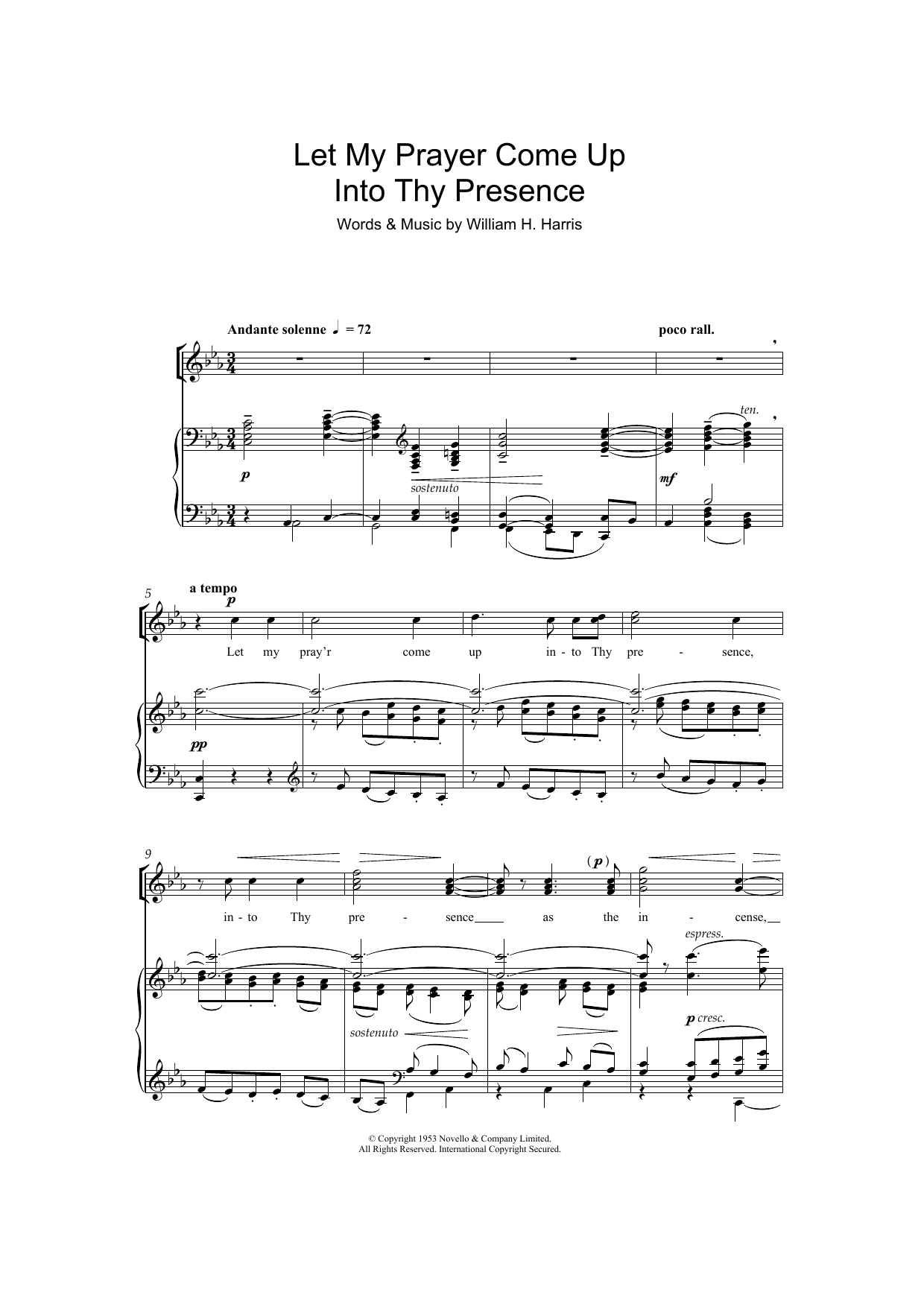
Let My Prayer Come Up Into Thy Presence Sheet Music Preview

Let My Prayer Come Up Into Thy Presence: SATB Choral Octavo

As performed by William H. Harris

Item: 35-DS00365835

Digital Download
$2.99
Description

Let My Prayer Come Up Into Thy Presence: SATB Choral Octavo isn't in MakeMusic Cloud just yet...but it could be. Let us know you'd like to see it, and you'll help shape what comes next. In the meantime, start a free trial and dive into thousands of interactive titles your students can play along with today.

Sample Audio
No sample audio found.
Sample Video
Additional Details
Publisher: Hal Leonard
Page Count: 3
SKU: 35-DS00365835

More about this title

About the Artist: William H. Harris

William H. Harris (1883–1973) was a prominent English organist and composer whose sacred choral works became staples of the Anglican cathedral tradition. His output ranged from grand liturgical settings to intimate motets, each crafted with the technical precision and harmonic sophistication expected of his generation. Harris served as organist at major English cathedrals and composed regularly for liturgical use, giving his sacred works an authenticity rooted in practical performance experience.

His choral writing balances accessibility with musical substance. Harris understood voice leading thoroughly and wrote idiomatically for singers, making his pieces rewarding without demanding virtuosic technique. His harmonic language, rooted in English Romanticism but informed by earlier contrapuntal traditions, creates pieces that sound both substantial and approachable for capable amateur and professional choirs alike.

Why we love this

This setting brings textural clarity and genuine warmth to a familiar liturgical prayer. Harris avoids both saccharine simplicity and needless complexity, instead allowing the text to shape the harmonic movement in ways that feel both inevitable and moving. The piece sits comfortably in the voice, rewards careful part balancing, and works equally well in a concert setting or liturgical context.

What to expect

The music settles into a meditative space without becoming maudlin. Warm harmonies emerge gradually from the text, creating an atmosphere of genuine prayer rather than theatrical emotion. There is a quiet confidence here; the piece doesn't strain for effect.

Who it's for

This piece works well for intermediate to advanced mixed choirs looking for sacred repertoire with musical substance but without extreme vocal demands. It suits both liturgical use and secular concert programming where a moment of contemplation fits the arc of the program.

How to get the most out of it

  • Shape the harmonic progression by listening for the strength of each chord change rather than the melody line. This piece works best when all four parts are equally engaged in the harmonic architecture.
  • Match vowel placement across parts in the opening phrase. Slight ensemble sloppiness in word formation will blur the piece's harmonic clarity.
  • Allow the text prosody to determine phrasing rather than imposing symmetrical four and eight bar phrases. Harris's punctuation follows the prayer's syntax.

How to use it

Place this toward the close of a concert as a reflective interlude before a final work of different character, or program it as the anchor of a sacred choral suite. In a liturgical setting, it serves well as an anthem during a service of evening prayer.

Skills your students will build

  • Reading and balancing four independent harmonic lines without doubling the melody
  • Sustaining legato phrase shapes across longer harmonic spans
  • Text-driven interpretation of harmonic rhythm and emotional contour
  • Part independence in mid-range voicing (inner parts)

You May Also Like