
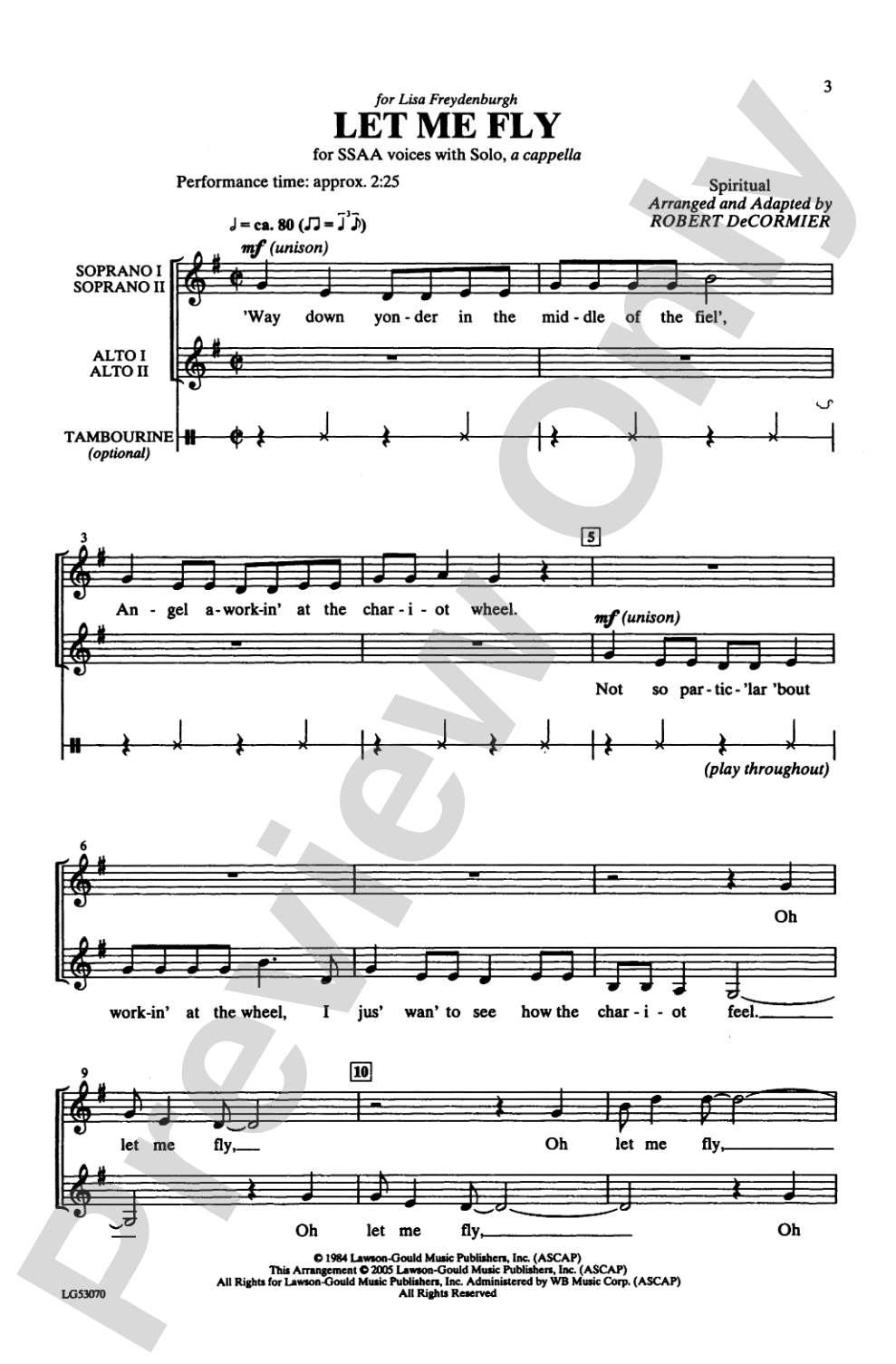
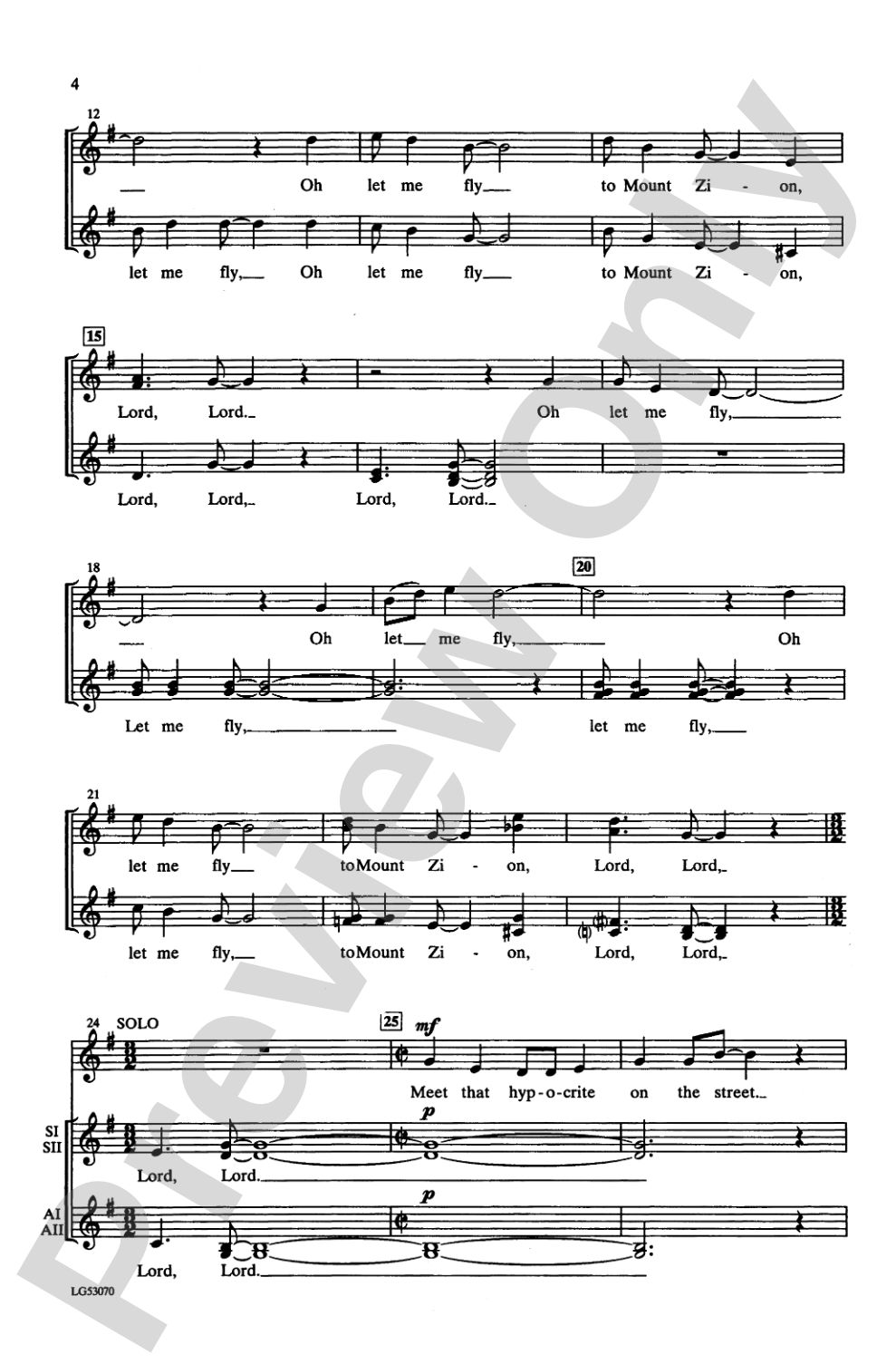

Let Me Fly: SSAA and Solo, a cappella Choral Octavo
Spiritual / arr. and adapted Robert DeCormier
Level: Moderately Difficult
Item: 00-PO-0003033
$2.25
Minimum order quantity: 20 copies
Pickup currently not available
Related Items
Let Me Fly: SSAA and Solo, a cappella Choral Octavo |
$2.25
|
View |
Description
"O let me fly to Mount Zion, Lord!" This bright, uplifting spiritual has become a standard in the choral repertoire for decades, and is a perennial favorite for festival performances.


Let Me Fly: SSAA and Solo, a cappella Choral Octavo isn't in MakeMusic Cloud just yet...but it could be. Let us know you'd like to see it, and you'll help shape what comes next. In the meantime, start a free trial and dive into thousands of interactive titles your students can play along with today.
Request This Title
Tell us you want it.
Start Your Free Trial
Explore everything that's ready to play right now.
Sample Audio
1
Audio File
--:--
0:00
0:00
Sample Video
No sample videos found.
Additional Details
Series:
Alfred Archive Edition: Lawson-Gould Music Publishers
Publisher:
Alfred Music
Page Count:
12
SKU:
00-PO-0003033
More about this title
About the Arranger: Robert DeCormier
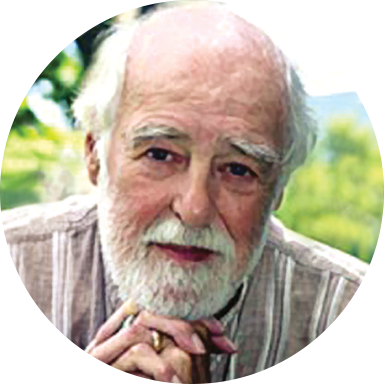
Robert DeCormier studied at Juilliard and spent decades shaping American choral music through conducting, arranging, and ensemble leadership. His résumé spans Broadway productions and opera houses to concert tours with the Robert De Cormier Singers, seventeen years directing the New York Choral Society, and nearly three decades as music director for Peter, Paul and Mary. He taught conducting and ensembles at the Eastman School of Music and founded Counterpoint, a professional vocal ensemble based in Vermont that recorded extensively and mentored high school choirs across New England.
DeCormier's arranging legacy centers on spirituals and folk song, genres he treated with both respect and musical sophistication. His work earned recognition through the Vermont Governor's Award for Excellence in the Arts (2002) and a Lifetime Achievement Award from the New England Choral Arts Foundation (2006). His recordings appear on multiple classical labels, and his television credits include collaborations with Jessye Norman and Harry Belafonte, including a CBS Emmy-winning special.
Why we love this
DeCormier's arrangement captures the spiritual's inherent joy while respecting its roots, making it work equally well in festival settings or concert programs. The SSAA voicing with optional solo line gives you flexibility for different ensemble sizes and allows featured singers to shine. A cappella spirituals at this level can feel sparse or overly academic, but this one breathes naturally and rewards choirs that sing it with conviction.
What to expect
Singing this spiritual feels like lifting your voice toward something greater. The harmony is warm and grounded, and the optional solo creates moments of vulnerable intensity before the full ensemble voice returns, creating a sense of communal affirmation. There is brightness in the writing without sentimentality, and the a cappella texture gives every voice space to be heard.
Who it's for
This arrangement suits choirs working at Grade 4 (late middle school through early high school) that want substantial repertoire with both spiritual depth and accessibility. Directors preparing for festival or contest performances will find a piece that sounds polished and purposeful without demanding virtuosic technical skills. It works for any ensemble that values a cappella singing and wants to deepen students' connection to African-American musical traditions.
How to get the most out of it
- Shape the solo line as a distinct musical voice that emerges from and returns to the ensemble texture, rather than treating it as an accompaniment layer.
- Let the a cappella sound settle into its harmonic foundation in the opening measures before adding dynamic energy; resist the urge to drive too hard too early.
- Balance the SSAA voicing by checking that the second soprano line sits clearly underneath the first soprano melody, especially in passages where they move in similar motion.
- Attend to the spiritual's rhythmic character by feeling the pulse in the longer note values; this prevents the piece from dragging even when the tempo is moderate.
How to use it
Program this early or mid-season once your choir has developed blend and rhythmic confidence in a cappella singing. It pairs naturally with other spirituals or American folk-based choral work, or it can stand alone as a concert centerpiece that speaks to both festival judges and general audiences. The piece also works as a rehearsal anchor for teaching sectional independence and harmonic listening in a cappella contexts.
Skills your students will build
- Singing a cappella without instrumental reference or drones
- Sustaining harmonic control in SSAA voicing across phrase lengths
- Balancing solo and ensemble textures in one arrangement
- Interpreting spiritual style with rhythmic authenticity and emotional nuance
- Listening for and correcting intonation drift in longer held notes