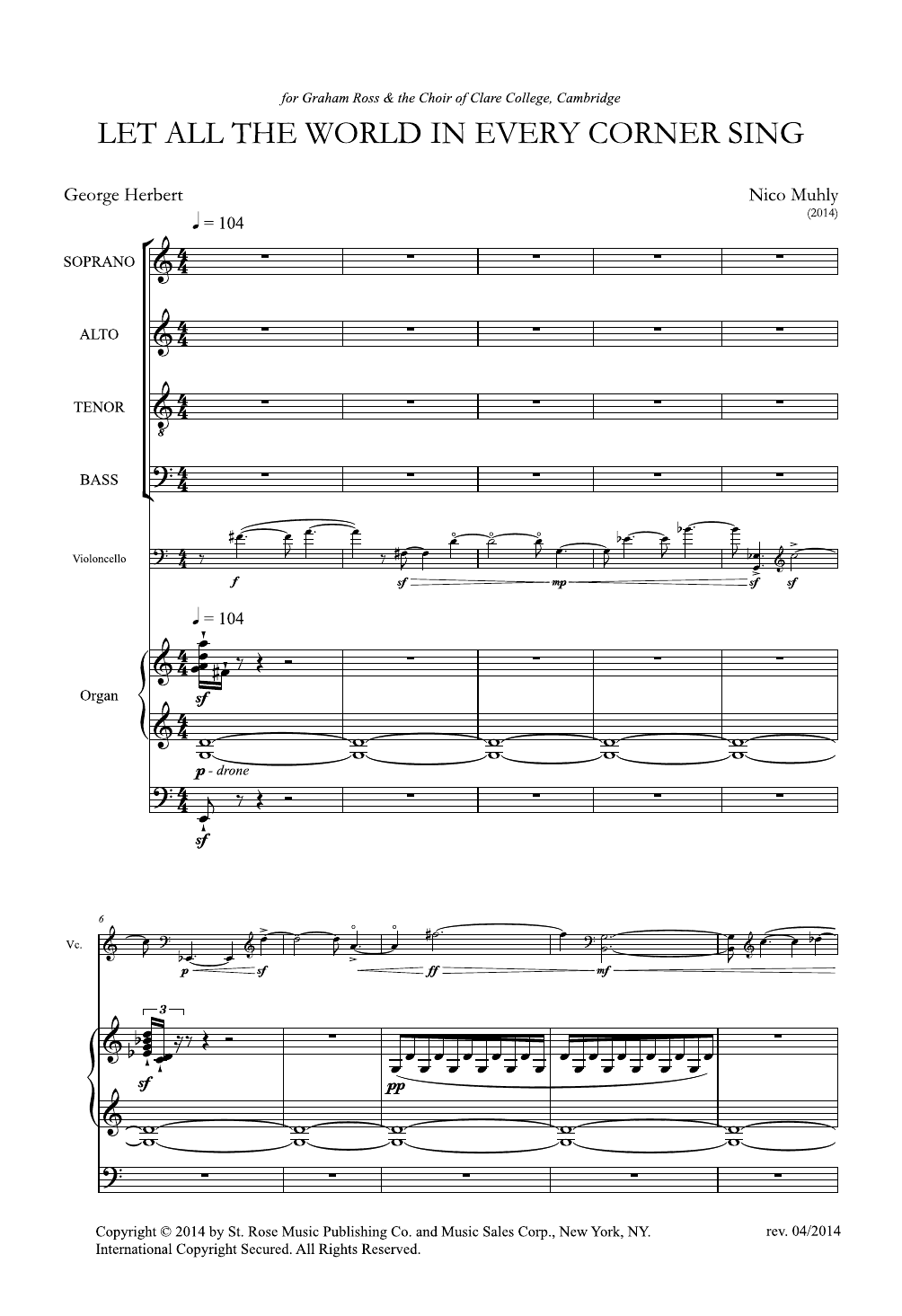
Let All The World In Every Corner Sing Sheet Music Preview

Let All The World In Every Corner Sing: SATB Choral Octavo

As performed by Nico Muhly

Item: 35-DS00362489

Digital Download
$2.99
Description

Let All The World In Every Corner Sing: SATB Choral Octavo isn't in MakeMusic Cloud just yet...but it could be. Let us know you'd like to see it, and you'll help shape what comes next. In the meantime, start a free trial and dive into thousands of interactive titles your students can play along with today.

Sample Audio
No sample audio found.
Sample Video
Additional Details
Publisher: Hal Leonard
Page Count: 13
SKU: 35-DS00362489

More about this title

About the Artist: Nico Muhly

Nico Muhly stands among the most performed composers of his generation, with works spanning opera, orchestral music, and choral writing. His compositional voice blends accessibility with harmonic sophistication, drawing listeners into emotionally direct narratives without sacrificing musical complexity. In educational settings, his choral works are valued for their singability alongside genuine artistic depth.

Why we love this

Muhly's treatment of this George Herbert text achieves something rare: it feels both contemporary and timeless. The harmonic language is fresh enough to engage singers who might otherwise default to expecting predictable choral writing, yet the piece remains accessible to ensembles without extensive rehearsal time. Directors looking for serious choral music that doesn't require a specialized ensemble will find this exceptionally rewarding.

What to expect

The music opens a quiet space where the familiar text becomes immediate and personal. Muhly's harmonies suggest both joy and introspection, drawing the ear through unexpected progressions without ever feeling forced. The overall effect is contemplative yet alive, inviting singers and audiences into active listening.

Who it's for

SATB choirs seeking repertoire with genuine artistic substance and contemporary harmonic language. This works equally well for high school honor choirs, collegiate ensembles, and community choruses that value thoughtful programming.

How to get the most out of it

  • Establish the harmonic language in sectional rehearsals before full choir runs. Muhly's voicings often distribute the melody across voices differently than singers expect, and clarity in parts prevents blending into generic chordal texture.
  • Shape phrases by listening for where the text naturally breathes rather than relying on obvious cadential markers. This approach honors Herbert's poetry and reveals the compositional architecture underneath.
  • Balance solo moments if they occur; even brief passages in the foreground need clear projection so the piece's transparency isn't lost to under-singing from surrounding voices.
  • Record a reference performance if available and listen as an ensemble. Muhly's work responds well to performers who have heard a realized version before tackling their own interpretation.

How to use it

Pair this with other contemporary sacred settings or use it as a centerpiece in a concert exploring different composers' approaches to devotional texts. The 13-page length makes it substantial enough for a recital feature without demanding excessive rehearsal time relative to its impact.

Skills your students will build

  • Singing contemporary harmonic language outside traditional functional progressions
  • Balancing textual clarity with choral blend across complex voicings
  • Reading and performing music with non-traditional phrase structures and cadences
  • Connecting poetic text to compositional architecture

You May Also Like