
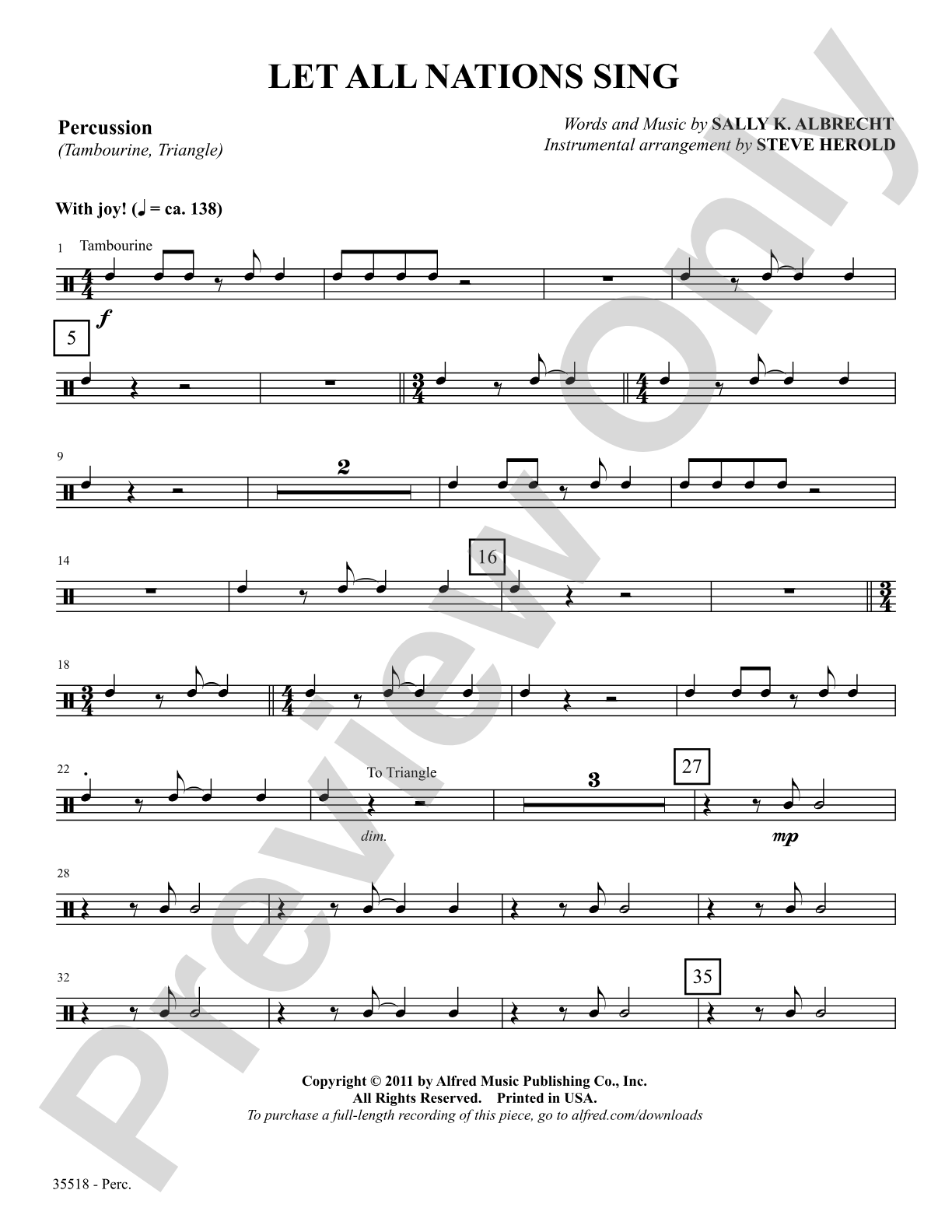

Let All Nations Sing: 1st Percussion: Choral SoundPax
Words and music by Sally K. Albrecht
Item: 00-PC-0014956_PC1
$3.00
Pickup currently not available
Description
This joyous and majestic fanfare features lots of echoes for effective singing (and easy learning). Appropriate for general and holiday use, school and church.


Don't just read it, hear it, play along with it, and watch your students grow with it. In MakeMusic Cloud, Let All Nations Sing: 1st Percussion: Choral SoundPax comes alive with professional accompaniment, adjustable tempo, and built-in practice tools that turn solo practice into real progress.
Open in the Player
Jump straight in and assign it today.
Start Your Free Trial
Open this title and explore the full library in minutes.
Sample Audio
1
Audio File
--:--
0:00
0:00
Sample Video
No sample videos found.
Additional Details
Series:
Alfred Choral Designs
Publisher:
Alfred Music
Page Count:
44
SKU:
00-PC-0014956_PC1
Instrumentation:
SoundPax
More about this title
About the Composer: Sally K. Albrecht

Sally K. Albrecht has shaped American choral music for over three decades, first as Director of School Choral, Vocal, and Elementary Publications at Alfred Music, and throughout her career as a prolific composer and conductor. Her catalog of more than 600 choral works reflects her deep understanding of what singers need: music that sounds sophisticated yet remains accessible, with clever use of texture and movement to engage both performers and audiences. Since 1987, she has received annual ASCAP Special Music Awards and has conducted honor choirs at Lincoln Center, Carnegie Hall, and The Kennedy Center.
Albrecht holds degrees from Rollins College (B.A. in Music and Theater) and the University of Miami (M.A. in Drama and M.M. in Accompanying). Her collaborative partnership with composer and arranger Jay Althouse, combined with her leadership roles including Chair of the Board of Trustees for Omicron Delta Kappa, demonstrates her commitment to both artistic excellence and educational service. In 2021, she received the Distinguished Alumna Award from both the University of Miami Frost School of Music and Rollins College.
Why we love this
Albrecht understands that echo effects aren't just musical window dressing—they're practical teaching tools that help singers lock in parts quickly while keeping energy high. The fanfare structure gives you immediate impact for both sacred and secular programming, and the SoundPax format means your singers can learn independently or perform with recorded accompaniment. Directors consistently choose her work because it sounds polished and celebratory without demanding excessive rehearsal time.
What to expect
Joyous and stately, with the bright ceremonial quality of a fanfare that opens doors and fills rooms. The echo passages create a sense of dialogue and expansion, as if the music is unfolding across a space, lifting spirits and drawing listeners in from the opening notes.
Who it's for
This works beautifully for school choirs at intermediate levels and up, as well as adult church choirs looking for accessible yet impressive seasonal or processional music. The echo design makes it particularly useful for programs where singers are learning parts independently or where rehearsal time is limited. General choirs of any size will find it rewarding.
How to get the most out of it
- Emphasize the echo sections as call-and-response moments; slight rhythmic separation between the initial phrase and its echo creates clarity and locks the parts into singers' ears.
- Balance the majestic opening against the echo passages by keeping the full choir's dynamic slightly forward, allowing the echoing voices to sit cleanly without doubling the texture.
- Use the recorded accompaniment during early rehearsals to establish the tempo and harmonic framework, then remove it gradually as confidence builds.
- Shape the fanfare with clear articulation on the strong beats; this style rewards crisp consonants and brightened vowels that enhance the ceremonial quality.
How to use it
Open a holiday concert with this piece to establish a festive, inclusive tone immediately. You can also program it as a processional for spring or fall choral festivals, or use it to welcome guests at a school assembly or community event. The versatility of general and sacred use means it fits easily between secular pops and hymn-based literature.
Skills your students will build
- Singing in echo texture and understanding spatial vocal effects
- Maintaining rhythmic precision within fanfare and march-like figures
- Balancing individual part clarity with full ensemble blend
- Responding to dynamic and articulation cues that enhance ceremonial style
- Learning parts efficiently through repetition and call-response structure