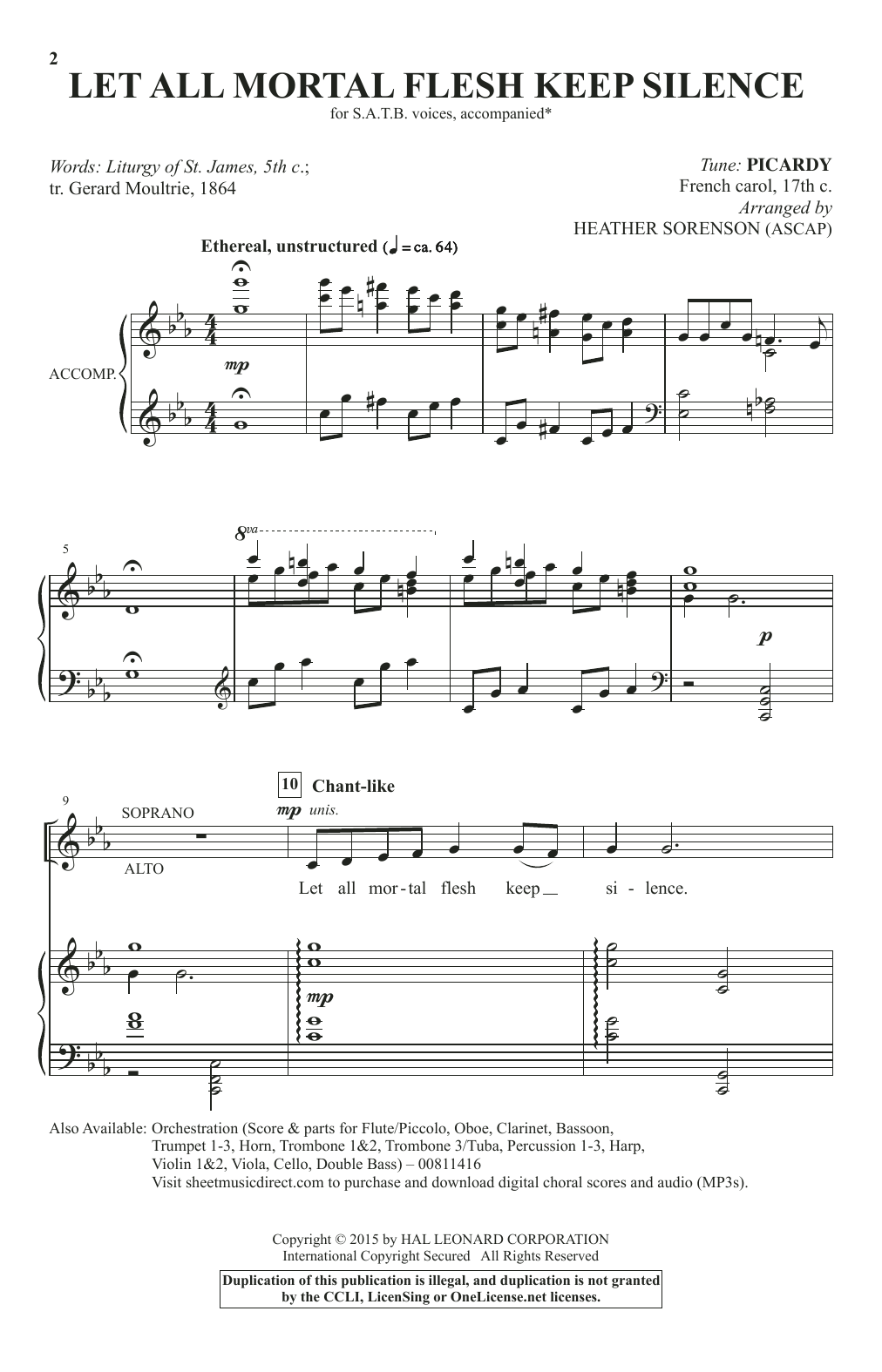
Let All Mortal Flesh Keep Silence Sheet Music Preview

Let All Mortal Flesh Keep Silence: SATB Choral Octavo

By PICARDY / Arranged by Heather Sorenson

Item: 35-DS01083229

Digital Download
$2.99
Description

Let All Mortal Flesh Keep Silence: SATB Choral Octavo isn't in MakeMusic Cloud just yet...but it could be. Let us know you'd like to see it, and you'll help shape what comes next. In the meantime, start a free trial and dive into thousands of interactive titles your students can play along with today.

Sample Audio
No sample audio found.
Sample Video
Additional Details
Publisher: Hal Leonard
Page Count: 11
SKU: 35-DS01083229

More about this title

About the Composer: PICARDY

Picardy is a 13th-century French melody that has endured across centuries of musical tradition. Originally paired with sacred Latin texts, the tune's elegant contour and modal character made it a natural choice for adaptation to English hymn texts during the Protestant Reformation. Its longevity speaks to the strength of its melodic writing and its capacity to carry profound spiritual meaning.

The melody remains a cornerstone of Christian worship and classical choral literature. Its association with "Let All Mortal Flesh Keep Silence" in particular has made it one of the most recognizable sacred tunes in the English-speaking world, appearing in countless hymnals and choral arrangements across centuries.

Why we love this

Heather Sorenson's arrangement honors the austere beauty of this medieval melody while making it accessible for contemporary SATB choirs. The writing sits comfortably for mixed voices and includes thoughtful harmonic movement that deepens the text's meditative quality without demanding extensive rehearsal time. This is a piece that sounds transcendent without requiring technical virtuosity.

What to expect

Contemplative and hushed, like a moment of collective silence before speech. The harmony unfolds with an almost liturgical quality, even as it remains entirely singable. There's a quality of suspension in time that makes this piece feel both ancient and immediately present.

Who it's for

Any SATB choir looking for profound Christmas or Advent repertoire that moves beyond the expected. This works equally well for sacred and secular choral programs because the melody transcends sectarian boundaries. It's particularly valuable for directors seeking material that teaches singers about modal writing and historical choral literature.

How to get the most out of it

  • Maintain a sense of stillness throughout. The modal character of the melody actually demands fewer dynamic gestures than Romantic-era hymn settings, so resist the urge to shape phrases too broadly. Let the text breathe.
  • Balance the soprano line carefully against the inner voices. In medieval harmonies, the alto and tenor lines often carry important counter-melodic material that would be buried if sopranos sing at full volume.
  • Shape the final cadence with restraint. The ending should feel like a gentle settling rather than a dramatic arrival. This serves the text far better than a soaring, emphatic close.

How to use it

Program this as the thoughtful center of a holiday concert, surrounded by more energetic seasonal fare. It pairs beautifully with other arrangements of traditional hymn melodies, or it can stand alone as a moment of reverence in an otherwise celebratory program. Consider placing it near the end of your first half to create a tonal shift for the audience.

Skills your students will build

  • Reading and singing in modal contexts
  • Balancing parts in non-traditional harmonic structures
  • Maintaining consistent vowel colors across sustained tones
  • Interpreting text with restraint and dignity
  • Understanding the relationship between melodic source material and harmonic arrangement

You May Also Like