
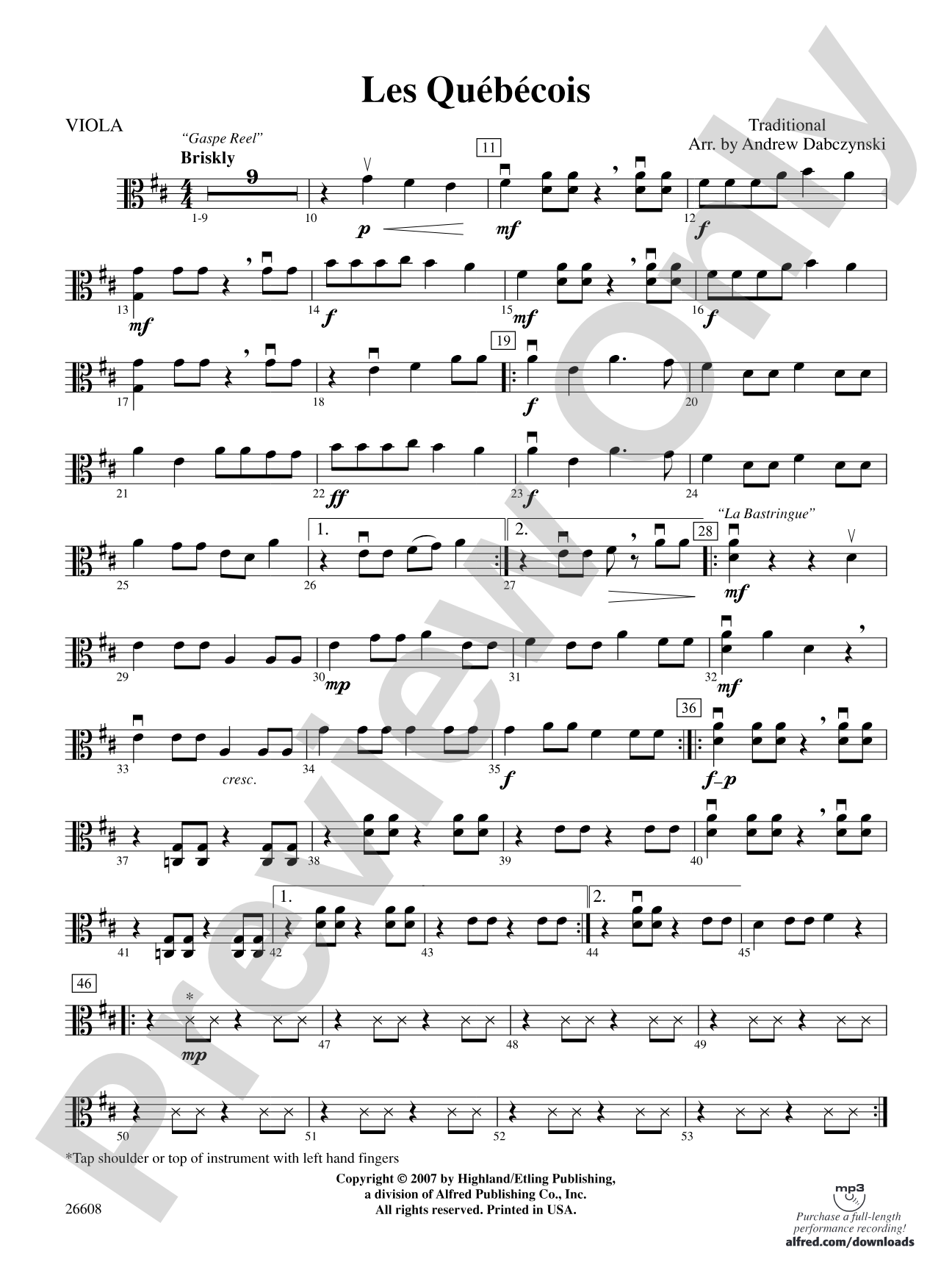

Les Québécois: Viola
Traditional / arr. Andrew H. Dabczynski
Grade: 2.5
Item: 00-PC-0001112_VA1
$5.99
Pickup currently not available
Description
The unique and captivating sounds of three French Canadian fiddle tunes - Gaspe Reel, La Bastringue, and Danse Antique - will have everyone tapping their toes! The driving rhythm of the traditional clogging is represented by interesting tapping of the instruments and optional improvisation. The unique syncopations and the unusual phrasing of the final "crooked tune" will make this a guaranteed showpiece for the players! This title is available in MakeMusic Cloud.


Don't just read it, hear it, play along with it, and watch your students grow with it. In MakeMusic Cloud, Les Québécois: Viola comes alive with professional accompaniment, adjustable tempo, and built-in practice tools that turn solo practice into real progress.
Open in the Player
Jump straight in and assign it today.
Start Your Free Trial
Open this title and explore the full library in minutes.
Sample Audio
1
Audio File
--:--
0:00
0:00
Sample Video
No sample videos found.
Additional Details
Series:
Highland/Etling String Alternatives
Publisher:
Alfred Music
Page Count:
66
SKU:
00-PC-0001112_VA1
More about this title
About the Arranger: Andrew H. Dabczynski

Andrew H. Dabczynski served as Emeritus Professor of Music Education at Brigham Young University, where he established the BYU "New Horizons Orchestra" as both a performance ensemble for adult beginners and a training ground for string educators. His work in this role earned him BYU's Joseph E. White Fellowship for Teaching and Learning. Throughout his career, he has held faculty positions at the Eastman School of Music and taught in public school systems across New York and Michigan, including a tenure as Fine Arts Supervisor in Waterford, Michigan.
As a performer, Dabczynski has appeared as violist with the Rochester Philharmonic, Hartford Symphony, Portland Symphony, Kalamazoo Symphony, and Greenwich Symphony. He was a six-year member of the Colden String Quartet, ensemble-in-residence at Western Michigan University. His scholarly interests center on fiddling traditions and ethnomusicology, work reflected in his co-authorship of the String Explorer method series published by Alfred. The Utah chapter of the American String Teachers Association recognized him as Higher Education Teacher of the Year in 2005 and honored his outstanding contributions to music education in 2014.
Why we love this
Dabczynski's deep knowledge of fiddling traditions shines through in this arrangement, which captures the rhythmic vitality and syncopated character of Quebec folk music without overwhelming a developing string orchestra. The three tunes progress in interest and complexity, giving you a natural arc for rehearsal momentum and concert impact. The optional improvisation and rhythmic tapping elements transform a grade 2.5 piece into something that feels contemporary and engaging rather than conventional.
What to expect
The energy of a winter fiddle dance comes through immediately. Toe-tapping grooves alternate with lilting melody passages, while the syncopated final tune creates a playful, almost unpredictable quality that pulls listeners forward. The arrangement honors the driving spirit of French Canadian folk music while remaining transparent enough for young players to feel their contribution to the whole.
Who it's for
String orchestras at the grade 2.5 level will find this arrangement accessible yet musically rewarding. It suits students ready to tackle non-traditional rhythms and tapping techniques without requiring advanced technical facility. This is equally valuable for contest preparation or concert programming that celebrates folk music traditions.
How to get the most out of it
- Establish the driving clogging rhythm as your foundation. Even when strings carry the melody, the tapping figures should lock in with the precision of a percussion section. This rhythmic clarity becomes your tuning fork for everything else.
- Treat the syncopations in the final tune as a feature, not a bug. Many young orchestras rush or iron out the rhythmic irregularities. Lean into the "crooked" phrasing; it's what makes this piece memorable.
- Encourage careful listening during any improvised sections. Even at this level, soloists can respond to what they hear in the ensemble rather than playing in isolation, which deepens musicianship across the whole group.
- Pay attention to intonation during the syncopated passages. Rhythmic displacement sometimes masks pitch problems. Slow down problem spots to expose tuning, then rebuild at tempo.
How to use it
Program this as a concert opener or a second-half highlight where you want to shift the energy and mood. Its accessibility makes it an excellent festival selection for orchestras seeking repertoire that demonstrates musicianship without requiring advanced technique. The stylistic contrast with conventional concert fare also works beautifully as a bridge between a classical work and another folk-influenced or contemporary piece.
Skills your students will build
- Reading and executing syncopated rhythms and unusual phrasing patterns
- Coordinating rhythmic tapping techniques with melodic playing
- Responding to flexible, folk-music-inspired phrasing rather than metrically strict conduct patterns
- Building ensemble precision in driving rhythmic textures
- Understanding and performing in folk music styles from French Canadian traditions