
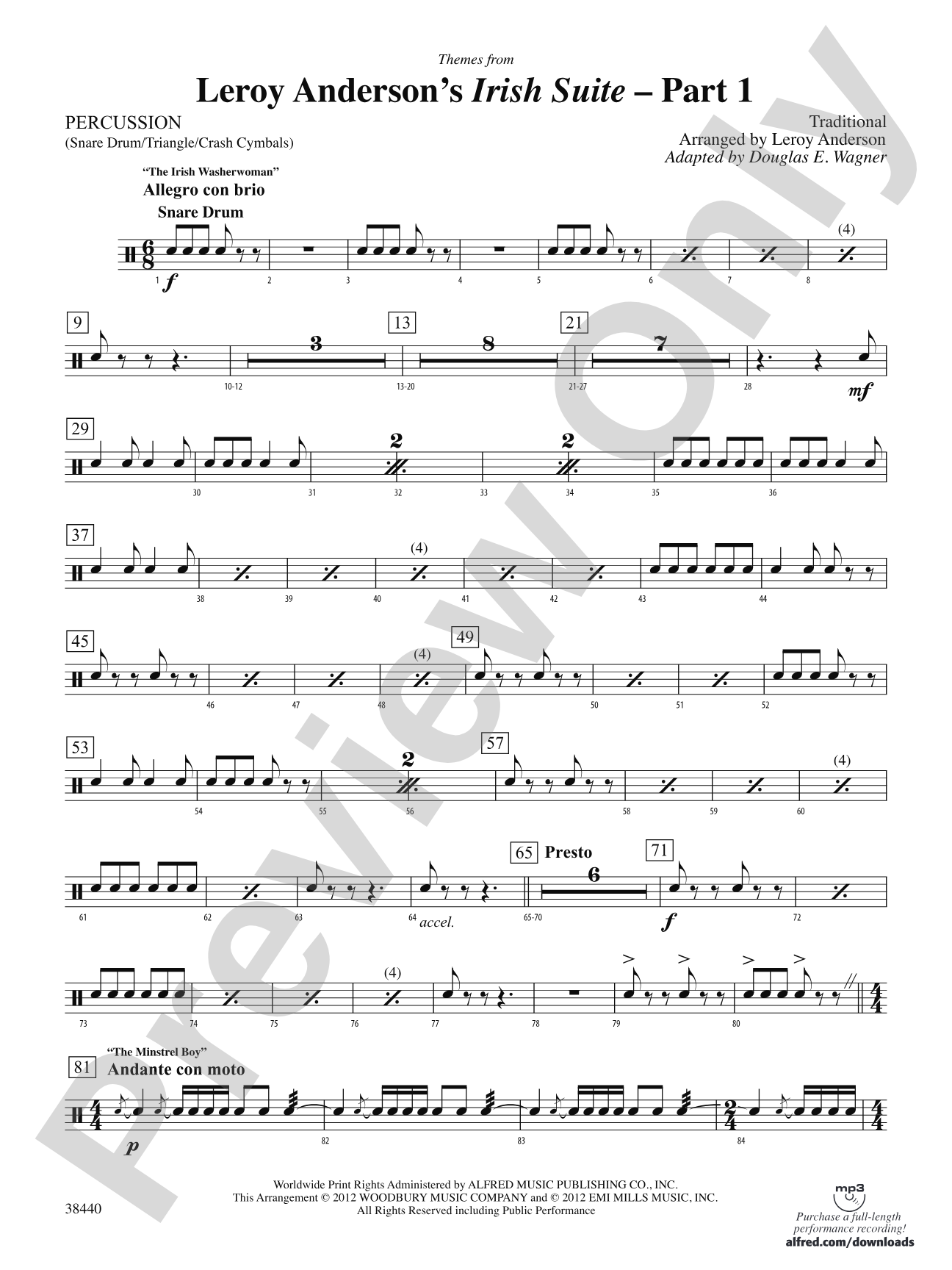

Leroy Anderson's Irish Suite, Part 1 (Themes from): 1st Percussion
Traditional / arr. Leroy Anderson, adapted by Douglas E. Wagner
Grade: 3
Item: 00-PC-0015807_PC1
$3.00
Pickup currently not available
Description
The first three movements of this iconic work are available in a dynamic scoring for your full orchestras. Major themes are presented with all of the color and fresh invention of the original score. This is music that will delight and entertain audiences of any age. It's as much fun to play as it is to listen to!


Don't just read it, hear it, play along with it, and watch your students grow with it. In MakeMusic Cloud, Leroy Anderson's Irish Suite, Part 1 (Themes from): 1st Percussion comes alive with professional accompaniment, adjustable tempo, and built-in practice tools that turn solo practice into real progress.
Open in the Player
Jump straight in and assign it today.
Start Your Free Trial
Open this title and explore the full library in minutes.
Sample Audio
1
Audio File
--:--
0:00
0:00
Sample Video
Additional Details
Series:
Pop Intermediate Full Orchestra
Publisher:
Alfred Music
Page Count:
232
SKU:
00-PC-0015807_PC1
More about this title
About the Arranger: Leroy Anderson
Leroy Anderson (1908-1975) was an American composer and conductor who became synonymous with light orchestral music in the mid-20th century. His gift for memorable melodies, clever orchestration, and infectious rhythms made his works staples of pops concerts and family audiences worldwide. Anderson's arrangements of folk material demonstrate his ability to honor traditional themes while infusing them with sophisticated harmonic color and orchestral texture that keeps audiences engaged across generations.
Douglas E. Wagner is a prolific composer and arranger whose work across concert band, orchestra, and choral idioms has shaped the repertoire available to school ensembles. His arrangements prioritize musical integrity and pedagogical value, creating accessible versions of significant works without sacrificing artistic content.
Why we love this
Anderson's gift for melody and orchestral color shines in this Grade 3 scoring, which captures the sparkle of the original without overwhelming younger orchestras. Wagner's arrangement makes the work accessible to developing musicians while preserving the sophisticated humor and charm that make Anderson's music so rewarding to conduct. Audiences respond immediately to this music, making it an ideal choice when you need pieces that build program momentum and leave listeners smiling.
What to expect
Warm, charming, and alive with character. The three movements unfold like a musical conversation among old friends, with themes that feel both instantly familiar and freshly orchestrated. You'll hear the landscape and spirit of Irish tradition filtered through Anderson's unmistakable gift for creating moments of delight and moments of genuine beauty.
Who it's for
Orchestras at Grade 3 level with developed string sections and competent woodwind and brass players. This is ideal repertoire for orchestras ready to move beyond beginner arrangements into music with real orchestral sophistication and thematic depth.
How to get the most out of it
- Bring out the individual instrumental solos that carry the main themes; they're the storytellers in each movement, so balance the accompaniment underneath them to let them sing.
- Pay attention to articulation markings as your primary tool for style. Anderson's orchestration relies on crisp, clear attacks in the woodwinds and brass to create the lightness and character the music needs.
- Use the conductor score to trace the orchestration changes across the three movements. Anderson and Wagner layer instruments strategically to build energy and color, so knowing when new voices enter helps you shape the phrases musically.
- Lock the tempo steady but allow for natural breathing in the phrasing. These melodies want to breathe like folk tunes, not sound mechanically precise.
How to use it
Program this as an anchor piece in a pops concert or family concert where you want sophisticated musical content with broad appeal. It pairs beautifully alongside other light orchestral works or as a contrasting opener to heavier classical repertoire. The three-movement structure also makes it substantial enough to anchor a concert section without overstaying its welcome.
Skills your students will build
- Balancing melodic lines with accompaniment textures
- Playing with stylistic lightness and articulate phrasing
- Responding to orchestration changes and instrumental layering
- Sustaining control across multiple contrasting movements
- Ensemble precision in folk-inflected musical phrasing