Legend of the Water Dragon: E-flat Alto Saxophone Sheet Music Preview

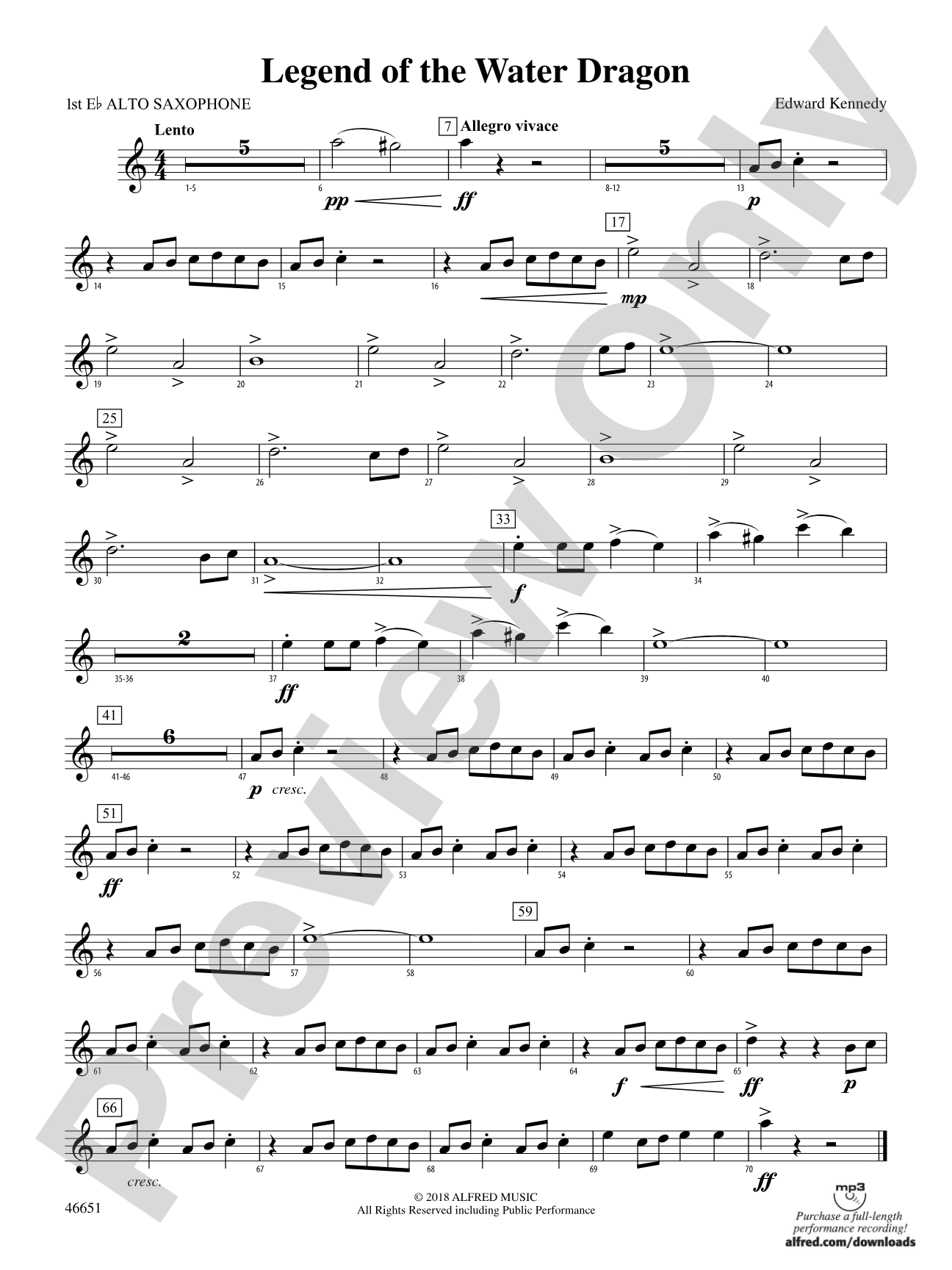
Legend of the Water Dragon: E-flat Alto Saxophone

By Edward Kennedy

Grade: 1.5 (Easy)

Item: 00-PC-0018081_AX1

Digital Download
$3.00
Description
Australian water dragons are fairly large lizards that have been around for 20 million years or so, and they can be seen along the rivers and waterways of Eastern Australia. For some Australian Aborigines, the water dragon is said to bring divine presence and a gateway to the astral world. This programmatic work portrays these mystical primordial creatures playing around in the midday sun.

Don't just read it, hear it, play along with it, and watch your students grow with it. In MakeMusic Cloud, Legend of the Water Dragon: E-flat Alto Saxophone comes alive with professional accompaniment, adjustable tempo, and built-in practice tools that turn solo practice into real progress.

Sample Audio
0:00
0:00
Sample Video
Additional Details
Series: Alfred Debut Series
Publisher: Alfred Music
Page Count: 128
SKU: 00-PC-0018081_AX1

More about this title

About the Composer: Edward Kennedy

Edward Kennedy

Edward Kennedy brings together training from both sides of the Atlantic and a deep commitment to wind band pedagogy. After earning his Bachelor of Teaching in Music from the University of Southern Queensland, he pursued advanced conducting studies at Salford University in Manchester and earned both Licentiate and Fellowship diplomas from Trinity College of Music London.

Based in Brisbane, Kennedy works as a multi-instrumental educator and band director within the Queensland Education Department while maintaining an active composing and arranging practice focused on brass and wind band literature. His dual background as a clinician, adjudicator, and conductor gives him insight into what student musicians actually need to grow.

Why we love this

Kennedy writes with a composer's ear for color and a teacher's respect for what young players can accomplish. The programmatic concept is clear enough to excite students without demanding virtuosity, and the scoring allows your ensemble to sound cohesive even at this accessible level. You get a piece that teaches musical storytelling rather than just technique.

What to expect

Warm and sun-drenched, with an underlying sense of ancient presence. The music captures movement and play without feeling rushed, letting listeners follow the dragons' journey through their natural habitat with gentle wonder and rhythmic vitality.

Who it's for

Directors building a Grade 1-2 contest or festival program who want something that engages student imagination without requiring advanced ensemble skills. It works equally well for a young band that needs confidence-building repertoire with musical substance.

How to get the most out of it

  • Let the middle section breathe; the contrast between the midday brightness of the outer sections and the more introspective passages depends on your willingness to shape phrase endings with space and air.
  • Balance the melodic voices against the supporting harmonies so that the water dragon imagery comes through the orchestration rather than getting buried under full band sound.
  • Experiment with articulation choices in the faster passages to find the right degree of lightness; the creatures playing in the sun benefit from crisp tonguing rather than heavy attacks.
  • Mark your score with clear cues so younger players can track the programmatic arc and understand when they're part of the foreground action versus atmospheric texture.

How to use it

Pair this with other Australian or nature-inspired works for a thematic concert, or use it as an opener that immediately establishes your ensemble's musicality and care for character. At this level, it's also a smart choice for building confidence before tackling more complex pieces later in the season.

Skills your students will build

  • Reading and maintaining programmatic context across multiple sections
  • Balance and blend at the Grade 1-2 level
  • Shaping melodic phrases with attention to expression rather than just execution
  • Rhythmic accuracy in faster scalar passages
  • Dynamic control across the full range of the ensemble

You May Also Like