
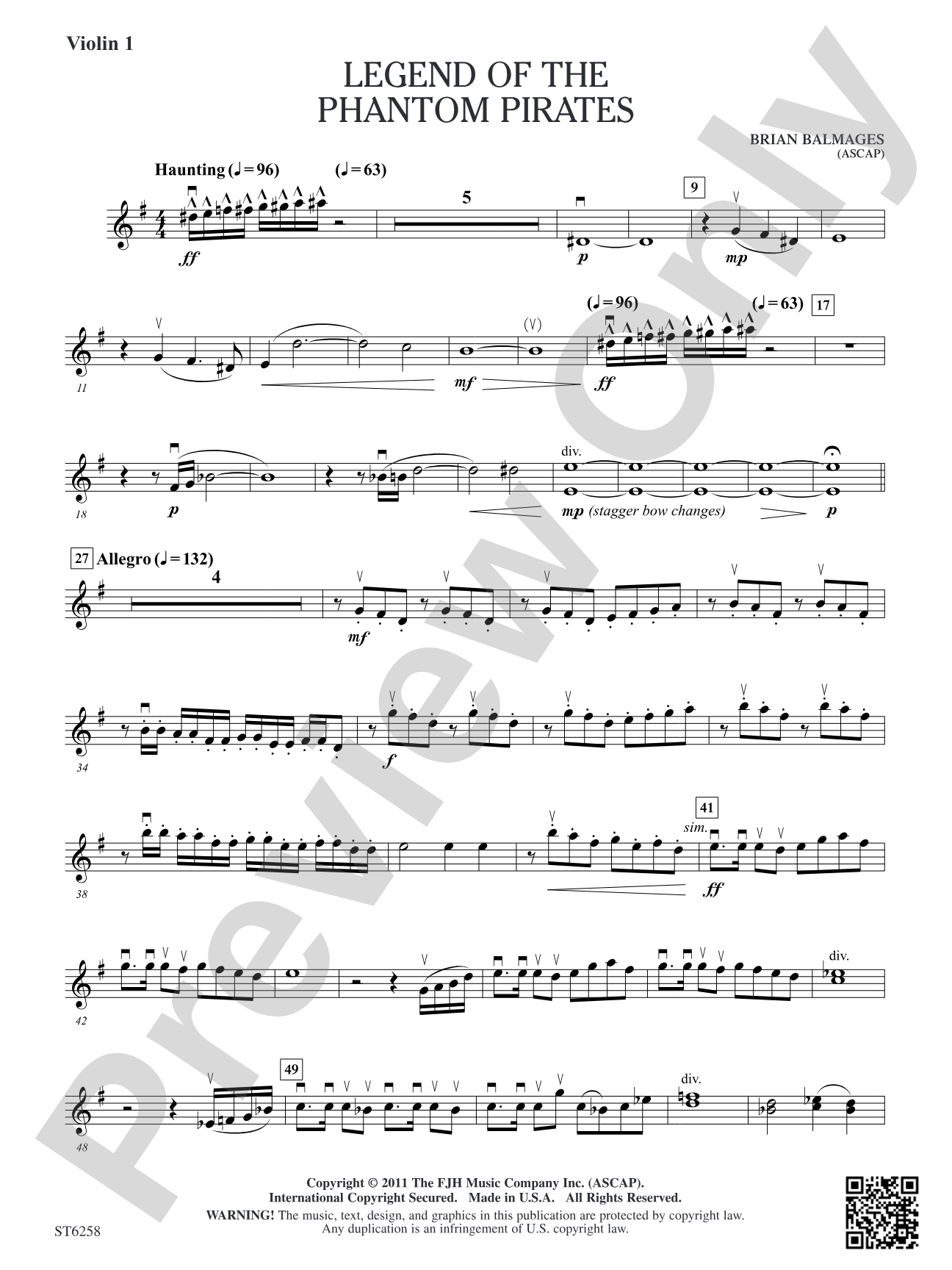

Legend of the Phantom Pirates: Violin 1
By Brian Balmages
Grade: 3.5
Item: 98-PC-DST6258_VN1
$7.00
Pickup currently not available
Description
This epic work conjures images of a ghostly pirate fleet wandering the high seas. The opening section paints an eerie picture of the forgotten crew, interspersed with brief "shrieks" as the phantoms burst in and out of view. The music becomes much more aggressive as listeners experience the adventures of life at sea. Ultimately, the pirates' fates are sealed, and they accept the fact that they are destined to haunt the seas for eternity. Powerful!


Don't just read it, hear it, play along with it, and watch your students grow with it. In MakeMusic Cloud, Legend of the Phantom Pirates: Violin 1 comes alive with professional accompaniment, adjustable tempo, and built-in practice tools that turn solo practice into real progress.
Open in the Player
Jump straight in and assign it today.
Start Your Free Trial
Open this title and explore the full library in minutes.
Sample Audio
1
Audio File
--:--
0:00
0:00
Sample Video
No sample videos found.
Additional Details
Series:
FJH String Orchestra
Publisher:
The FJH Music Company, Inc.
SKU:
98-PC-DST6258_VN1
More about this title
About the Composer: Brian Balmages

Brian Balmages has established himself as a composer and conductor working across orchestral, band, and chamber idioms at every level, from elementary school ensembles to professional symphony orchestras. His works have been performed at Carnegie Hall, the Kennedy Center, Sydney Opera House, and Toronto Centre for the Arts. He received the A. Austin Harding Award from the American School Band Directors Association and won the 2020 NBA William D. Revelli Composition Contest for Love and Light.
Balmages holds degrees from James Madison University and the University of Miami and was honored with JMU's inaugural Distinguished Alumni Award from the School of Visual and Performing Arts. He has been commissioned to compose for major institutional events, including music for the inauguration of the University of Miami's sixth president and a work performed at the 2013 Presidential Inaugural Prayer Service. As a conductor, he maintains regular engagements with all-state and regional ensembles, university groups, and professional orchestras worldwide, with notable appearances at the Midwest Clinic, Western International Band Clinic, and ASTA conferences. He serves as Director of MakeMusic Publications and Digital Education for Alfred and MakeMusic.
Why we love this
Balmages delivers a programmatic arc that young orchestras can actually execute. The narrative unfolds clearly enough for audiences to follow without losing the musical substance beneath the storytelling. String players at the 3.5 level get a chance to play something genuinely exciting and cinematic while building fundamental ensemble skills.
What to expect
The piece opens with an unsettling, sparse atmosphere where phantom crews materialize and dissolve into the mist. As the adventure intensifies, the music swells with driving energy and swagger, capturing the chaos and danger of life on the high seas. The final acceptance settles into a haunting beauty, as if the ghostly fleet has resigned itself to an eternal wandering.
Who it's for
String orchestras working at grades 3.5 and up will find the technical demands reasonable but the musical storytelling substantial. Directors programming a concert that mixes substantive repertoire with audience appeal will appreciate having a piece that accomplishes both.
How to get the most out of it
- Shape the opening section with dynamic restraint. The eerie quality depends on transparency and control rather than volume; let silence and space do as much work as the notes themselves.
- Coordinate the 'shrieks' with precision so they land as genuine surprises. Brief rehearsals of just those moments will pay off in performance impact.
- Build intensity gradually through the aggressive middle section without sacrificing tuning. Watch for intonation dips when players push harder, and use sectionals to lock in unison passages.
- Honor the acceptance that emerges in the final section. Resist the urge to rush the ending; let the music settle into its resolution with quiet inevitability.
How to use it
This works well as a centerpiece in a concert that balances classical works with contemporary programming. Position it after lighter fare to showcase what your orchestra can do musically, or use it as an opener if you want to command immediate attention and set a more adventurous tone for the evening.
Skills your students will build
- Sustaining lyrical lines with consistent tone and intonation
- Executing precise rhythmic attacks in fast passages
- Responding to sudden dynamic shifts and textural changes
- Balancing ensemble sound while maintaining individual voice clarity
- Following programmatic cues to shape phrasing and expression