
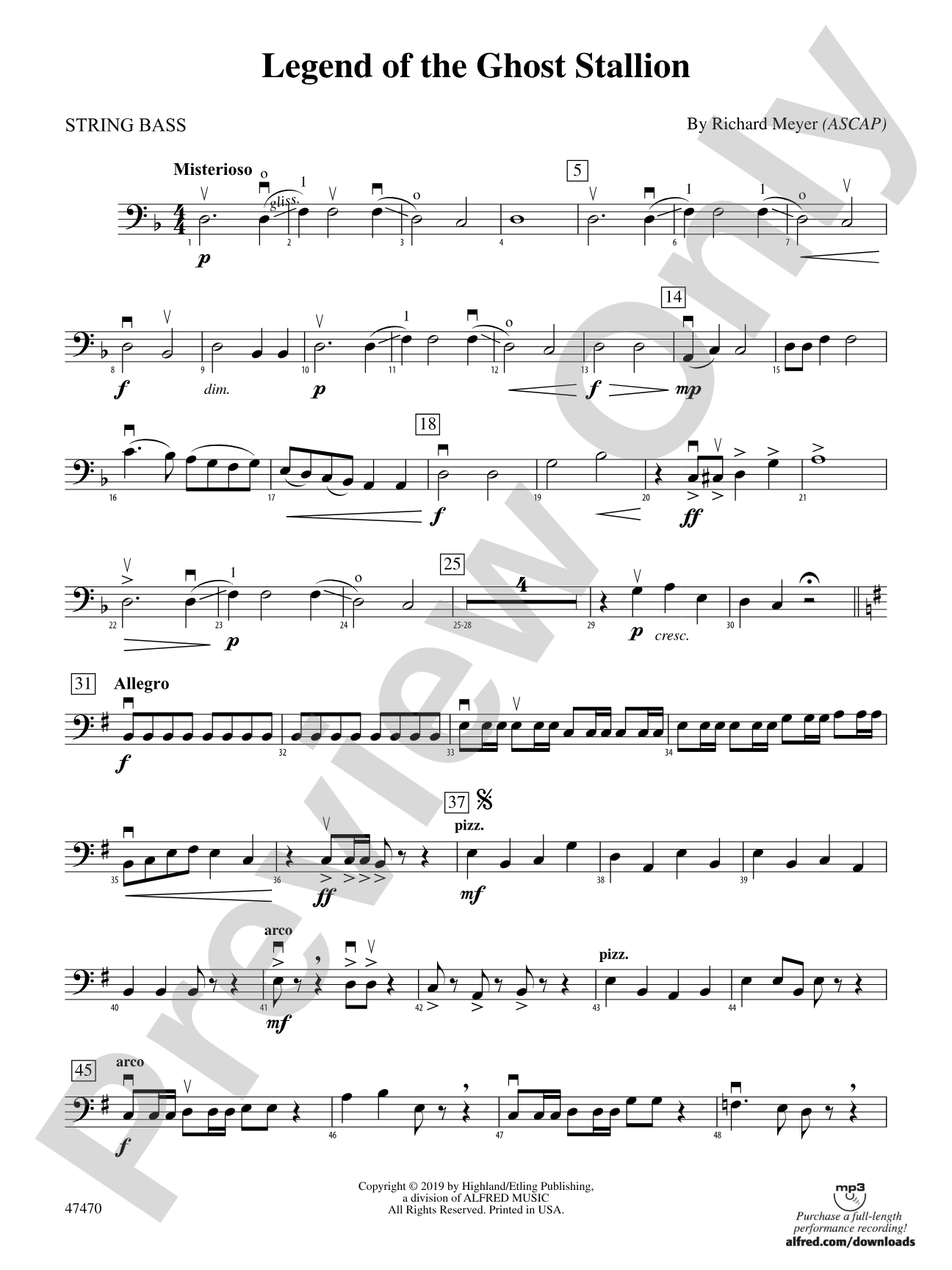

Legend of the Ghost Stallion: String Bass
By Richard Meyer
Grade: 2.5
Item: 00-PC-0017999_SB
$5.99
Pickup currently not available
Description
This ode to the Wild West begins with a mysterious introduction using the folk song "All the Pretty Little Horses" in an eerie setting that will send shivers up the spines of performers and audience members alike. Brief solos for violin, viola, and cello are heard. The pace then picks up as we hear the driving and energetic theme of the Ghost Stallion riding through the moonlit countryside. The repeated galloping rhythm (eighth/two sixteenths) appears in stretches and is designed to improve your students' abilities to perform this all-important bowing pattern. This picturesque and educationally sound selection by Richard Meyer is sure to capture the imagination and improve the technique of everyone in both intermediate and more advanced orchestras. This title is available in MakeMusic Cloud.


Don't just read it, hear it, play along with it, and watch your students grow with it. In MakeMusic Cloud, Legend of the Ghost Stallion: String Bass comes alive with professional accompaniment, adjustable tempo, and built-in practice tools that turn solo practice into real progress.
Open in the Player
Jump straight in and assign it today.
Start Your Free Trial
Open this title and explore the full library in minutes.
Sample Audio
1
Audio File
--:--
0:00
0:00
Sample Video
Additional Details
Series:
Highland/Etling String Orchestra
Publisher:
Alfred Music
Page Count:
124
SKU:
00-PC-0017999_SB
More about this title
About the Composer: Richard Meyer

Richard Meyer brings three and a half decades of string teaching experience to his compositions, having built one of Southern California's largest middle school orchestra programs from 29 students to 200. His work as conductor of the Pasadena Youth Symphony Orchestra for 16 years took students to performance venues across the United States, Europe, and Australia, giving him deep insight into what engages both young musicians and audiences.
Beyond the podium, Meyer has shaped string music education through his prolific output of nearly 200 published compositions and arrangements, his tenure as string editor for Alfred Publishing Company, and his co-authorship of influential method books including the String Explorer Series. His "Giving Bach" program, launched in 2009, demonstrates his commitment to using interactive concerts to reach underserved student populations throughout Southern California.
Why we love this
Meyer has crafted a piece that works equally well for musical storytelling and technical development. The galloping rhythm pattern embedded throughout the Ghost Stallion theme serves as targeted bow work instruction without sacrificing narrative momentum, and the contrasting "All the Pretty Little Horses" introduction gives your students a chance to shine in brief solos while maintaining cohesion across the entire orchestra.
What to expect
The piece opens in shadow and mystery, with "All the Pretty Little Horses" transformed into something unsettling and spectral. Energy surges as the Ghost Stallion gallops through the moonlit landscape, driven by relentless rhythmic energy and the pounding hoofbeats that seem to sweep across the stage.
Who it's for
This piece fits orchestras at the intermediate-to-advanced level (Grade 2.5) ready for a substantial concert or festival selection with real narrative arc. Directors leading groups with developing second-violin and lower-string players will appreciate how Meyer targets that critical eighth-sixteenth bowing pattern while keeping the entire ensemble engaged.
How to get the most out of it
- Balance the eerie opening carefully so the viola and cello solos cut through without forcing; the mystery comes from clarity, not volume.
- Lock the repeated eighth-sixteenth galloping figure across all sections before adding tempo; rhythmic precision here drives the entire forward momentum.
- Shape the folk melody with a sense of unease in the opening; let the introduction breathe slightly and resist rushing into the faster section.
- Mark the transition from the mysterious introduction to the Ghost Stallion theme clearly for your ensemble so the shift feels intentional, not abrupt.
How to use it
Program this for October and Halloween concerts where the atmospheric opening and galloping theme create vivid imagery without leaning into obvious spookiness. It also works well as a festival piece that showcases your orchestra's rhythmic precision and ability to shape character through tempo and texture changes.
Skills your students will build
- Executing the eighth-sixteenth galloping rhythm across multiple string parts
- Shaping lyrical melodic lines with expression and control
- Managing tempo contrast between the slow, mysterious introduction and driving faster section
- Balancing individual solos (violin, viola, cello) within ensemble context
- Building stamina through repeated rhythmic patterns
- Creating dramatic narrative and character through musical phrasing