
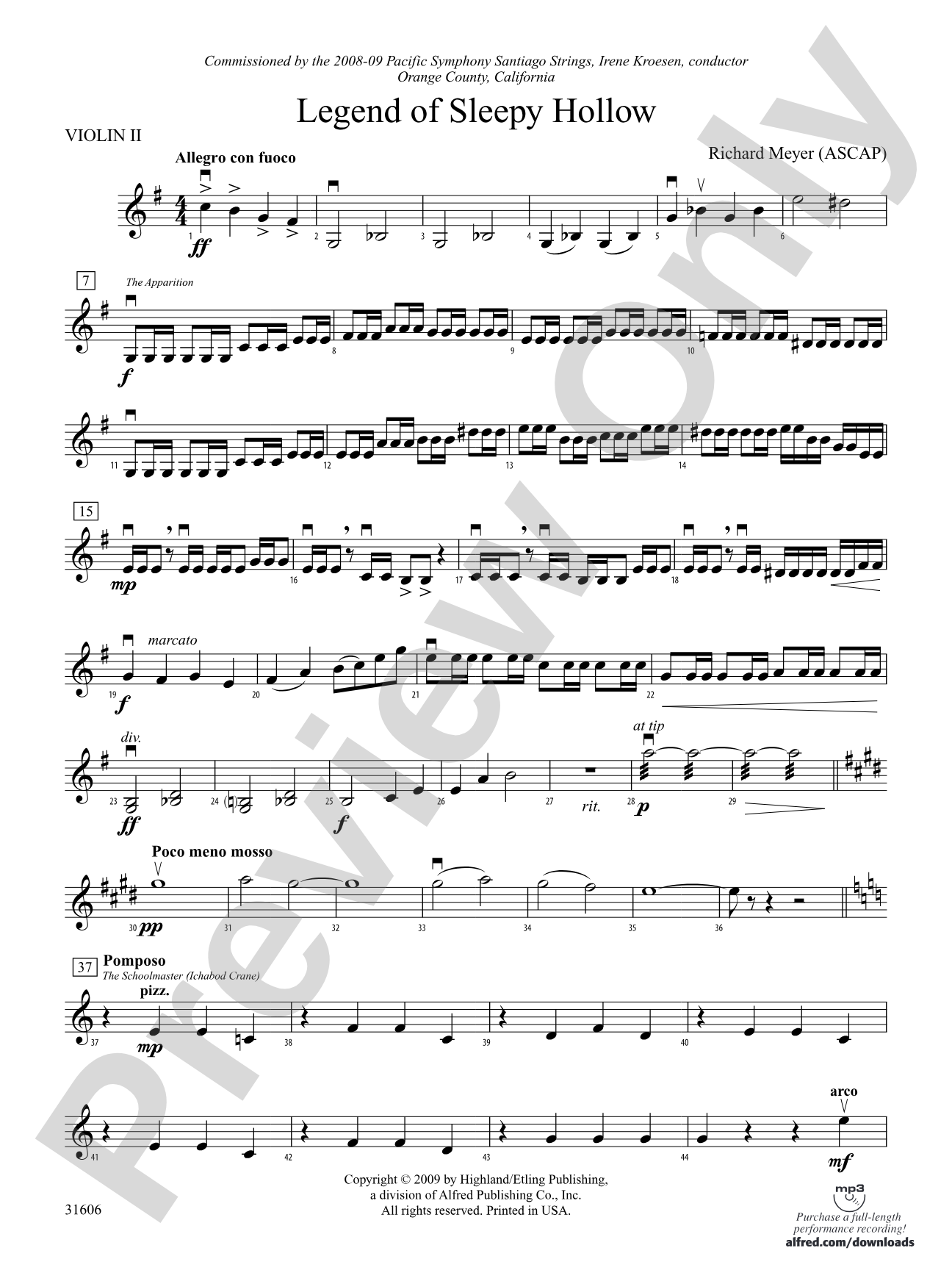

Legend of Sleepy Hollow: 2nd Violin
By Richard Meyer
Grade: 4
Item: 00-PC-0001771_VN2
$5.99
Pickup currently not available
Description
An exciting and colorful tone poem based on Washington Irving's famous short story, your students will love this musical depiction of the fateful night when Schoolmaster Ichabod Crane meets up with the fabled Headless Horseman. Whimsical, romantic and frightening, this piece is sure to stir the imaginations of your students and their audience. A great challenge for the more advanced string orchestra, and a wonderful lesson in tone painting. This title is available in MakeMusic Cloud.


Don't just read it, hear it, play along with it, and watch your students grow with it. In MakeMusic Cloud, Legend of Sleepy Hollow: 2nd Violin comes alive with professional accompaniment, adjustable tempo, and built-in practice tools that turn solo practice into real progress.
Open in the Player
Jump straight in and assign it today.
Start Your Free Trial
Open this title and explore the full library in minutes.
Sample Audio
1
Audio File
--:--
0:00
0:00
Sample Video
Additional Details
Series:
Highland/Etling String Orchestra
Publisher:
Alfred Music
Page Count:
124
SKU:
00-PC-0001771_VN2
More about this title
About the Composer: Richard Meyer

Richard Meyer spent 35 years teaching strings across elementary, middle, and high school levels in Southern California public schools. At Oak Avenue Intermediate School in Temple City, he built the orchestra program from 29 students to 200 over 22 years while simultaneously directing the city's elementary string initiative. His work earned national recognition through the "Giving Bach" program, which uses interactive concerts to reach special needs and underserved student populations throughout the region.
Beyond the classroom, Meyer has guest-conducted All-State and Honor Orchestras across multiple states and led the Pasadena Youth Symphony Orchestra for 16 years, taking them on international tours to Vienna, Australia, and Canada. He served as string editor for Alfred Publishing Company for 16 years and has published over 190 compositions and arrangements. Meyer is also a co-author of widely-used string method materials, including the String Explorer Series and Sight-read It for Strings.
Why we love this
Meyer writes with genuine understanding of what advanced string orchestras can achieve, and this piece demonstrates that perfectly. The tone painting is sophisticated enough to engage students musically while remaining playable at Grade 4, and the literary connection gives students genuine reason to care about their parts rather than simply executing notes on a page.
What to expect
The music captures the charm and unease of Irving's tale with vivid orchestration. You'll hear Ichabod's nervous energy in bright, chattering figures; the Horseman's presence grows through darker, urgent string writing; and moments of genuine romance emerge in the lyrical sections that ground the narrative between frights.
Who it's for
Advanced string orchestras at the high school level or unusually strong middle school programs. This Grade 4 piece demands strong intonation, independent reading, and the ability to sustain character through extended phrases, making it ideal for orchestras that have moved beyond early-intermediate fundamentals.
How to get the most out of it
- Shape the whimsical passages with clear articulation and dynamic contrast; the comedy lands only if the orchestra commits to the character shifts between Ichabod's scenes and the Horseman's appearances.
- Balance the texture carefully so that melodic ideas remain audible even when layered with accompaniment; string tone painting requires transparency, not thickness.
- Use the conductor score to mark the specific dramatic moments tied to the narrative so you can build anticipation during rehearsal; students will invest more energy when they understand exactly what musical event corresponds to each story beat.
- Manage the tempo fluctuations that support the emotional arc; rushing the frightening sections undermines the impact, while dragging the romantic passages loses their warmth.
How to use it
This works beautifully as a fall concert centerpiece, especially when paired with other American programmatic works or orchestral selections that explore storytelling. The Halloween connection makes it natural for late October programming, but the musical content transcends the holiday theme, making it equally valuable for a spring concert focused on tone painting or descriptive music.
Skills your students will build
- Tone painting through orchestration and dynamic shaping
- Executing rapid articulation patterns and maintaining clarity in faster passages
- Reading and responding to conductor cues that reflect dramatic narrative moments
- Sustaining lyrical lines with consistent vibrato and phrase shape
- Balancing independent parts within an ensemble texture
- Interpreting tempo and character changes that align with programmatic content