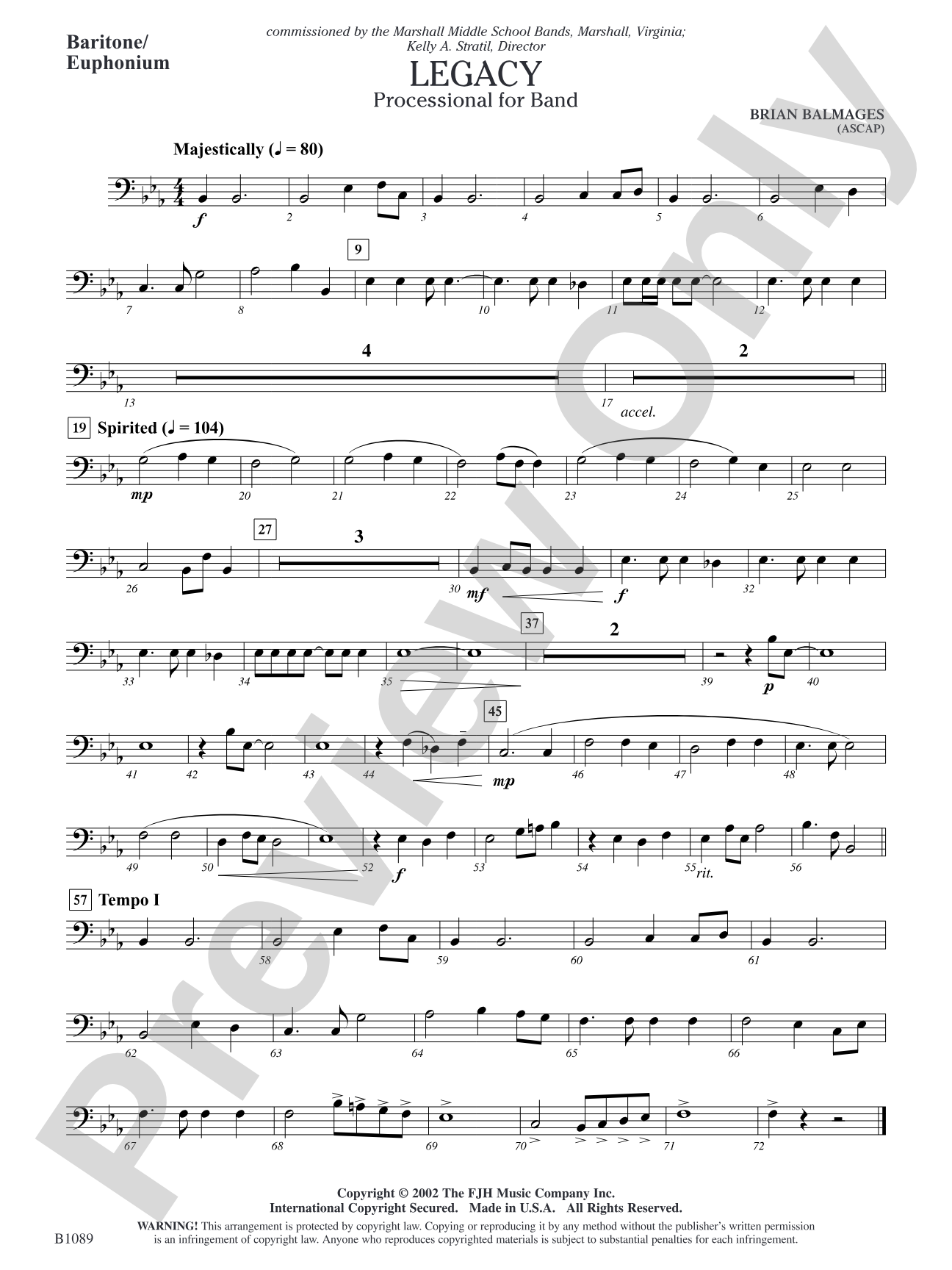
Legacy (Processional for Band): Baritone/Euphonium Sheet Music Preview

Legacy (Processional for Band): Baritone/Euphonium

Processional for Band

By Brian Balmages

Grade: 2.5

Item: 98-PC-DB1089_BBC1

Digital Download
$7.00
Description
This processional is ideal for concerts, graduations, or other special ceremonies. Stately fanfares in the brass and woodwinds move into a middle section with more motion and pulse, while switching to a more legato style. The opening figure returns with a final brilliant fanfare in the brass. (3:20)

Legacy (Processional for Band): Baritone/Euphonium isn't in MakeMusic Cloud just yet...but it could be. Let us know you'd like to see it, and you'll help shape what comes next. In the meantime, start a free trial and dive into thousands of interactive titles your students can play along with today.

Sample Audio
0:00
0:00
Sample Video
Additional Details
Series: FJH Young Band
Publisher: The FJH Music Company, Inc.
SKU: 98-PC-DB1089_BBC1

More about this title

About the Composer: Brian Balmages

Brian Balmages

Brian Balmages composes across orchestral, band, and chamber idioms with equal fluency, and his works have reached audiences everywhere from Carnegie Hall to the Sydney Opera House. He holds membership in the American Bandmasters Association, won the 2020 NBA William D. Revelli Composition Contest, and received the A. Austin Harding Award from the American School Band Directors Association. His music was performed at the 2013 Presidential Inaugural Prayer Service and has been commissioned by major institutions including the University of Miami for its presidential inauguration.

As a conductor, Balmages leads engagements with all-state ensembles, university bands, and professional orchestras on stages ranging from the Midwest Clinic to Teatro dell'Aquila in Italy. He holds alumni distinction from James Madison University and currently serves as Director of MakeMusic Publications and Digital Education for Alfred and MakeMusic.

Why we love this

Balmages understands what makes a processional land with impact. The architecture here is clean: fanfares establish dignity, a rhythmic middle section gives the ensemble room to shine without stretching into complexity, and the return feels genuinely ceremonial rather than recycled. At 2.5, it's accessible enough for developing bands yet written with enough musical intelligence that audiences hear real composition, not filler.

What to expect

Ceremonial and unhurried, with brass cuts clean and bright against the woodwinds. The middle section loosens the formality just enough to prevent stiffness, then the opening material returns with accumulated weight and authority.

Who it's for

Bands at the early intermediate level performing for graduations, award ceremonies, or concert programs that need something dignified but not demanding. Directors seeking a piece that teaches young musicians how to balance fanfare style with lyrical writing will find it here.

How to get the most out of it

  • Balance the brass fanfares so they project without drowning the inner voices; a bit of space in the acoustics reveals more of the orchestration than you might expect.
  • Let the middle section breathe. The increased pulse can feel rushed if you pull the tempo forward; lean into the legato writing to keep it flowing naturally.
  • The final brass fanfare should feel earned. Build through the return of the opening figure so the last statement lands as a genuine climax, not an abrupt return.

How to use it

Open a concert with this to set a formal tone, or use it as the processional for a graduation or recognition ceremony. At 3:20, it fills a specific program moment without eating into rehearsal time for larger works, making it a natural fit for spring events or year-end celebrations.

Skills your students will build

  • Balancing fanfare articulation with inner harmonic clarity
  • Shaping melodic phrases with legato across style changes
  • Reading straightforward concert band voicing at the early intermediate level
  • Ensemble control during contrasting sections (fanfare, rhythmic pulse, legato return)
  • Approaching processional style with appropriate weight and ceremony

You May Also Like