
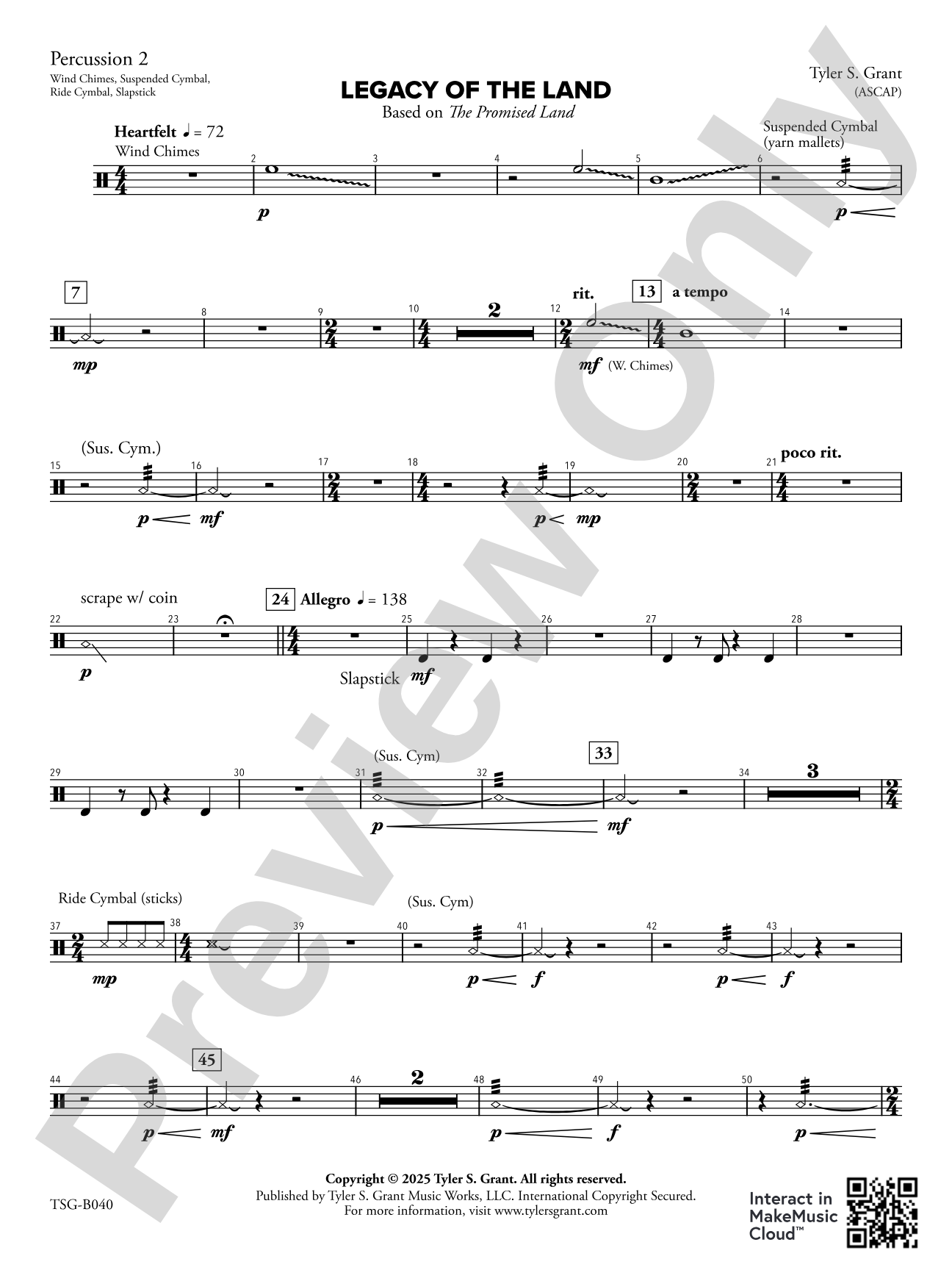

Legacy of the Land (Based on "The Promised Land"): 2nd Percussion
Based on "The Promised Land"
By Tyler S. Grant
Grade: 2.5
Item: 98-PC-TGB040_PC2
$4.50
Pickup currently not available
Description
Based on "The Promised Land" from the shape-note singing tradition, this programmatic work paints a picture of the Kentucky heartland. Beginning with a portrayal of the morning sunrise, "Legacy of the Land" by Tyler S. Grant moves into a set of swift variations that represent galloping horses across the open fields. A perfect choice for contest or festival! (3:30)


Discover MakeMusic Cloud: thousands of interactive titles your students can play along with today.
Sample Audio
1
Audio File
--:--
0:00
0:00
Sample Video
Additional Details
Publisher:
Tyler S. Grant Music Works, LLC.
SKU:
98-PC-TGB040_PC2
More about this title
About the Composer: Tyler S. Grant

Tyler S. Grant has established himself as a prolific voice in band composition, with works regularly appearing on honor ensemble programs and earning recognition on national repertoire lists. His piece Panoramic Fanfare won the Dallas Wind Symphony's 2014 "Call for Fanfares" Competition and has since circulated through collegiate and professional ensembles across North America. Since 2010, he has maintained a steady output of commissions and publications while conducting clinics with over 100 school programs across more than 15 states.
Grant's experience spans composition, arrangement, and conducting, with notable performances of his work at venues including The Midwest Clinic, Carnegie Hall, and the Macy's Thanksgiving Day Parade. He studied instrumental music education and conducting at the University of Alabama under Professor Randall Coleman, and credits composer Brian Balmages as fundamental to his development. Beyond his own compositions, Grant contributed to Alfred Music's Sound Innovations: Ensemble Development series and regularly shares his insights through podcasts and music education publications.
Why we love this
Grant captures something genuinely Americana in this work without relying on obvious folk song quotations. The programmatic arc, from sunrise through energetic variations, gives your ensemble a clear narrative to build around, and the Grade 2.5 level makes it accessible to bands still developing their musical independence. Contest and festival audiences respond immediately to the vivid imagery and forward momentum.
What to expect
The piece opens with quiet contemplation as light breaks over the landscape, then shifts into galloping energy and rhythmic vitality. There's genuine joy in the variations, a celebration of movement and open space captured through bright orchestration and forward-driving rhythms.
Who it's for
Grade 2.5 concert bands preparing for festival or contest, and any director looking for engaging programmatic material that doesn't demand virtuosic technique. It works equally well for groups building repertoire depth or looking for a showpiece with substance.
How to get the most out of it
- Shape the opening sunrise section with deliberate dynamic control. The mood here sets everything that follows, so resist the urge to rush into the quicker material.
- Articulate the variations crisply; Grant's rhythmic figures need clarity to suggest the gallop imagery. Clean tonguing in the woodwinds and tight section work in the brass will bring the piece to life.
- Balance the accompaniment figuration against any melodic material riding above it. This piece works best when layers stay proportionate rather than one dominating.
- Use the full three-and-a-half minutes to your advantage in contest. Resist compression for time; the work is designed to breathe.
How to use it
This works beautifully as a contest or festival entry, but it's equally at home on a spring concert paired with lyrical selections to highlight the contrast between sections. The clear programmatic structure makes it valuable for teaching students how visual imagery can drive musical choices and interpretation.
Skills your students will build
- Phrasing across longer melodic lines with minimal harmonic support
- Rhythmic precision in quick-moving accompaniment figures
- Dynamic control and contrast between narrative sections
- Ensemble balance when multiple rhythmic layers interact
- Sustaining energy through tempo changes without rushing