
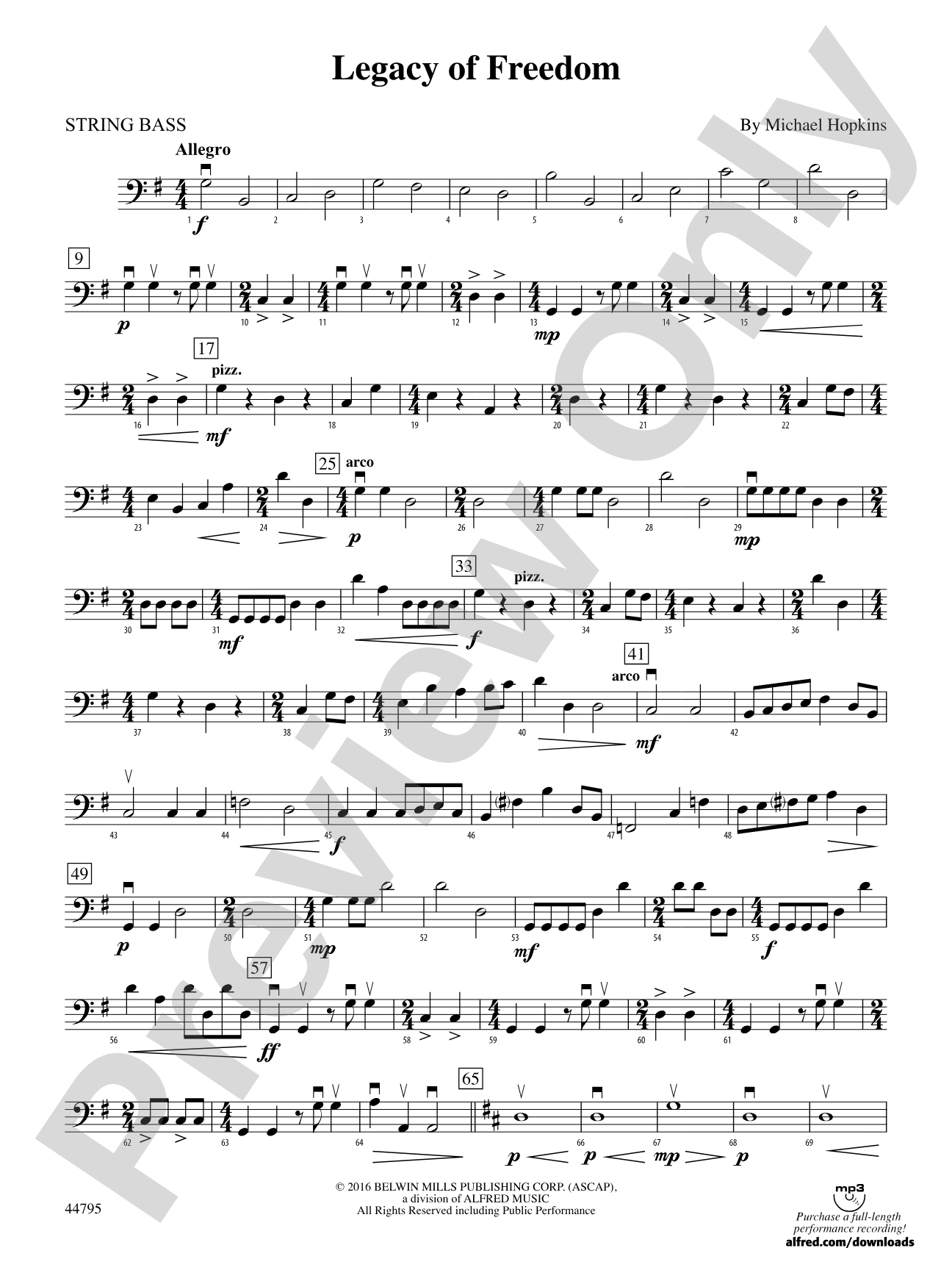

Legacy of Freedom: String Bass
By Michael Hopkins
Grade: 2.5
Item: 00-PC-0017312_SB
$5.99
Pickup currently not available
Description
With a bright and cheerful opening and a lyrical middle section, this piece celebrates the early years of the United States and the sacrifices that secured our freedom. Composed by Michael Hopkins, this piece will provide a patriotic flavor for any concert. With no shifting except in the basses, this piece includes many opportunities for right-hand development and work on dynamics. Some hi third fingers are required in viola and violin, and the cello part requires an extension. The ending is a return of the opening, but with a descending chromatic line in the cello and bass parts.


Don't just read it, hear it, play along with it, and watch your students grow with it. In MakeMusic Cloud, Legacy of Freedom: String Bass comes alive with professional accompaniment, adjustable tempo, and built-in practice tools that turn solo practice into real progress.
Open in the Player
Jump straight in and assign it today.
Start Your Free Trial
Open this title and explore the full library in minutes.
Sample Audio
1
Audio File
--:--
0:00
0:00
Sample Video
Additional Details
Series:
Belwin Intermediate String Orchestra
Publisher:
Alfred Music
Page Count:
144
SKU:
00-PC-0017312_SB
More about this title
About the Composer: Michael Hopkins

Michael Hopkins leads the music education program at the University of Michigan, where he teaches string techniques, orchestra methods, and music pedagogy to future teachers and conductors. His career spans three decades of conducting and teaching in higher education and K-12 settings across Colorado, Michigan, and Vermont. He founded the Burlington Chamber Orchestra and has guest conducted at over 100 festivals and clinics nationwide.
Hopkins has composed and arranged more than 70 works for orchestra, with a particular focus on educational repertoire that serves both pedagogical and musical goals. His scholarship appears regularly in the Journal of Research in Music Education, American String Teacher, and other peer-reviewed publications. He authored The Art of String Teaching, a comprehensive resource for string educators at all levels.
Why we love this
Hopkins writes for the actual teaching orchestra, not an idealized one. The technical demands grow naturally from what students can do at this level: minimal shifting in upper strings, achievable extension work in cello, and genuine right-hand study through varied dynamics and articulation. The patriotic theme gives students meaningful content to perform while the musical architecture (bright opening, lyrical center, dramatic return with chromatic color) holds their attention and yours.
What to expect
The piece opens with infectious optimism and clarity, the kind of direct melodic writing that immediately captures student engagement. The middle section softens into genuine lyricism, asking players to listen and blend carefully. The coda brings back that opening brightness but deepens it with chromatic coloring in the lower strings, creating a sense of reflection alongside celebration.
Who it's for
String orchestras at the intermediate level (grades 6-9) or adult community ensembles with basic technical foundation. Students should be comfortable with extensions and some position work, though the arrangement keeps shifting minimal outside the bass section, making it accessible for developing violinists and violists.
How to get the most out of it
- Shape the bright opening with clarity in articulation first, then layer in dynamic contrast; many middle school orchestras rush cheerful material, so a clear pulse keeps ensemble confidence high.
- Prepare the lyrical middle section by isolating the melodic line (likely in first violins or violas) and building supportive texture around it; this prevents the piece from sagging during its emotional center.
- Balance the descending chromatic figures in cello and bass at the return; these lines deserve to be heard as a sophisticated restatement, not merely accompaniment to the main theme.
- Drill the right-hand work in sections before full rehearsal; dynamics and bow control separate a polished performance from a competent one at this level.
How to use it
Program this as a centerpiece for a patriotic-themed concert or a spring celebration of American music. It works equally well as a standalone concert opener that sets a confident, uplifting tone, or paired with other intermediate string works to build a coherent program. The bright character and clear structure also make it an effective festival or competition selection.
Skills your students will build
- Right-hand bow control through dynamic shaping and varied articulation
- Third finger extensions in higher positions on viola and violin
- Extension technique in cello (preparatory for more advanced repertoire)
- Sustained tone and blend in lyrical passages
- Reading and executing chromatic passages with accuracy
- Understanding harmonic context and phrasing in thematic material