
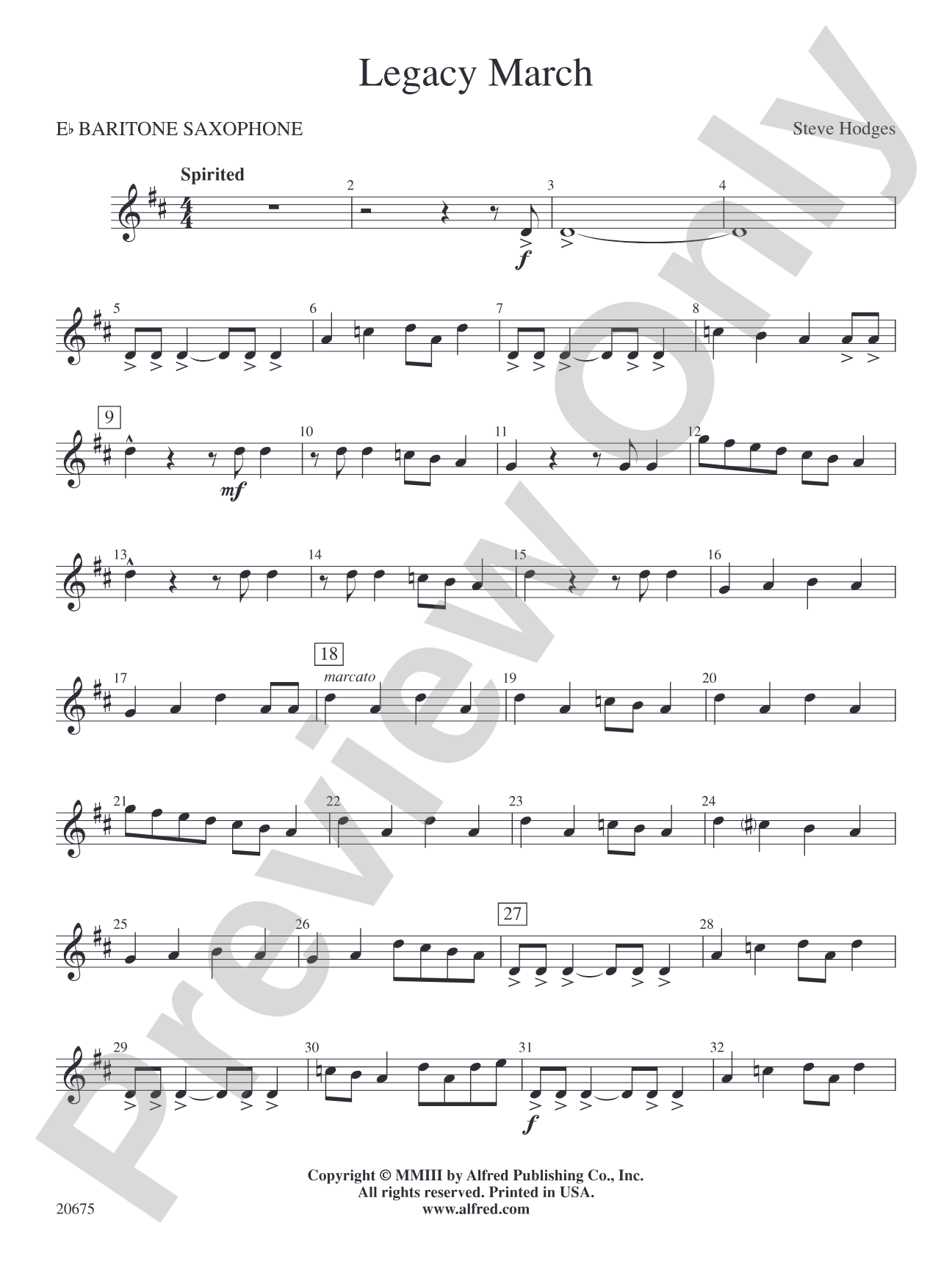

Legacy March: E-flat Baritone Saxophone
By Steve Hodges
Grade: 1.5 (Easy)
Item: 00-PC-0000429_BTX
$3.00
Pickup currently not available
Description
You'll find yourself humming this catchy march over and over! Beginning with a fanfare in the trumpets, horns, and saxophones, the low brass soon enters followed by the woodwinds playing a countermelody. The march tune is introduced by the trumpets and saxes, then turned over to the winds. The B section brings a quieter mood, followed by a return of the A theme with a brief coda that brings the piece to a grandiose conclusion. A fantastic new addition to the march repertoire


Don't just read it, hear it, play along with it, and watch your students grow with it. In MakeMusic Cloud, Legacy March: E-flat Baritone Saxophone comes alive with professional accompaniment, adjustable tempo, and built-in practice tools that turn solo practice into real progress.
Open in the Player
Jump straight in and assign it today.
Start Your Free Trial
Open this title and explore the full library in minutes.
Sample Audio
1
Audio File
--:--
0:00
0:00
Sample Video
No sample videos found.
Additional Details
Series:
Challenger Band Series
Publisher:
Alfred Music
Page Count:
184
SKU:
00-PC-0000429_BTX
More about this title
About the Composer: Steve Hodges

Steve Hodges holds degrees from Western Oregon University (Bachelor of Science) and Central Washington University (Master of Music Education). He spent four decades as a public school music director, leading bands, choirs, and small ensembles across multiple grade levels before retiring from full-time teaching.
Since 1986, Hodges has composed and published over 120 concert band works through Alfred Music, along with choral arrangements for Staff Music and Shawnee Press. His music has appeared at festivals and state conventions worldwide, earned commissions from honor bands and school districts in Virginia, Iowa, Winnipeg, British Columbia, Oregon, Washington, and North Carolina, and reached television audiences through TBS and ESPN. He holds membership in ASCAP and resides in The Dalles, Oregon, where he continues supporting community music alongside his family.
Why we love this
Hodges knows exactly what early-level bands need: a piece that sounds impressive without overwhelming players still building fundamentals. The transparent orchestration and logical sectional progression make this a natural fit for a young ensemble's first concert marches, and the straightforward harmonic language means your students can focus on precision and style rather than decoding complex notation.
What to expect
Bright, purposeful, and instantly memorable. The fanfare grabs attention right away, and the march melody hooks itself into your head. There's a moment of reflection in the B section that gives the piece dimension before returning to triumph, making it feel more substantial than a straight march through.
Who it's for
Beginning and early-intermediate concert bands working at Grade 1.5 level, particularly ensembles preparing their first or second formal concert. This piece sits comfortably for groups still solidifying sectional balance and ensemble blend without demanding advanced rhythmic or harmonic literacy.
How to get the most out of it
- Shape the opening fanfare with clear articulation in the trumpet and horn entrance; this sets the tone for the entire piece and immediately engages your audience.
- Balance the countermelody in the woodwinds against the march tune so both lines sing without either disappearing into the texture.
- Use the B section's quieter mood as an opportunity to demonstrate your band's control at a gentler dynamic; resist the urge to push through just because it's a march.
- Bring real energy to the final coda so the grandiose conclusion feels earned and celebratory rather than rushed.
How to use it
Open a concert with this piece to build confidence and momentum with your audience and performers alike. Its approachable energy pairs well on a program with lyrical selections or classical transcriptions, and it works equally well in a formal concert setting or a community event where accessibility matters.
Skills your students will build
- Clear articulation in fanfare passages and march sections
- Balance between melody and countermelody
- Sectional coordination and tuning in ensemble contexts
- Dynamic control and shaping, particularly in contrasting A and B sections
- Reading full-score instrumentation for concert band