
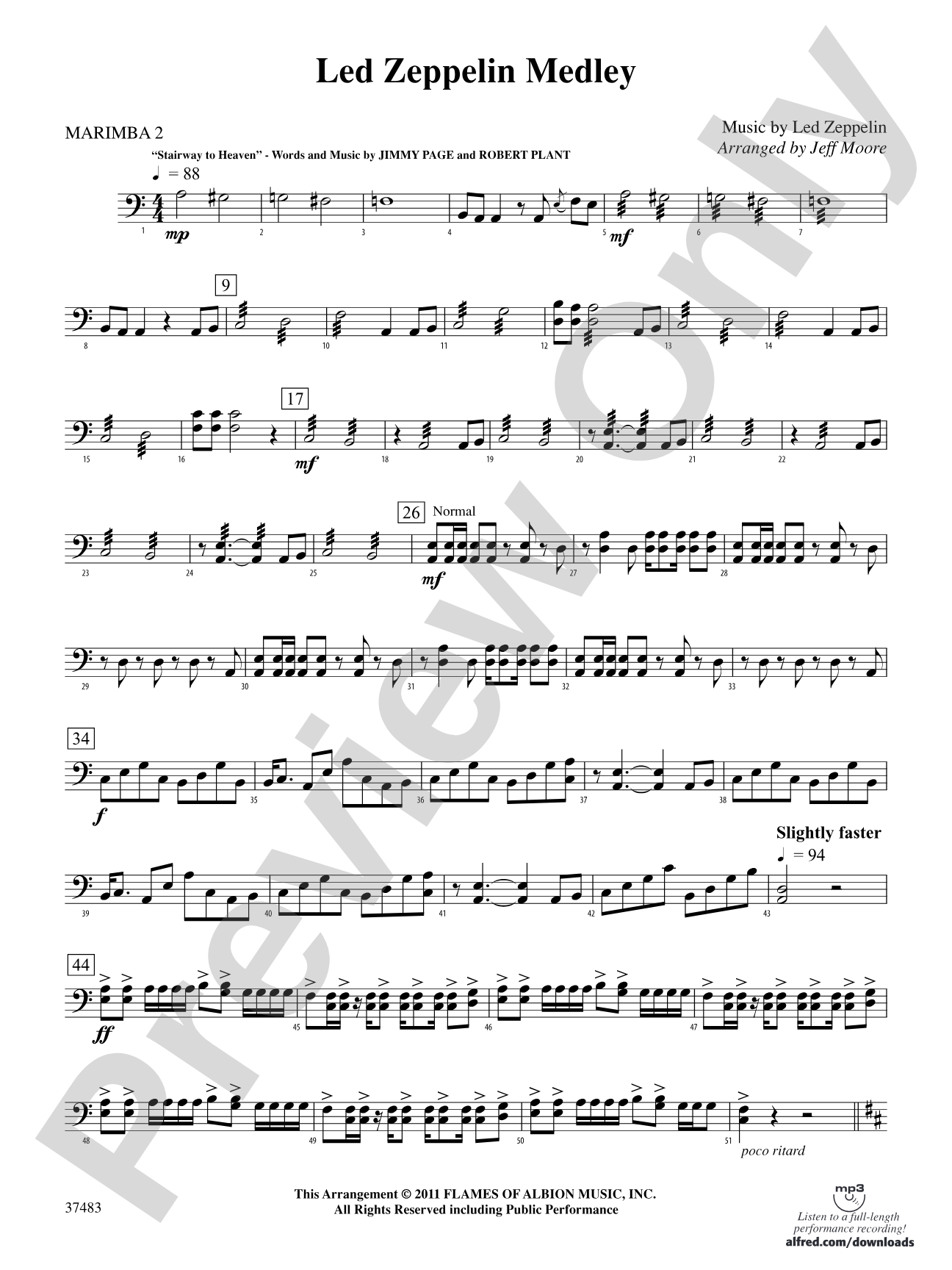

Led Zeppelin Medley: 2nd Mallet Percussion
For Percussion Septet and Bass Guitar
Arr. Jeff Moore
Item: 00-PC-0015785_M2
$3.00
Pickup currently not available
Description
This medley is a tribute to drumming legend John "Bonzo" Bonham and was written to feature the drumset player in a percussion-ensemble setting. Bonham's grooves, fills, and solos are accurately transcribed to provide the performer with the signature sound of Led Zeppelin. The ensemble parts have been arranged to capture the essence of these iconic songs and to provide the drummer with a realistic setting to perform these classic drum parts. If you are looking for a piece to showcase an outstanding drumset performer, you have found it!


Don't just read it, hear it, play along with it, and watch your students grow with it. In MakeMusic Cloud, Led Zeppelin Medley: 2nd Mallet Percussion comes alive with professional accompaniment, adjustable tempo, and built-in practice tools that turn solo practice into real progress.
Open in the Player
Jump straight in and assign it today.
Start Your Free Trial
Open this title and explore the full library in minutes.
Sample Audio
1
Audio File
--:--
0:00
0:00
Sample Video
No sample videos found.
Additional Details
Series:
Alfred's Pop Percussion Ensemble Series
Publisher:
Alfred Music
Page Count:
28
SKU:
00-PC-0015785_M2
More about this title
About the Artist: Led Zeppelin
Led Zeppelin redefined rock music in the 1970s through a potent fusion of blues, folk, and hard rock. Their legacy rests not only on iconic songwriting but on the instrumental prowess of each band member, particularly drummer John Bonham, whose powerful, innovative playing became synonymous with the band's sound and influence across generations of musicians.
Bonham's drumming combined technical precision with raw power and musicality. His ability to drive songs, execute intricate fills, and anchor the band's arrangements while maintaining a deeply personal style made him one of the most studied and emulated drummers in rock history. His work remains essential listening for any percussionist seeking to understand how drums can carry and define a band's identity.
Why we love this
Jeff Moore's arrangement captures the unmistakable character of Bonham's drumming through accurate transcriptions that sit within a full ensemble context. Your drumset player gets to own these grooves and fills in a setting that feels authentic to the originals while building real ensemble skills. This is one of the few rock percussion pieces that honors both the iconic drum parts and the collaborative nature of rehearsal and performance.
What to expect
Raw, groove-driven, and undeniably powerful. The medley captures the swagger and precision of Led Zeppelin's rhythm section, with moments of quiet intensity and explosive fills that keep performers and audiences locked in. This is music that swings and lands with authority.
Who it's for
Percussion ensembles with a strong drumset player who can execute rock grooves, complex fills, and dynamic control with accuracy. This arrangement works equally well in a band program featuring a standout drummer or in a dedicated percussion ensemble looking for accessible, engaging repertoire with real substance.
How to get the most out of it
- Study recordings of the original songs before rehearsal. Bonham's dynamics, ghost notes, and pocket variations are as important as the basic groove, and your drummer will benefit from hearing how these parts sit in the actual arrangements.
- Balance the drumset volume carefully with the ensemble. The point is to feature the drummer, not bury the rest of the group. Let the drumset sit naturally in the texture, allowing fills and solos to cut through without the ensemble losing definition.
- Work the transitions between medley sections deliberately. The shift from one song to another requires ensemble locks on tempo and feels; rehearse section changes as intentionally as you would phrase changes in a classical work.
- Emphasize rhythmic precision from the supporting percussion parts. Bonham's drumming only shines when the ensemble underneath provides a tight, accurate foundation. Clean attacks and releases are essential.
How to use it
Program this for a spring or end-of-year concert when your percussion section is ready to shine. It pairs well alongside classical percussion works, providing a stylistic contrast that energizes the concert experience. The 28-page score also makes it substantial enough to anchor a dedicated percussion feature concert or showcase.
Skills your students will build
- Translating drum kit grooves and fills from notation to performance with stylistic accuracy
- Coordinating multiple percussion parts (mallet percussion, cymbals, and drums) in a rock ensemble context
- Maintaining consistent groove and pocket awareness while executing dynamic variations
- Balancing featured soloist with ensemble support in a non-classical idiom
- Reading and executing rhythmic notation specific to drumset writing (kick drum, snare, hi-hat coordination)