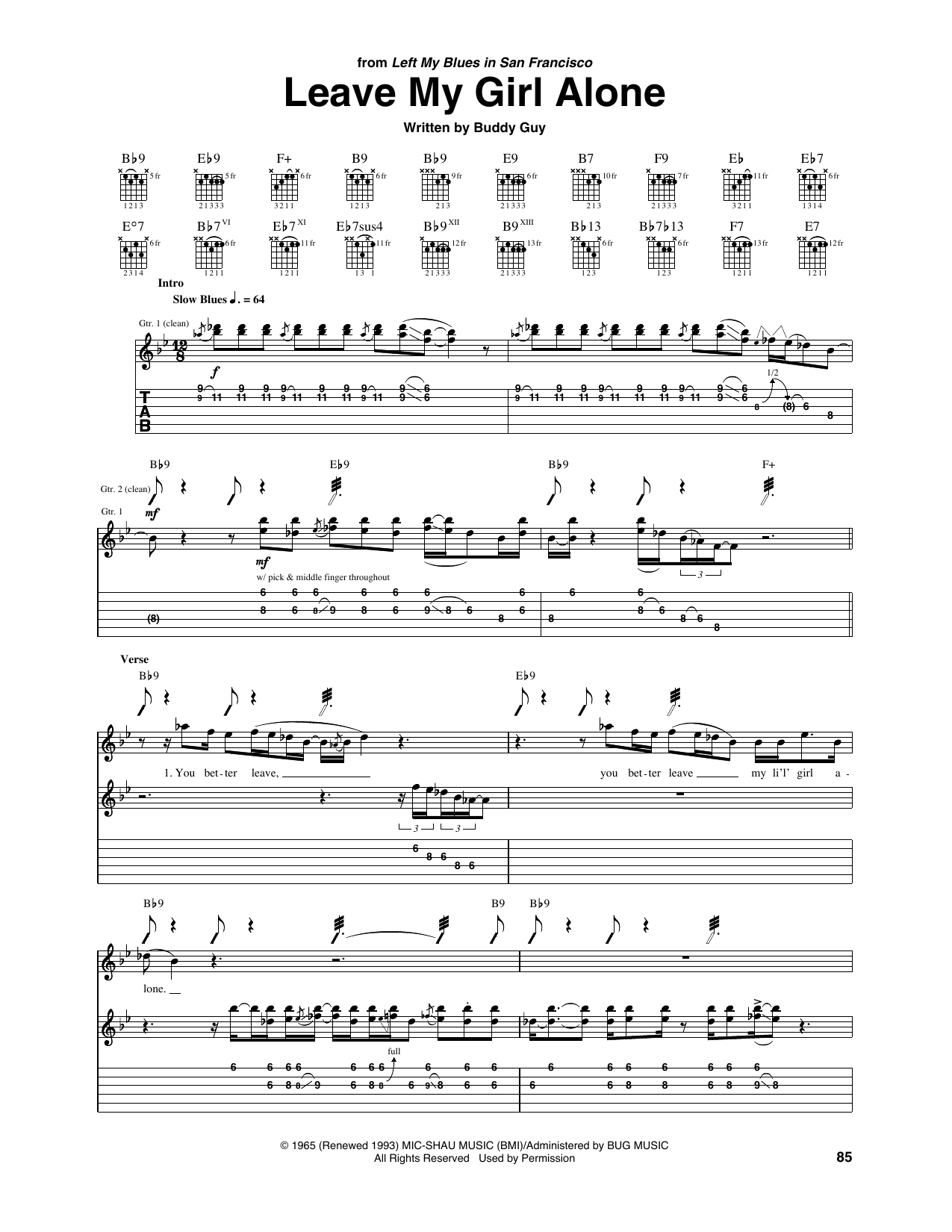
Buddy Guy stands as one of the most influential electric blues guitarists of the modern era, with a career spanning seven decades and counting. His approach to the instrument combined raw emotional expression with technical precision, influencing everyone from Eric Clapton to contemporary players. Guy's willingness to blend blues with rock and jazz elements made him a bridge figure in how these genres cross-pollinated from the 1960s onward.
Why we love this
This collaboration captures three generations of blues rock guitarists tackling the same material, giving students direct access to how different eras and approaches interpret classic blues vocabulary. The tab format makes the variations immediately learnable, and comparing the three versions reveals how phrasing, tone, and rhythmic feel shift while the core blues language remains grounded.
What to expect
Direct, energetic, and conversational. The song moves with confident swagger, built on blues changes that feel both familiar and authoritative. Each take carries the personality of its player: some versions lean into raw power while others favor precision and control, but all maintain that swagger-filled confidence that defines the best blues rock.
Who it's for
Intermediate to advanced guitarists who understand basic blues scales and want to study how professional players interpret the same song across different eras and genres. This is equally valuable for jazz and rock students looking to expand their blues vocabulary beyond their primary style.
How to get the most out of it
Study each version's bending approach separately before attempting them back to back. Buddy Guy's bends often reach pitch from below and hold with subtle vibrato; Stevie Ray Vaughan's tend to be faster and more dramatic. These aren't preferences but teachable technical choices.
Lock the rhythm section feel first. This song depends on groove pocket more than flashy runs. Get comfortable with the underlying shuffle or straight feel before layering in the lead lines.
Pay attention to dynamics and space. The best moments in blues guitar often come from what you don't play. Each artist leaves silence strategically, which is harder to teach than the fast passages but far more musical.
How to use it
Use this as a case study in your guitar curriculum when teaching how the same composition can live in different genre contexts. It works particularly well when covering the connections between classic Chicago blues and 1980s rock guitar, or as part of a unit on interpretation and arrangement.
Skills your students will build
blues scale application across multiple positions
bending techniques and pitch accuracy
rhythm variations and groove pocket feel
comparing stylistic approaches to the same harmonic structure
reading and executing lead lines from tab
You May Also Like
Scan to Complete Your Purchase
Use your phone's camera to scan the code below
You'll log in on your phone and the order will be added to your account