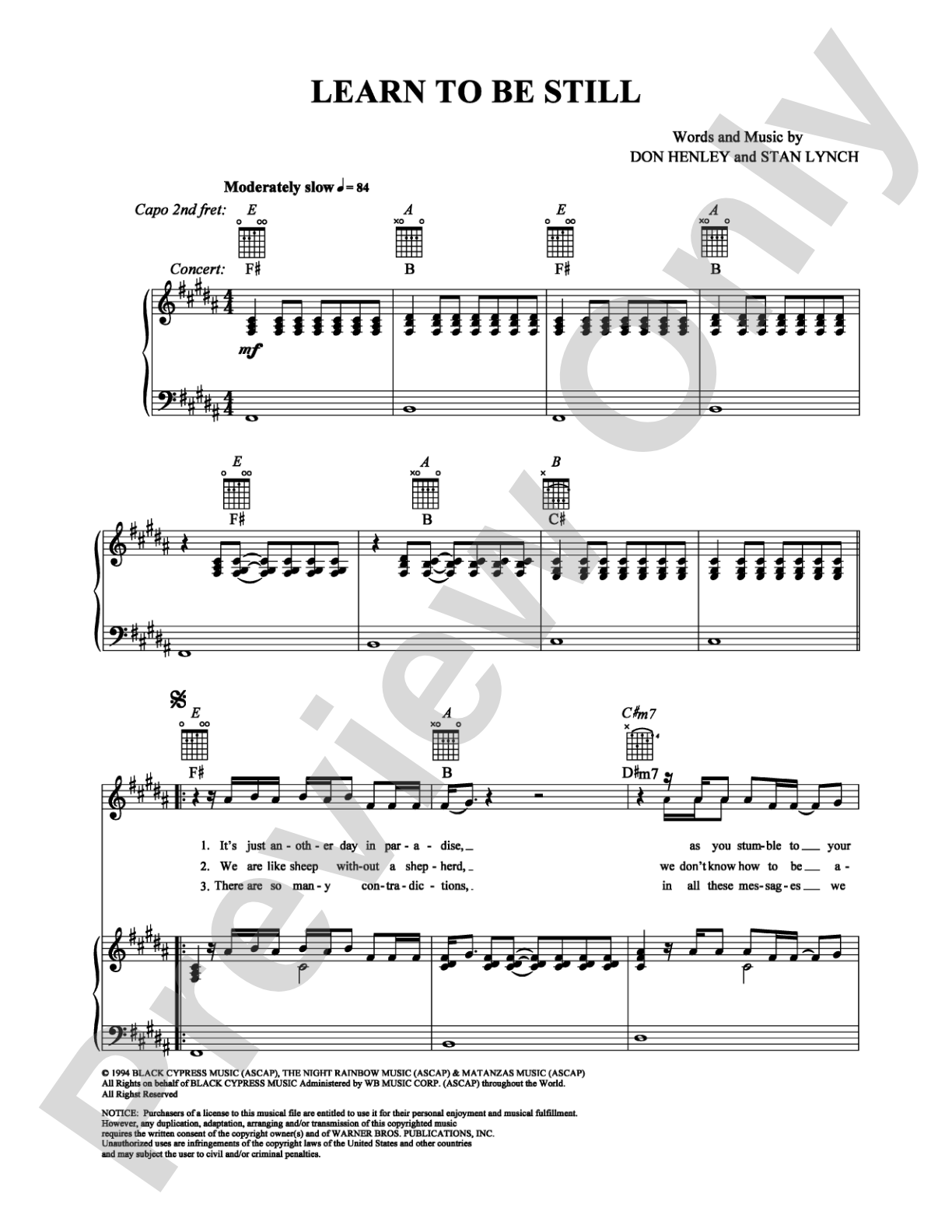
Learn To Be Still: Piano/Vocal/Chords Digital Sheet Music

Learn To Be Still: Piano/Vocal/Chords Digital Sheet Music

Eagles, Don Henley, Stan Lynch

Item: 00-PS-0005989

Digital Download
$3.99
Description

Learn To Be Still: Piano/Vocal/Chords Digital Sheet Music isn't in MakeMusic Cloud just yet...but it could be. Let us know you'd like to see it, and you'll help shape what comes next. In the meantime, start a free trial and dive into thousands of interactive titles your students can play along with today.

Sample Audio
No sample audio found.
Sample Video
Additional Details
SKU: 00-PS-0005989

More about this title

About the Artist: Eagles

The Eagles redefined rock music in the 1970s, crafting some of the era's most enduring harmonies and storytelling. Their ability to blend country influences with rock sensibility created a sound that appealed across radio formats and remains central to American popular music canon.

For music educators, the Eagles' catalog offers accessible entry points into sophisticated song construction. Their arrangements reward attention to voice leading, chord movement, and the interplay between melody and accompaniment—all skills that transfer directly to classical study and ensemble musicianship.

Why we love this

This song sits in a sweet spot for singers developing interpretive skills without excessive technical demands. The piano voicing supports a conversational vocal approach, making it ideal for students learning how to shape lyrical content with musical choices rather than vocal pyrotechnics.

What to expect

Measured and introspective, with a meditative quality that rewards singers who listen to their own storytelling. The harmonic language is lush without being overwrought, creating space for vulnerability and genuine connection to the text.

Who it's for

Singers and pianists working at intermediate levels who want to develop interpretive nuance and understand how accompaniment shapes a vocal performance. Teachers programming contemporary music alongside art song or musical theater can use this to bridge student familiarity with rigorous musicality.

How to get the most out of it

  • Balance the vocal line with piano accompaniment by letting the melody breathe in space; resist filling every moment with sound, especially in early verses.
  • Work the chord changes deliberately in the left hand so listeners hear the harmonic movement that supports the emotional arc of the lyrics.
  • Establish a conversational tempo at rehearsal and stick with it; this song lives in restraint rather than momentum.
  • Pay attention to where the vocal melody sits relative to the piano's right-hand voicings to avoid muddiness, particularly during fuller arrangements.

How to use it

Pair this with American songwriting standards or contemporary pop repertoire in a recital exploring how modern songs employ classical song principles. It works equally well as a standalone piece for piano students learning to accompany or as a vocal recital staple for intermediate singers building a diverse and engaging set.

Skills your students will build

  • Phrasing lyrical text with musical sensitivity
  • Reading and playing seventh chords and extended harmonies
  • Balancing vocal melody with piano accompaniment
  • Sustaining legato line across chord changes
  • Interpreting style and tempo without excessive notation

You May Also Like