Kirby Shaw's influence spans choral music education across North America, Europe, Australia, and beyond. With formal training in music education, choral composition, and conducting from San Jose State University and the University of Washington, he has brought this expertise to public school classrooms, community colleges, and university programs. His work founding and directing acclaimed vocal jazz ensembles at multiple institutions reflects his conviction that singers thrive when learning is paired with genuine musical joy.
As a composer and arranger, Shaw has created over 2500 works that have sold nearly 20 million copies worldwide. His catalog reflects decades of understanding what works in rehearsal and what resonates with singers and audiences alike. Beyond his prolific compositional output and numerous ASCAP awards, Shaw remains actively engaged in performance and education, currently directing the Jefferson State Choral Coalition at Southern Oregon University while continuing to mentor musicians across multiple idioms.
Why we love this
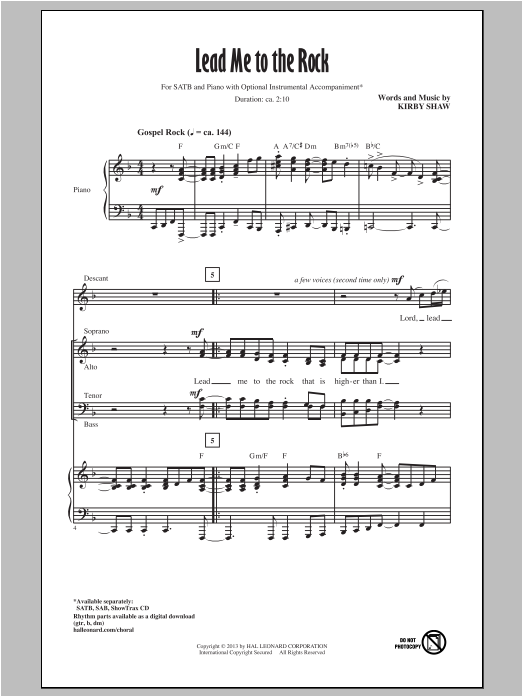
Shaw's arrangement honors the spiritual depth of this text while remaining accessible to mixed choirs of moderate ability. The four-part writing balances soloistic moments with powerful unison sections, giving every voice a meaningful role without requiring virtuosic singers. What makes this standout is Shaw's instinct for emotional pacing; he knows exactly when to pull back and when to build, making the arrangement feel inevitable rather than arbitrary.
What to expect
The arrangement unfolds with quiet conviction, inviting singers and listeners into a moment of genuine reflection. There's a balance between the vulnerability of seeking and the steadiness of faith that gives the piece an emotional anchor. Shaw's writing feels both contemporary in sensibility and timeless in its appeal.
Who it's for
This works beautifully for sacred choral programs, church services, and concert settings serving intermediate to advanced mixed choirs. It fits equally well in school choirs seeking substantial repertoire with spiritual substance and in community or volunteer ensembles wanting material that deepens musicianship without excessive difficulty.
How to get the most out of it
Find the gentleness in the opening phrases. This text calls for reverence, not volume. Let the SATB blend be about clarity and warmth rather than blend-at-all-costs.
Pay attention to where the arrangement shifts register or voicing. These transitions are Shaw's roadmap for emotional arc; honor them as deliberate compositional choices rather than technical hurdles.
Shape phrases toward natural language stress, not just musical stress. The words 'Lead me to the rock' carry their own weight; don't overpower the text with unnecessary dynamic swells.
How to use it
Consider programming this as an anchor piece for a sacred or contemplative concert section, where it can stand alongside both traditional hymnic material and more contemporary sacred works. It also serves as an excellent choice for commissioning a commissioning service, funeral program, or healing-focused community event, offering singers and audiences a moment of genuine connection without requiring extended concert time.
Skills your students will build
Balancing soloistic clarity with ensemble blend in mixed voicing
Interpreting text-driven phrasing in sacred music
Managing dynamic contrast across four-part harmony
Sustaining emotional authenticity in reverent repertoire
You May Also Like
Scan to Complete Your Purchase
Use your phone's camera to scan the code below
You'll log in on your phone and the order will be added to your account