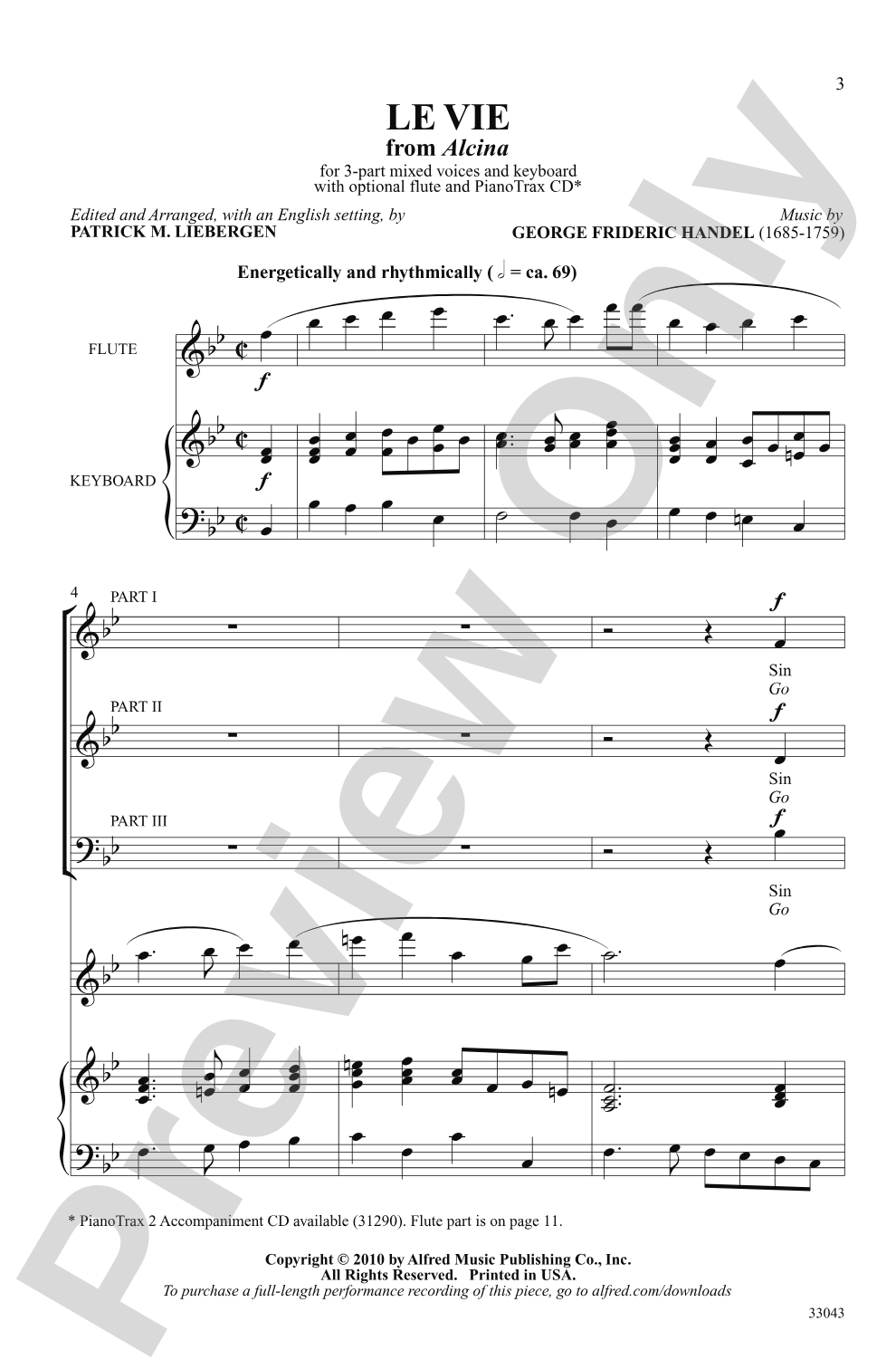
Le Vie (from <i>Alcina</i>) Sheet Music Preview

Le Vie (from Alcina): 3-Part Mixed Choral Octavo

From Alcina

Music by George Frideric Handel / ed. and arr., with English setting, Patrick M. Liebergen

Item: 00-PO-0000859

Digital Download
$1.75

Minimum order quantity: 20 copies

Description
This Handel opera chorus is a perfect fit for 3-part mixed choirs. Each forte phrase is softly echoed, and a graceful flute dances above. A quick learn in either English or Italian. Accompaniment available on PianoTrax 2 CD (00-31290).

Le Vie (from Alcina): 3-Part Mixed Choral Octavo isn't in MakeMusic Cloud just yet...but it could be. Let us know you'd like to see it, and you'll help shape what comes next. In the meantime, start a free trial and dive into thousands of interactive titles your students can play along with today.

Sample Audio
0:00
0:00
Sample Video
Additional Details
Series: Alfred Choral Designs
Publisher: Alfred Music
Page Count: 12
SKU: 00-PO-0000859

More about this title

About the Composer: George Frideric Handel

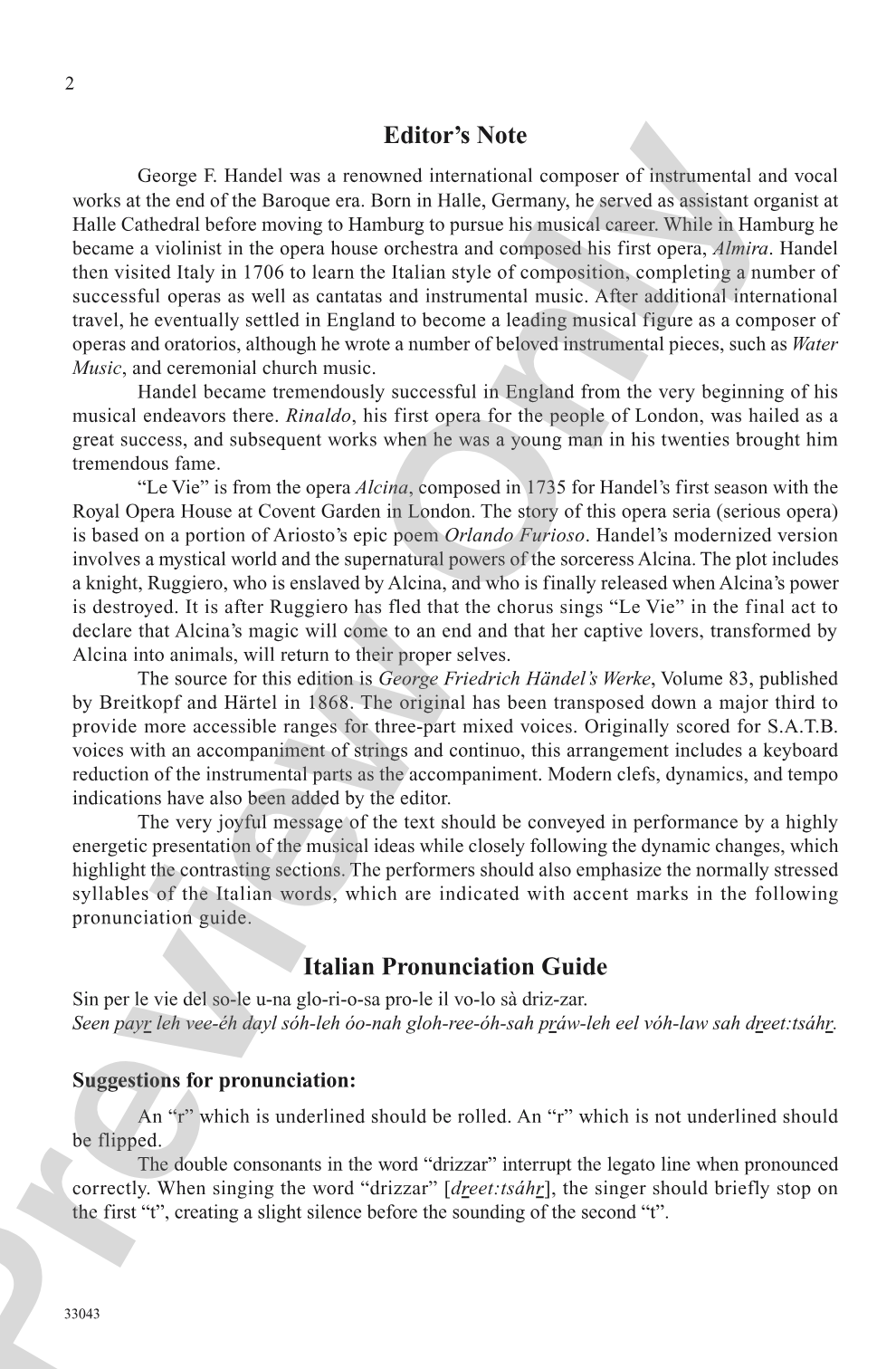
George Frideric Handel (1685-1759) was a German-born composer who spent most of his career in England, where he became one of the most celebrated figures in Baroque music. He wrote more than 40 operas, numerous oratorios, and instrumental works that defined the sound of the era and continue to anchor concert repertoires worldwide.

Handel's theatrical works showcase his gift for melody and dramatic pacing. His opera choruses, in particular, blend accessibility with genuine musical sophistication, making them ideal for choral ensembles seeking repertoire that challenges singers without overwhelming them. His music remains central to music education because it teaches clear voice leading, phrase architecture, and the expressive power of counterpoint.

Why we love this

Liebergen's arrangement preserves the opera's theatrical energy while scaling it perfectly for developing mixed choirs. The echo structure (forte followed by soft repetition) creates immediate musical drama without requiring complex interpretation, and the optional flute part adds elegance that doesn't depend on having advanced singers.

What to expect

Bright and theatrical, with a playful character that never descends into cuteness. The echo device creates a conversational quality, as if the choir is in dialogue with itself. The optional flute adds a touch of courtly elegance without becoming precious.

Who it's for

Three-part mixed choirs (SAB voicing) at the intermediate level will find this a natural fit. Directors seeking standalone Baroque material for festivals, concerts, or all-school events have a quick-learning piece that sounds far more polished than the rehearsal time required.

How to get the most out of it

  • Balance the forte-echo relationship carefully. The repeated phrase should feel like a musical response, not a diminished restatement. Use dynamic contrast to make the echo feel intentional rather than merely quieter.
  • Shape the melodic line across the full phrase rather than treating each segment in isolation. Baroque phrasing benefits from a sense of forward motion even within the echo passages.
  • If including the flute obbligato, ensure it doesn't overwhelm the choral sound. The instrumental line should complement and enhance the voices, not compete for attention.
  • Work rhythmic precision early, especially where voices enter at staggered moments. Handel's counterpoint depends on clean articulation to sound clean rather than muddy.

How to use it

This works as a strong mid-program piece on a choral concert, offering a stylistic contrast to contemporary or romantic fare. It also fits well in a Baroque-themed program or a program exploring opera across different eras, where it serves as an accessible entry point into operatic writing.

Skills your students will build

  • Baroque phrasing and articulation
  • Dynamic contrast and terraced dynamics
  • Balancing solo passage work with tutti sections
  • Reading three-part mixed voicing
  • Singing with clear diction in both Italian and English
  • Responding to instrumental accompaniment and obbligato lines

You May Also Like