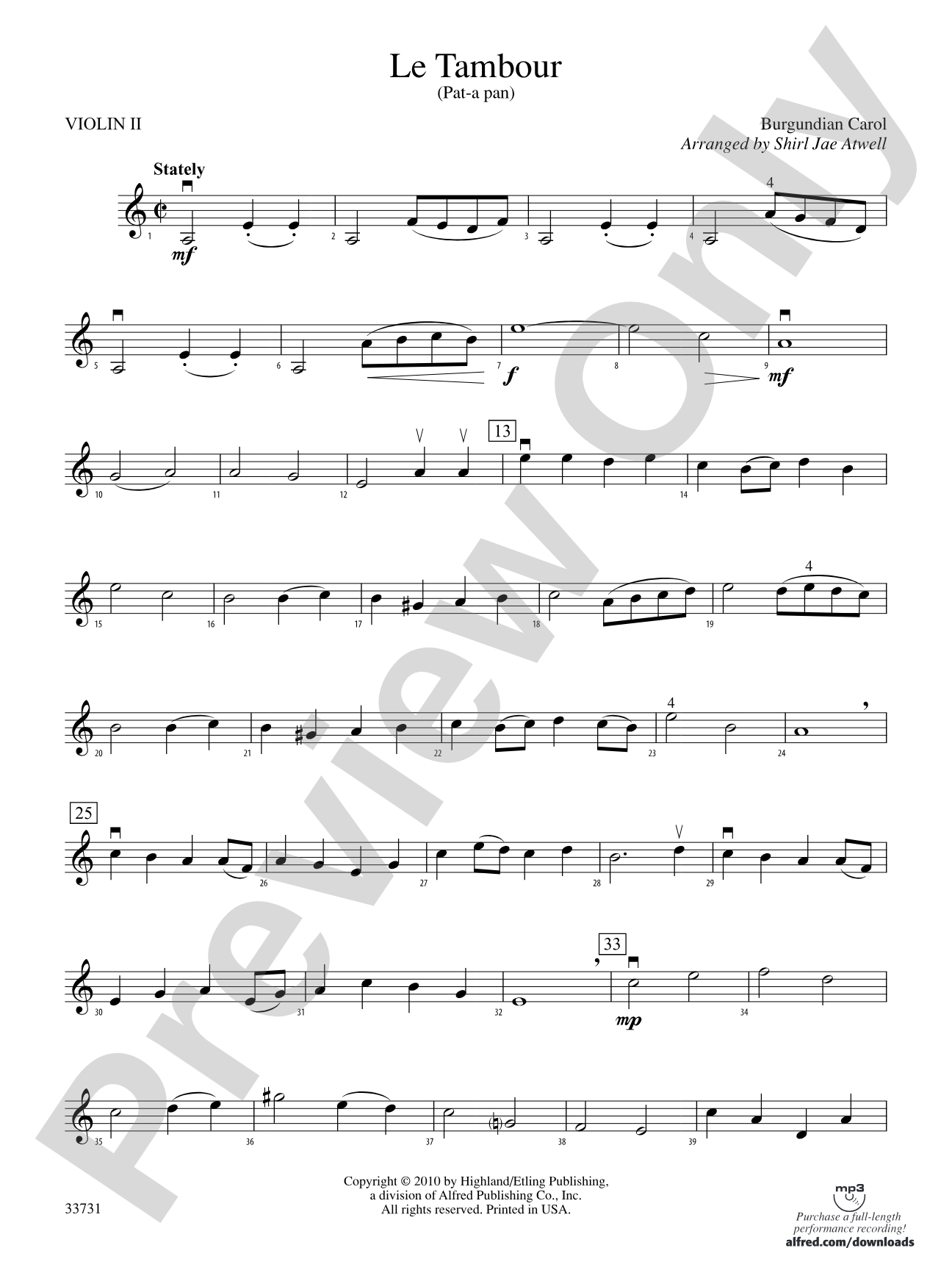
Le Tambour (Pat-a-Pan): 2nd Violin Sheet Music Preview

Le Tambour (Pat-a-Pan): 2nd Violin

Burgundian Carol / arr. Shirl Jae Atwell

Grade: 2.5

Item: 00-PC-0014516_VN2

Digital Download
$5.99
Description
In the tradition of 17th century Burgundian carols, the overall character of this piece is homophonic with strong rhythm underneath. A beautiful addition to any holiday concert!

Don't just read it, hear it, play along with it, and watch your students grow with it. In MakeMusic Cloud, Le Tambour (Pat-a-Pan): 2nd Violin comes alive with professional accompaniment, adjustable tempo, and built-in practice tools that turn solo practice into real progress.

Sample Audio
0:00
0:00
Sample Video
Additional Details
Series: Highland/Etling String Orchestra
Publisher: Alfred Music
Page Count: 124
SKU: 00-PC-0014516_VN2

More about this title

About the Arranger: Shirl Jae Atwell

Shirl Jae Atwell

Shirl Jae Atwell studied composition at the University of Louisville, where she earned her Master of Music Theory/Composition degree, and continued advanced work in composition at the University of South Carolina. Her orchestral and operatic works have been performed across the United States, from the Louisville Ballet's premiere of her ballet Lucy in 1999 to multiple premieres by regional orchestras and school ensembles.

Atwell's compositions have earned significant recognition, including the 1984 Clifford Shaw Memorial Award for Kentucky Composers, a 1996 National School Orchestra Association composition contest win, and a 1997 Texas Orchestra Directors Association award. Her string orchestra piece Modus á Four and several other scores are held in the permanent collection of the Paris Bibliothèque Internationale de Musique Contemporaine. The televised production of Lucy received an Emmy Award for Arts and Culture in 2000 from the Ohio Valley Chapter of the National Academy of Television Arts and Sciences.

Why we love this

This arrangement brings a beloved carol into the string orchestra idiom with authentic harmonic language grounded in 17th century tradition. The strong rhythmic foundation keeps young players engaged while the homophonic texture allows every section to contribute meaningfully to the overall sound, making it both musically satisfying and manageable at Grade 2.5.

What to expect

Warm and processional, with the rhythmic vitality of a community celebration. The piece carries the spirit of a traditional carol while the steady pulse underneath gives it forward momentum and festive energy.

Who it's for

String orchestra directors seeking accessible holiday repertoire that connects to historical traditions while remaining engaging for young players. This arrangement works equally well for middle school orchestras and advanced elementary ensembles looking for substantial seasonal material.

How to get the most out of it

  • Establish the rhythmic pulse clearly in rehearsal before focusing on line; the steady foundation underneath carries this piece and requires precision from the rhythm section and lower strings.
  • Shape the melodic phrases gently despite the homophonic texture; avoid letting the strong rhythm flatten the singing quality of the tune.
  • Balance the divisi passages so that no section overwhelms the others; this carol works best when all voices blend into a unified sound rather than standing apart.
  • Consider the acoustic of your venue when setting tempo; this piece benefits from space for the sustained tones to resonate without rushing the rhythm.

How to use it

Program this as a standalone holiday piece or pair it with other seasonal offerings to create a cohesive winter concert segment. The Grade 2.5 level and 124 pages of parts make it practical for orchestras seeking music that fills rehearsal time and concert time without excessive complexity.

Skills your students will build

  • Sustaining tone quality within a homophonic texture
  • Reading and executing rhythmic patterns with consistency across multiple parts
  • Playing divisi passages with balance and awareness of blend
  • Responding to historical musical traditions through performance

You May Also Like