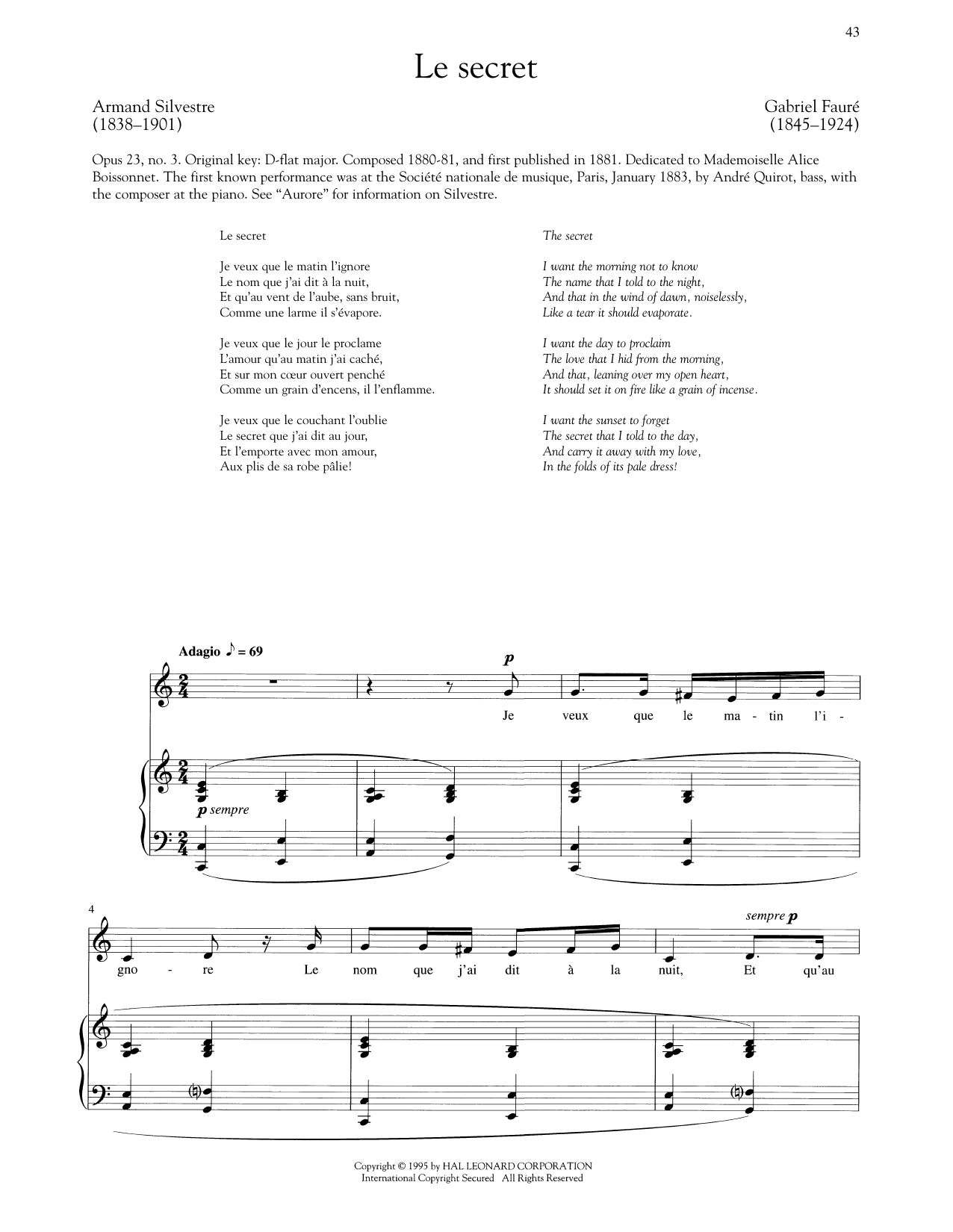
Le Secret (Low Voice) Sheet Music Preview

Le Secret (Low Voice): Piano Vocal

By Gabriel Fauré

Item: 35-DS01827455

Digital Download
$5.99
Description

Le Secret (Low Voice): Piano Vocal isn't in MakeMusic Cloud just yet...but it could be. Let us know you'd like to see it, and you'll help shape what comes next. In the meantime, start a free trial and dive into thousands of interactive titles your students can play along with today.

Sample Audio
No sample audio found.
Sample Video
Additional Details
Publisher: Hal Leonard
Page Count: 3
SKU: 35-DS01827455

More about this title

About the Composer: Gabriel Fauré

Gabriel Fauré (1845-1924) shaped French musical language through decades of innovation in song, chamber music, and orchestral writing. His harmonic language, marked by subtle chromaticism and unexpected tonal shifts, influenced generations of composers and remains central to understanding early twentieth-century music.

As a pedagogue, Fauré directed the Paris Conservatoire and mentored many of France's most important musicians. His output of nearly one hundred songs demonstrates his mastery of setting French text with psychological depth and formal sophistication, making his vocal works invaluable for understanding the art song tradition.

Why we love this

Fauré's melodic gift shines in this intimate setting, where a deceptively simple vocal line conceals harmonic richness beneath. The piano part rewards careful listening and provides genuine musical partnership rather than mere accompaniment, making it rewarding for both singer and pianist to rehearse seriously.

What to expect

Quiet revelation emerges from restraint. The harmonic language murmurs beneath a gentle vocal surface, creating intimacy without sentimentality. This is music that breathes in close quarters, rewarding absolute attention with moments of unexpected emotional clarity.

Who it's for

Solo vocalists preparing auditions, recitals, or concert repertoire will find this a touchstone of the French mélodie tradition. Pianists seeking chamber music that demands real musicianship will appreciate the sophisticated accompaniment. Students of song literature benefit from studying how Fauré balances textual intimacy with formal coherence.

How to get the most out of it

  • Shape the vocal line with long-lined phrasing; resist breaking at every rest. The melody gains power through continuity, even when the accompaniment suggests fragmentation.
  • Balance the singer's projection so the text remains clear without oversinging. This song thrives in chamber acoustics and dies under forced volume.
  • Listen closely to the piano's harmonic movement, especially where Fauré shifts expectantly. The accompanist should bring out inner voices that guide the harmonic journey.
  • Attend to the French text's natural vowel colors and consonant clarity. Fauré's setting responds to authentic French diction with immediate musical payoff.

How to use it

Include this in a recital pairing French song literature, perhaps alongside works by Debussy or Duparc for a cohesive exploration of the mélodie. Solo voice and piano concerts gain genuine weight from Fauré's artistic stature and the work's substantive musical content. Vocal students benefit from performing it in studio class as a model of economy and sophistication.

Skills your students will build

  • Interpreting French text with authentic vowel colors and liaison
  • Sustaining long melodic lines without phrase breaks
  • Reading and responding to chromatic harmonic movement
  • Ensemble listening and balance between voice and piano
  • Analyzing formal structure within intimate song design

You May Also Like