
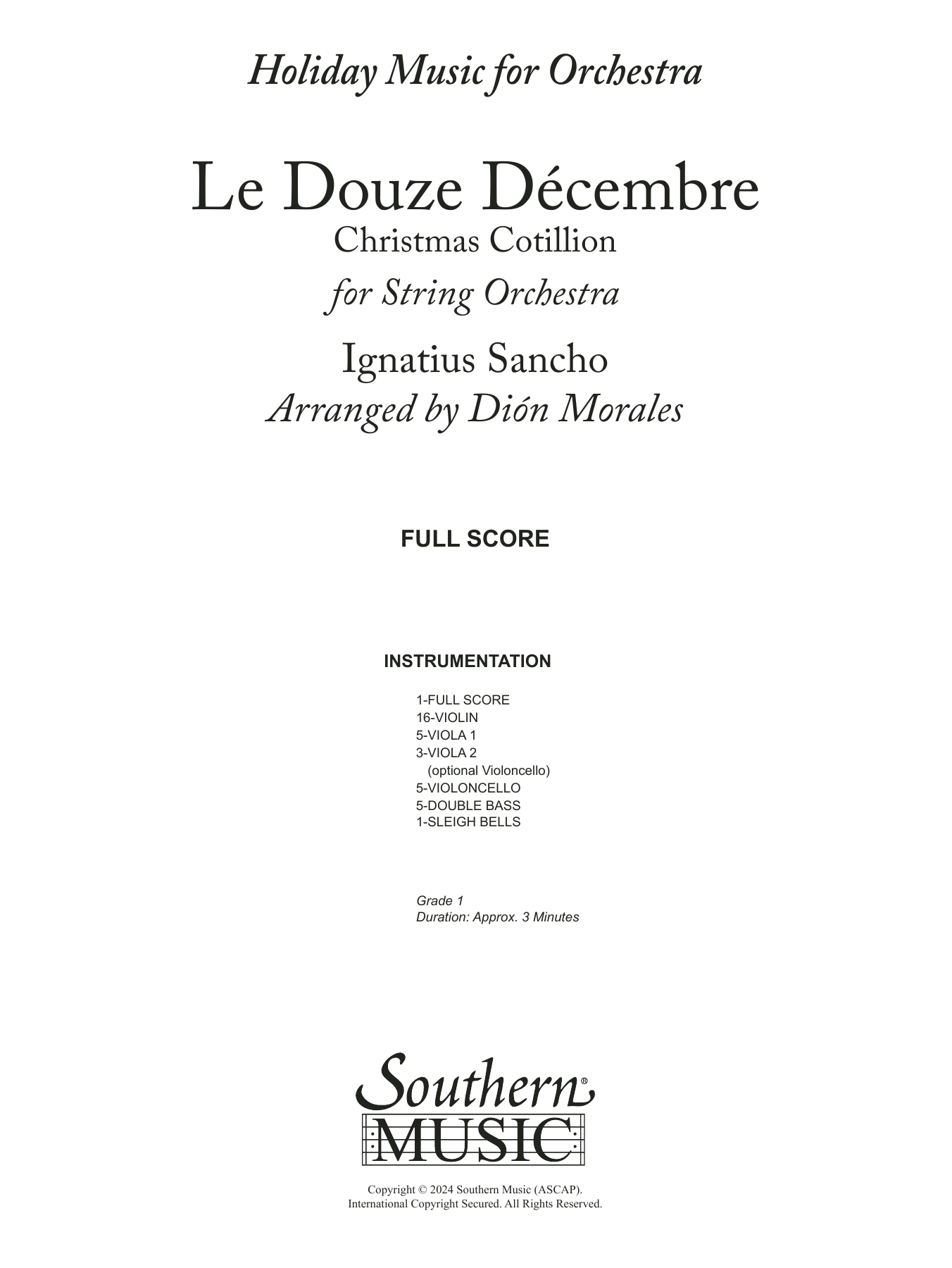

Le Douze Decembre: Christmas Cotillion (arr. Dion Morales): String Orchestra Conductor Score & Parts
By Ignatius Sancho / Arranged by Dion Morales
Grade: 1
Item: 35-PK01723599
$40.00
Pickup currently not available
Buy Extra Parts (Digital PDF Download)
Parts Added to Cart!
Description
Sancho's original DOUZE DE DÉCEMBRE is one of two holiday themed dances he included in his collection. It was originally written to be played by an unaccompanied keyboard instrument. Like most of the dances in this collection, he included the dance moves that he choreographed specifically for this piece. The dance, which involves 8 people, has 4 people doing a specific dance (allemande) and the other 4 doing a different dance (chasse). The 2 groups then trade choreography for the second half of the song.


Le Douze Decembre: Christmas Cotillion (arr. Dion Morales): String Orchestra Conductor Score & Parts isn't in MakeMusic Cloud just yet...but it could be. Let us know you'd like to see it, and you'll help shape what comes next. In the meantime, start a free trial and dive into thousands of interactive titles your students can play along with today.
Request This Title
Tell us you want it.
Start Your Free Trial
Explore everything that's ready to play right now.
Sample Audio
No sample audio found.
Sample Video
No sample videos found.
Additional Details
Publisher:
Hal Leonard
SKU:
35-PK01723599
More about this title
About the Composer: Ignatius Sancho
Ignatius Sancho (1729-1780) was an accomplished composer and keyboard virtuoso whose work bridged European classical traditions with the musical life of 18th-century London. Born in West Africa, he became one of the most documented Black musicians of his era, earning recognition for his compositions, letters, and cultural contributions. His dance collection, which includes Le Douze Décembre, reflects the social music-making practices of Georgian society, where instrumental pieces were inseparable from their choreographic life.
Sancho's approach to composition was distinctive in its inclusion of detailed dance instructions. Rather than writing dances as abstract musical forms, he choreographed them specifically for social occasions, creating a complete artistic vision. This integration of music and movement makes his collection invaluable for understanding how instrumental music functioned in ensemble settings of his time.
Why we love this
This arrangement brings accessible 18th-century social music into the modern string orchestra, offering your students something genuinely different from typical holiday fare. Morales's orchestration maintains the elegance of Sancho's keyboard original while creating an engaging Grade 1 piece that sounds mature and purposeful rather than simplified. The built-in choreography opens possibilities for cross-curricular collaboration or a concert presentation that moves beyond traditional seated performance.
What to expect
Elegant and lively, with the refined charm of a Georgian ballroom. The piece moves with graceful momentum, inviting the listener into a social world of structured yet joyful movement. There is lightness throughout, never heavy or overly sentimental, which gives it a fresh quality that holiday audiences will appreciate.
Who it's for
String orchestras at the early intermediate level seeking quality holiday repertoire that goes beyond the usual suspects. Directors working with Grade 1 ensembles want pieces that sound polished and purposeful; this arrangement delivers exactly that while introducing students to a fascinating historical composer.
How to get the most out of it
- Emphasize the clarity of the two contrasting dance sections. The alternation between allemande and chasse gestures should come through in your articulation and phrasing; use subtle dynamic shaping to distinguish the groups' material.
- Balance the string parts carefully so neither melody nor accompaniment dominates. At Grade 1, students often struggle with textural balance; mark your parts to show which voices carry the primary line in each section.
- Keep the tempo steady and dance-like. This piece requires rhythmic precision without rushing; a consistent pulse will help younger players lock in together.
- Consider staging the choreography mentioned in the program notes as an educational or concert feature. Even a simple representation of the trade-off between groups adds visual interest and deepens students' understanding of the piece's original context.
How to use it
Include this in a December concert that explores how different cultures and historical periods have celebrated the season. It pairs naturally with other dances or with instrumental pieces from the Baroque and Classical periods. The choreographic element also makes it a strong choice for a thematic concert about music and movement, or for educational demonstrations about how musicians once performed.
Skills your students will build
- Sustaining steady pulse in a dance context
- Balancing melody and accompaniment across multiple string parts
- Executing Baroque articulation and ornamentation appropriate to 18th-century style
- Responding to clear sectional structure and phrasing
- Coordinating ensemble entrances and transitions between contrasting musical ideas