
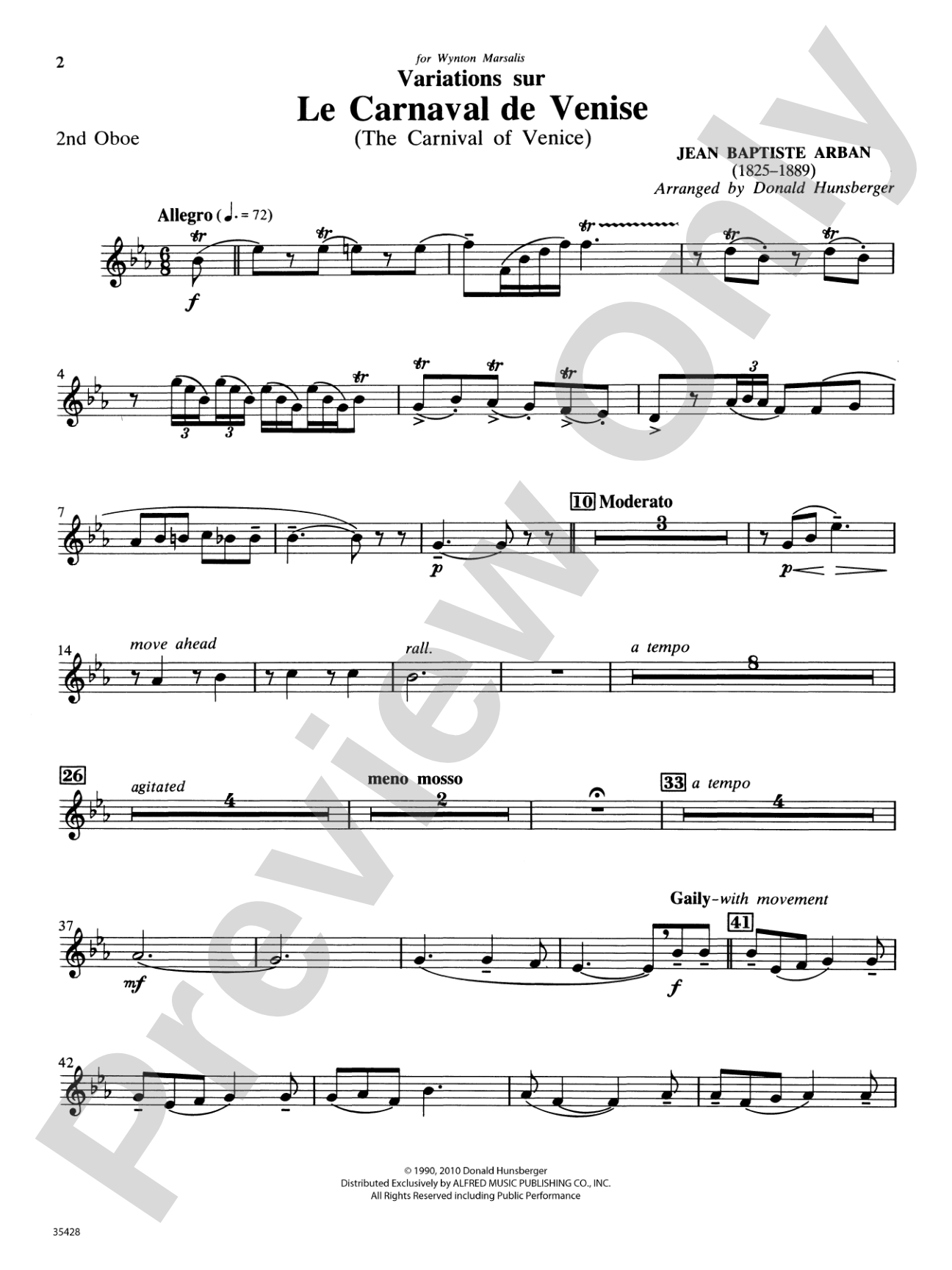

Le Carnaval de Venise: 2nd Oboe
For Wynton Marsalis (Trumpet Solo with Band)
By Jean Baptiste Arban / arr. Donald Hunsberger
Grade: 3 (Medium Easy)
Item: 00-PC-0014952_O2
$3.00
Pickup currently not available
Description
Celebrating 25 years, Alfred's recently acquired Carnaval project is an epic collection of eleven solos, crafted by Hunsberger himself for Wynton Marsalis. Translated, "The Carnival of Venice," this work celebrates the longtime Venetian festival that is held prior to Easter and provides celebrations, and parties with elaborate costumes and disguises. (7:30)


Le Carnaval de Venise: 2nd Oboe isn't in MakeMusic Cloud just yet...but it could be. Let us know you'd like to see it, and you'll help shape what comes next. In the meantime, start a free trial and dive into thousands of interactive titles your students can play along with today.
Request This Title
Tell us you want it.
Start Your Free Trial
Explore everything that's ready to play right now.
Sample Audio
No sample audio found.
Sample Video
No sample videos found.
Additional Details
Series:
Donald Hunsberger Wind Library
Publisher:
Alfred Music
Page Count:
260
SKU:
00-PC-0014952_O2
More about this title
About the Composer: Jean Baptiste Arban
Jean Baptiste Arban (1825–1889) was a French cornet virtuoso and pedagogue whose technical innovations transformed brass playing in the 19th century. His method book remains foundational to trumpet and cornet instruction, and his compositions for brass instruments established a standard for brilliance, clarity, and musical elegance that still defines the genre. Arban's writing celebrates the technical capabilities of brass players while maintaining strong melodic content and harmonic interest, qualities that have kept his works central to concert band and brass ensemble repertoires.
Why we love this
Donald Hunsberger's arrangement captures the spectacle and virtuosity of Arban's original concept while reshaping it for the full concert band ensemble. The orchestration brings out character voices throughout the section, making this not merely a solo vehicle but a collaborative celebration where every musician has something rewarding to play. At Grade 3, it remains genuinely playable for developing bands while maintaining the festive energy and technical sparkle that makes Arban's music so engaging for audiences.
What to expect
Imagine the pageantry and revelry of the Venetian Carnival translated into sound. There is ornament and flourish throughout, masked rhythmic energy, brilliant passages that catch the light, and moments of genuine lyricism that emerge from the festive context. The whole ensemble becomes part of the celebration, supporting a virtuoso voice with harmonic richness and rhythmic momentum.
Who it's for
This score and parts package serves conductors leading concert bands at the high school or early college level who want to feature a strong soloist while engaging the full ensemble. It works equally well for directors seeking repertoire that combines technical interest for advancing players with accessibility for the broader section, and for programs looking to celebrate a specific soloist's capabilities within a musically substantial work.
How to get the most out of it
- Establish the conductor's role as an animator of the carnival atmosphere. This work thrives on clear, energetic conducting that propels the ensemble through the celebratory passages and balances solo moments with ensemble support.
- Balance the featured soloist's brilliance against the ensemble backdrop. The full parts shouldn't overshadow the solo line, so encourage the section players to listen actively and respond to the soloist's phrasing and interpretation.
- Shape the harmonic progression underneath the flashy figures. The solo passages sit atop rich harmonic movement; having the ensemble understand their role in the overall architecture keeps performances cohesive rather than scattered.
- Attend to articulation clarity in ensemble passages. Arban's writing favors crisp, well-defined attacks that contribute to the work's sparkle and momentum, especially in the supporting lines.
How to use it
This work excels as a centerpiece in a concert program where you want to feature a principal soloist and demonstrate the full ensemble's musicianship. It pairs well with other character pieces or Masterwork arrangements, and its 7:30 duration makes it substantial enough to anchor a section without consuming an entire concert. Consider programming it near the middle of a concert to capitalize on the audience energy it generates.
Skills your students will build
- Listening and responding to solo line direction while maintaining ensemble cohesion
- Reading articulation and rhythmic figures at a brisk tempo with precision
- Supporting a featured soloist with balanced harmonic and rhythmic accompaniment
- Executing the characteristic ornamental figures and figurations typical of 19th-century virtuoso writing