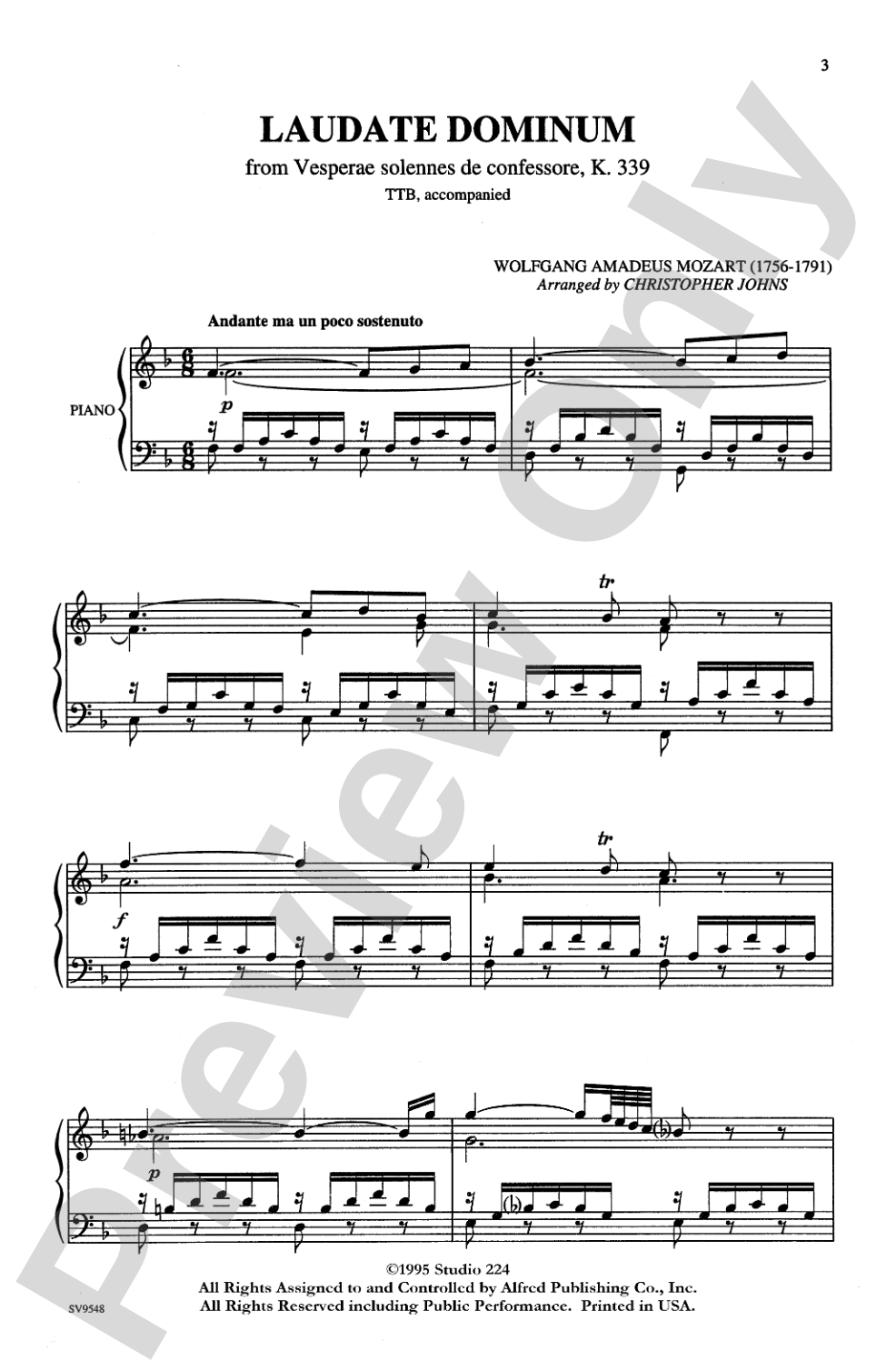
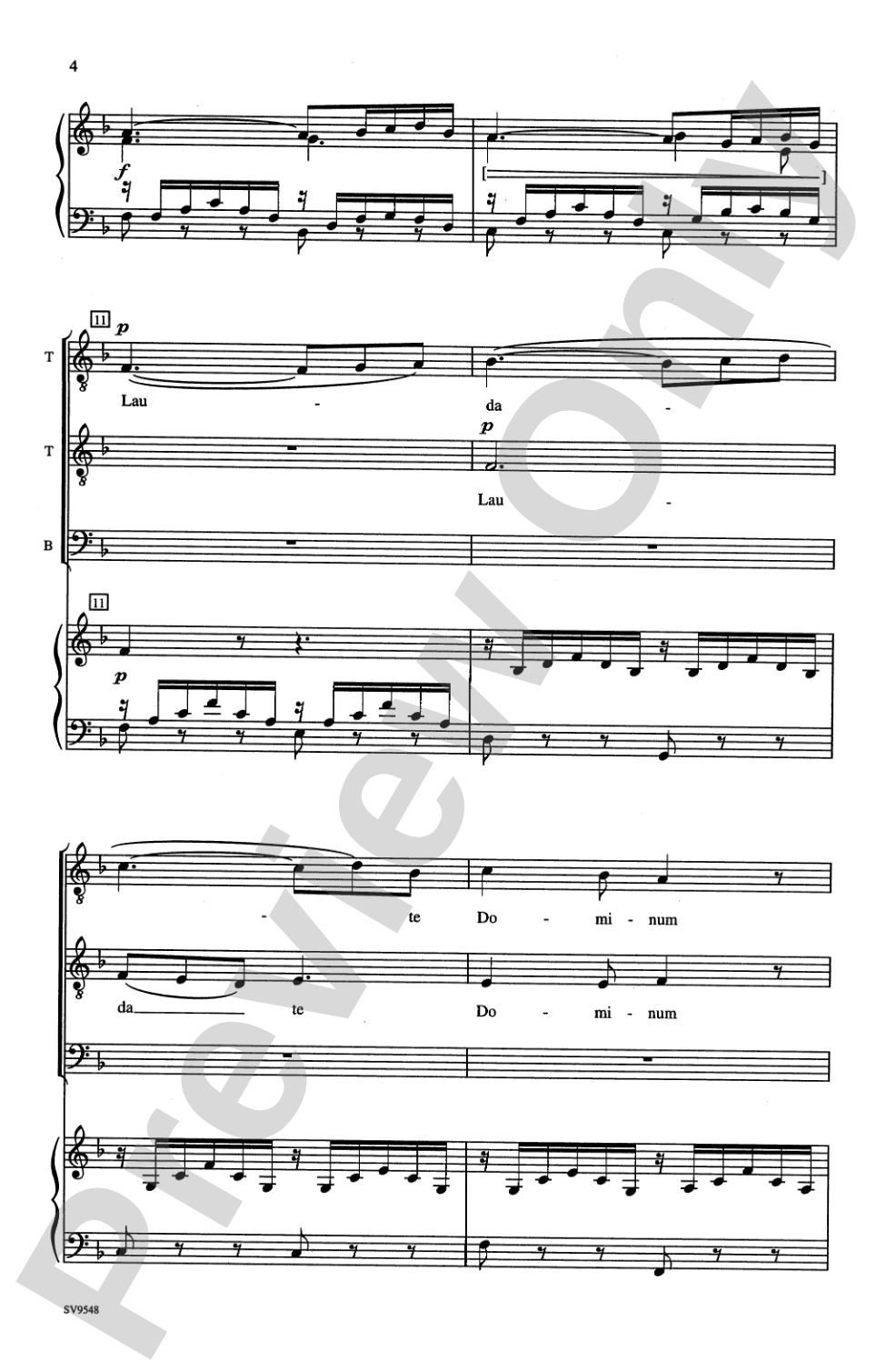
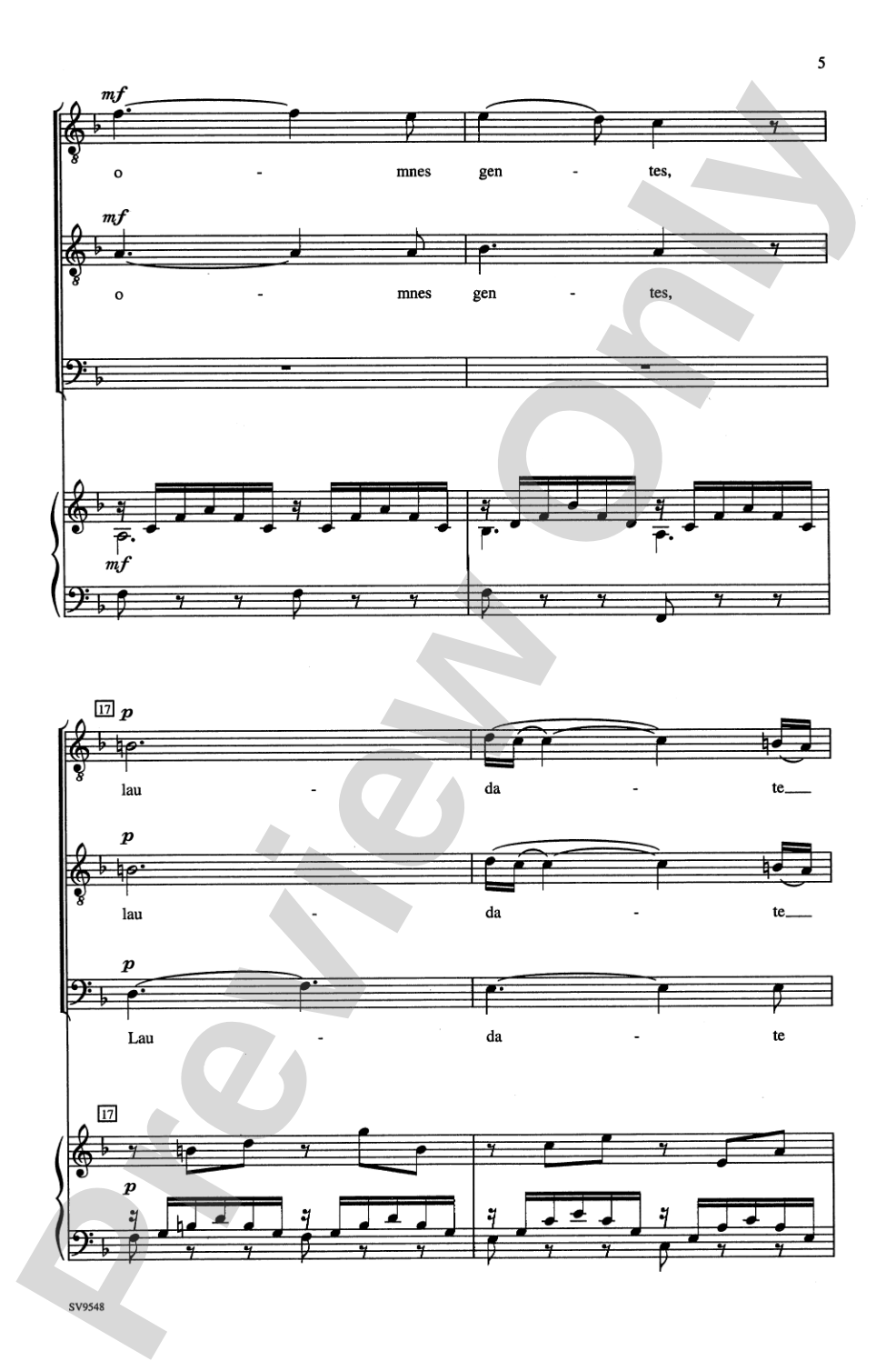
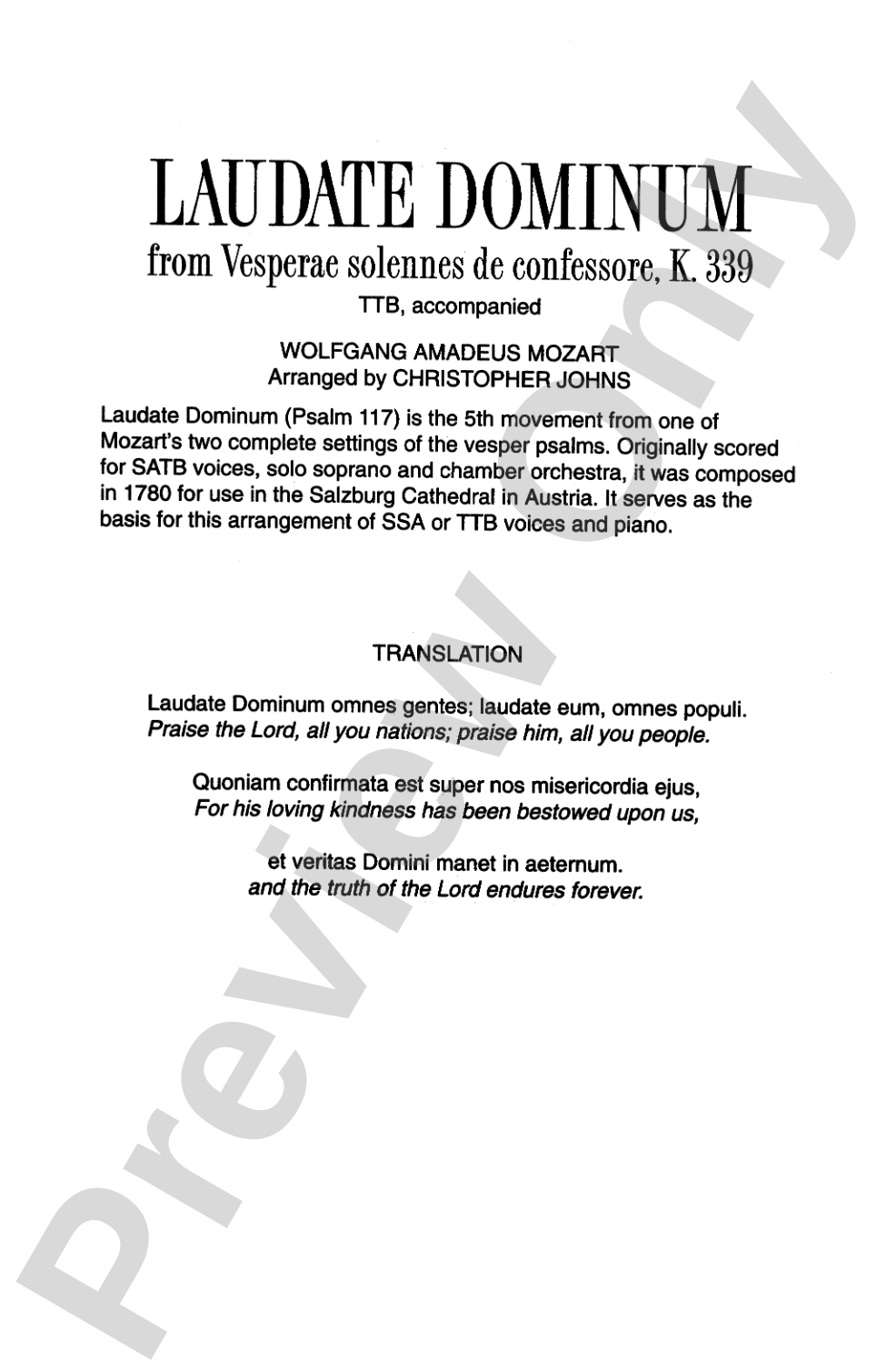
Laudate Dominum (from <I>Vesperae Solennes De Confessore,</I> K. 339) Sheet Music Preview

Laudate Dominum (from Vesperae Solennes De Confessore, K. 339): TTB Choral Octavo

From Vesperae Solennes De Confessore, K. 339

By Wolfgang Amadeus Mozart / arr. Christopher Johns

Level: Moderate

Item: 00-PO-0005240

Digital Download
$2.25

Minimum order quantity: 20 copies

Description
At last, this beautiful work from Mozart's Vespers is available for your women's and men's choruses. The melodic lines soar. The transcription of Mozart's beautiful accompaniment is sublime. Both settings are stunning.

Laudate Dominum (from Vesperae Solennes De Confessore, K. 339): TTB Choral Octavo isn't in MakeMusic Cloud just yet...but it could be. Let us know you'd like to see it, and you'll help shape what comes next. In the meantime, start a free trial and dive into thousands of interactive titles your students can play along with today.

Sample Audio
No sample audio found.
Sample Video
Additional Details
Series: Alfred Archive Edition: Studio PR Catalog
Publisher: Alfred Music
Page Count: 20
SKU: 00-PO-0005240

More about this title

About the Composer: Wolfgang Amadeus Mozart

Wolfgang Amadeus Mozart (1756-1791) composed some of the most enduring sacred music in the Western canon while simultaneously writing operas, symphonies, and chamber works that defined the Classical era. His liturgical works, including the Vesperae Solennes de Confessore, demonstrate his gift for combining strict formal requirements with soaring melodic invention and emotional depth.

Mozart's choral writing balances clarity of text with elaborate musical architecture. His ability to write idiomatically for voices while maintaining sophisticated harmonic language makes his sacred works rewarding for both singers and listeners, and this arrangement brings that elegance within reach of school and community choirs.

Why we love this

Christopher Johns has preserved the luminous quality of Mozart's original while scaling the accompaniment to ensemble capabilities at this grade level. The soaring soprano line stays memorable and grateful to sing even as the inner voices gain independence and color, creating a piece that sounds far more advanced than its technical demands suggest.

What to expect

Laudate Dominum radiates grace and reverence without sentimentality. The melody floats across hymn-like harmonic support, creating a luminous quality that feels both intimate and transcendent. This is Mozart at his most direct: expressive without excess, liturgical without austerity.

Who it's for

This arrangement serves treble-voice or mixed choirs at the high school or community level who want to perform Mozart without the demands of a large vocal range or complex divisi writing. It works equally well for men's choruses using the TTB and TBB voicings provided, making it a genuine multi-voicing solution.

How to get the most out of it

  • Balance the soprano line so it sings through the texture without forcing; this melody carries the prayer and needs space to breathe across phrases.
  • Shape each phrase toward the text's natural accentuation in Latin rather than strictly metric emphasis, allowing rubato to emerge organically from the harmonic motion.
  • Warm the tone throughout the middle voices; the alto and tenor parts create the harmonic foundation, and their resonance supports the soprano's arc.
  • Approach the key modulations with subtle tempo flexibility to acknowledge the harmonic shifts without losing forward momentum.

How to use it

Program this as a centerpiece for sacred or classical-themed concerts, or pair it with other shorter liturgical works to create a substantial choral suite. Its moderate length and accessible tessitura make it ideal for late-fall or winter programming when most ensembles have built vocal stamina and ensemble discipline.

Skills your students will build

  • Singing sustained legato lines across phrase boundaries
  • Balancing independent voice parts while maintaining textural cohesion
  • Interpreting Latin diction with clear vowels and natural phrasing
  • Understanding Classical-era harmonic progression and modulation
  • Singing Mozart's clean, efficient vocal writing without unnecessary tension

You May Also Like