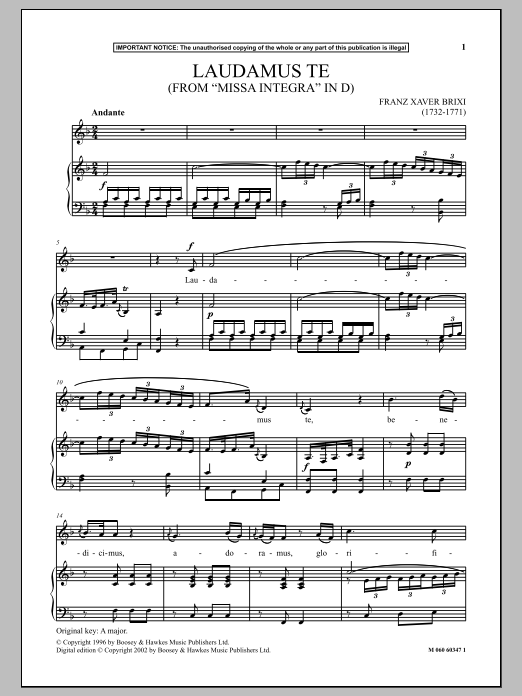
Laudamus Te (from Missa Integra In D) Sheet Music Preview

Laudamus Te (from Missa Integra In D): Piano Vocal

As performed by Franz Xaver Brixi

Item: 35-DS00238145

Digital Download
$5.99

One moment…

One moment…

Description

Laudamus Te (from Missa Integra In D): Piano Vocal isn't in MakeMusic Cloud just yet...but it could be. Let us know you'd like to see it, and you'll help shape what comes next. In the meantime, start a free trial and dive into thousands of interactive titles your students can play along with today.

Sample Audio
No sample audio found.
Sample Video
Additional Details
Publisher: Hal Leonard
Page Count: 5
SKU: 35-DS00238145

More about this title

About the Artist: Franz Xaver Brixi

Franz Xaver Brixi (1723–1771) was a Czech composer and organist whose sacred works shaped the musical life of Prague during the Classical period. His liturgical output was substantial and practical: Brixi composed directly for the needs of the churches where he worked, combining solid counterpoint with the melodic clarity that defined mid-18th-century style.

As a pedagogical figure, Brixi matters because his sacred music sits at the crossroads between Renaissance polyphonic tradition and Classical simplicity. His masses and motets demonstrate how to write singable, rewarding vocal lines without sacrificing structural integrity, making them valuable models for understanding how composers adapted their approach to liturgical function.

Why we love this

Brixi's setting carries the weight of genuine liturgical purpose without excess ornamentation. The text declamation feels natural across the piano reduction, and the harmonic language rewards singers with clear melodic shape while respecting the sanctity of the words. This is the kind of music that teaches singers how to phrase through a sustained legit line rather than relying on the grandeur of larger forces.

What to expect

Quiet reverence with architectural clarity. The music moves without rushing, letting each phrase settle before the next arrives. There is warmth in the harmonic movement, but it stems from restraint rather than emotional declaration.

Who it's for

Soloists preparing sacred repertoire for recital or liturgical performance, and voice teachers seeking accessible yet musically substantial 18th-century material. Singers at the intermediate level and above will find this piece melodically rewarding without requiring virtuosic technique.

How to get the most out of it

  • Shape the melodic line through long, supported breaths rather than breaking at convenient harmonic moments. Brixi's phrasing follows text meaning, not just cadence points.
  • Let the piano part breathe with you. The accompaniment is lean enough that rubato here sounds natural, not self-indulgent.
  • Attend to vowel consistency in longer note values. This music exposes uneven tone production instantly, so use it as a diagnostic tool for your voice students.

How to use it

Fit this into a mixed recital pairing it with other Classical sacred fragments or alongside Italian vocal chamber music of the same era. It also serves as a bridge piece in a liturgical concert, offering congregational familiarity through text while introducing the particular voice behind Bohemian Classical style.

Skills your students will build

  • Baroque-to-Classical text underlay and declamation
  • Long-line phrasing in sacred vocal music
  • Awareness of harmonic rhythm and support for sustained tone
  • Sight-reading fluency in piano-vocal reductions

You May Also Like