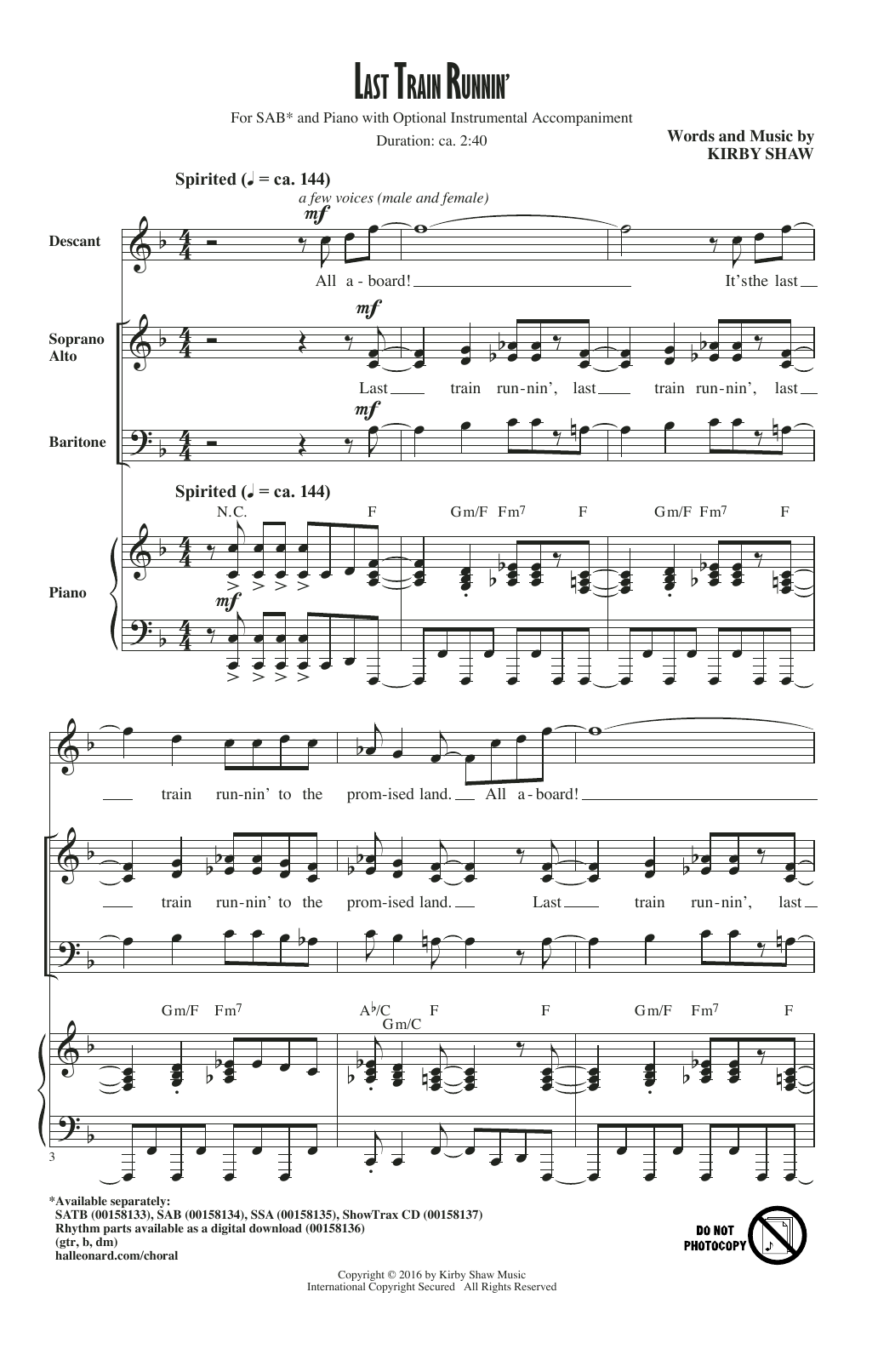
Last Train Runnin' Sheet Music Preview

Last Train Runnin': SAB Choral Octavo

Arranged by Kirby Shaw

Item: 35-DS00333354

Digital Download
$2.99
Description

Last Train Runnin': SAB Choral Octavo isn't in MakeMusic Cloud just yet...but it could be. Let us know you'd like to see it, and you'll help shape what comes next. In the meantime, start a free trial and dive into thousands of interactive titles your students can play along with today.

Sample Audio
No sample audio found.
Sample Video
Additional Details
Publisher: Hal Leonard
Page Count: 11
SKU: 35-DS00333354

More about this title

About the Arranger: Kirby Shaw

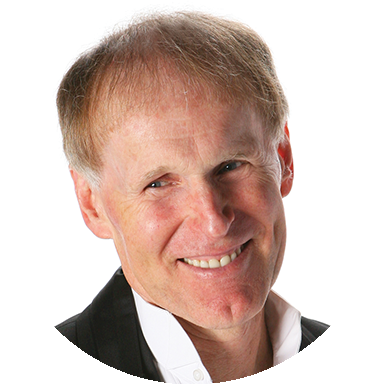
Kirby Shaw

Kirby Shaw's influence extends across six continents, where he has conducted workshops and masterclasses in 45 states plus Canada, Australia, the Bahamas, Sweden, The Netherlands, Italy, Spain, and Germany. He holds degrees in Music Education and Choral Composition from San Jose State University and a DMA in Choral Conducting from the University of Washington. His approach to teaching blends rigorous musicianship with infectious humor and deep stylistic knowledge.

Shaw's career has spanned directing innovative vocal jazz ensembles at the College of the Siskiyous, Colorado State University, and the University of Missouri at Kansas City. He has scatted one-on-one with vocalists including Bobby McFerrin, Mark Murphy, Al Jarreau, and Jon Hendricks, whose praise for Shaw's precision became something of a standing joke. As a composer and arranger with more than 2,500 works in print, Shaw has overseen the creation of hundreds of educational recordings and multiple college albums. His prolific output has earned numerous ASCAP awards, and his arrangements are performed by choirs worldwide, with sales approaching 20 million copies.

Why we love this

Shaw understands how to energize a three-part mixed choir without condescending to the voicing. The spiritual material here sits beautifully in SAB range, and his writing keeps all three parts engaged melodically rather than relegating any voice to harmonic filler. Gospel arrangements at this level often either oversimplify or overwhelm; this one finds the middle ground where students feel the style authentically.

What to expect

Propulsive and joyful, built on a groove that invites movement. The texture opens room for soloists to shine while the choir provides a supportive foundation that feels alive and conversational rather than static.

Who it's for

Choirs at the high school or community college level seeking gospel repertoire that respects three-part voicing. Directors who want their SAB ensemble to develop comfort with spiritual style and rhythmic independence without choosing material that feels either juvenile or technically out of reach.

How to get the most out of it

  • Establish the groove early in rehearsals by tapping the backbeat as a ensemble before adding text. This locks the pocket in a way that reading rhythm alone won't accomplish.
  • Encourage altos to lean slightly into their part during moments where SAB harmony thickens. The middle voice carries important color that can disappear if singers listen only downward.
  • Record a sectional rehearsal with just the soprano and bass lines, then layer in alto. Students hear how Shaw voices the movement and why their line matters to the overall sound.
  • Let the soloists breathe freely over the final chorus. Shaw's arrangement supports flexible phrasing, and a slight rubato in the lead voice will lift the whole piece.

How to use it

Pair this with other spirituals or contemporary sacred works to build a concert set that explores different eras and styles within one tradition. It works equally well as an opener that energizes an audience or as a closing number that sends listeners out on a high note. Consider programming it in a spring concert or community service context where the optimistic spirit finds natural resonance.

Skills your students will build

  • Gospel swing feel and rhythmic independence across parts
  • Sustaining pitch stability in a rhythmically driven arrangement
  • Blending individual voices into a cohesive SAB texture
  • Soloist-to-ensemble interplay and responsive accompaniment
  • Stylistic authenticity in spiritual and gospel idioms

You May Also Like