Last Night Was The End Of The World (arr. Barbershop Harmony Society) Sheet Music Preview

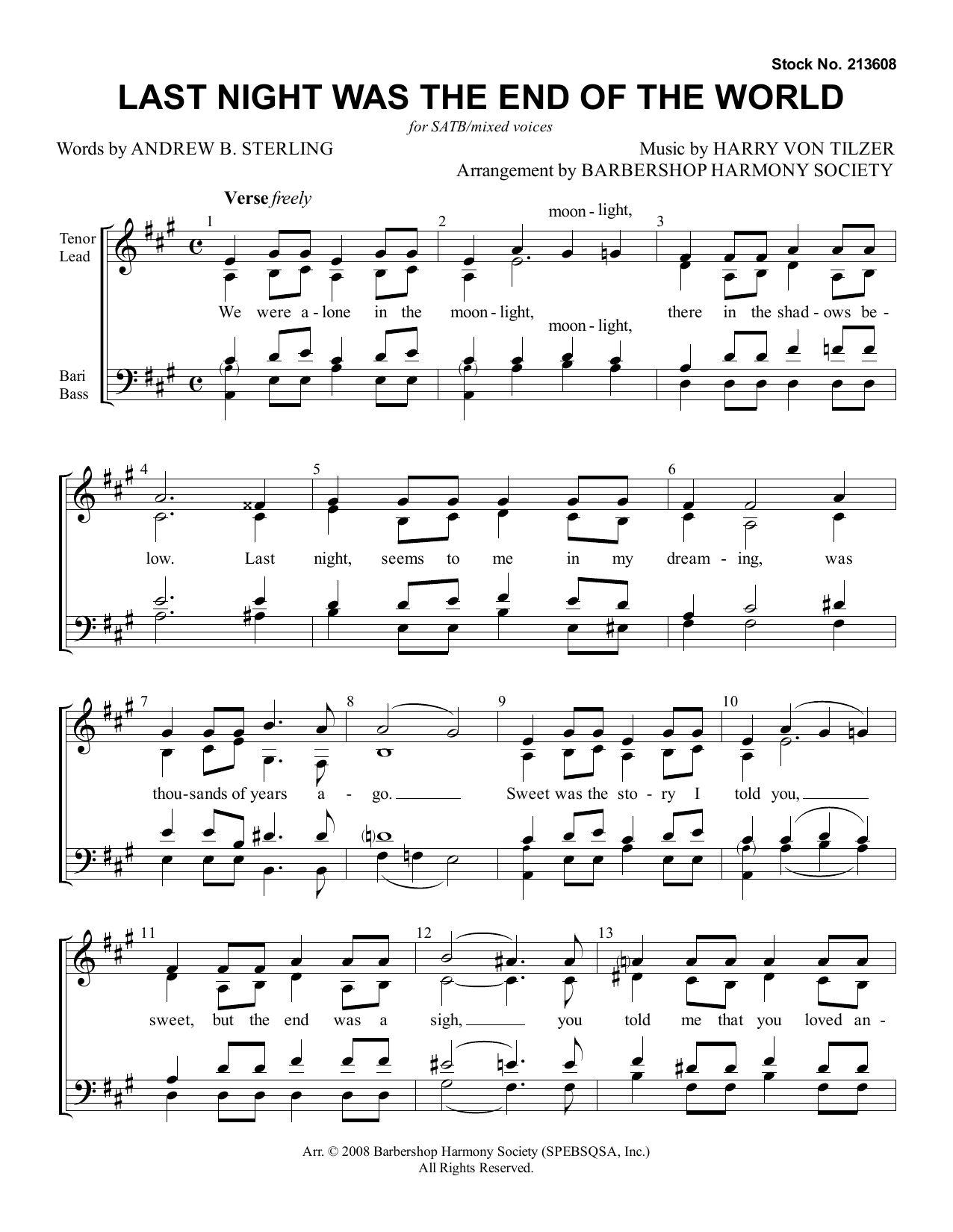
Last Night Was The End Of The World (arr. Barbershop Harmony Society): SATB Choral Octavo

By Andrew B. Sterling Harry von Tilzer / By Andrew B. Sterling / By Harry Von Tilzer / Arranged by Barbershop Harmony Society

Item: 35-DS00472532

Digital Download
$3.20
Description

Last Night Was The End Of The World (arr. Barbershop Harmony Society): SATB Choral Octavo isn't in MakeMusic Cloud just yet...but it could be. Let us know you'd like to see it, and you'll help shape what comes next. In the meantime, start a free trial and dive into thousands of interactive titles your students can play along with today.

Sample Audio
No sample audio found.
Sample Video
Additional Details
Publisher: Hal Leonard
Page Count: 3
SKU: 35-DS00472532

More about this title

About the Composer: Andrew B. Sterling Harry von Tilzer

Andrew B. Sterling and Harry von Tilzer were prolific songwriting partners in the early 20th century, crafting popular songs that defined the Tin Pan Alley era. Their catalog spans sentimental ballads and upbeat novelty numbers, many of which became standards performed by vaudeville acts and concert singers alike. Sterling handled lyrics with a gift for emotional directness, while von Tilzer's melodies paired perfectly with the conversational phrasing that made their work singable and memorable.

Their compositions endured partly because they understood what performers wanted: clear melodic lines, accessible ranges, and lyrics that audiences could follow. This arrangement by the Barbershop Harmony Society honors that accessibility while adding the rich harmonic texture that defines the barbershop style.

Why we love this

The Barbershop Harmony Society's arrangement captures the wistful charm of this early 20th century song while building in the close harmonies and chromatic voice leading that make barbershop singing so satisfying. Directors benefit from a straightforward three-page score that packs genuine harmonic interest without overwhelming less experienced singers. This is the kind of arrangement that lets singers feel the sophistication of their own voicing work.

What to expect

Wistful and tender, with the bittersweet quality of early popular song meeting the warm harmonic glow of close-voiced barbershop writing. The arrangement wraps the melody in lush inner-voice movement that gives the impression of much greater harmonic complexity than the vocal writing actually demands.

Who it's for

Mixed choirs seeking repertoire that sounds more sophisticated than its difficulty level suggests. Groups already familiar with barbershop harmony will find this a natural fit, while choirs discovering the style for the first time will appreciate its melodic accessibility and emotional directness.

How to get the most out of it

  • Balance the harmonic sweep across all four voices; the chromatic movement in the inner voices can disappear if sopranos and basses dominate.
  • Shape the phrases with a gentle, nostalgic lilt rather than dramatic sweep. This song thrives on conversational intimacy.
  • Lock the cadences with precision. Barbershop voicings demand rhythmic unity to land those characteristic seventh chords cleanly.
  • Let the lyrics drive phrasing choices. The text about heartbreak and loss benefits from micro-rubatos that reflect the emotional beats.

How to use it

Nest this alongside other early 20th century popular songs for a concert exploring the roots of American song, or feature it as a standalone gem when programming needs a shorter, confident opener. The brevity and emotional clarity make it ideal for contests or festivals where barbershop style is featured.

Skills your students will build

  • Singing closely voiced seventh and ninth chords with rhythmic precision
  • Balancing blend across SATB in arrangements with active inner voices
  • Shaping popular song phrasing with period-appropriate style
  • Reading straightforward octavo layout with chromatically shifting harmonies

You May Also Like