
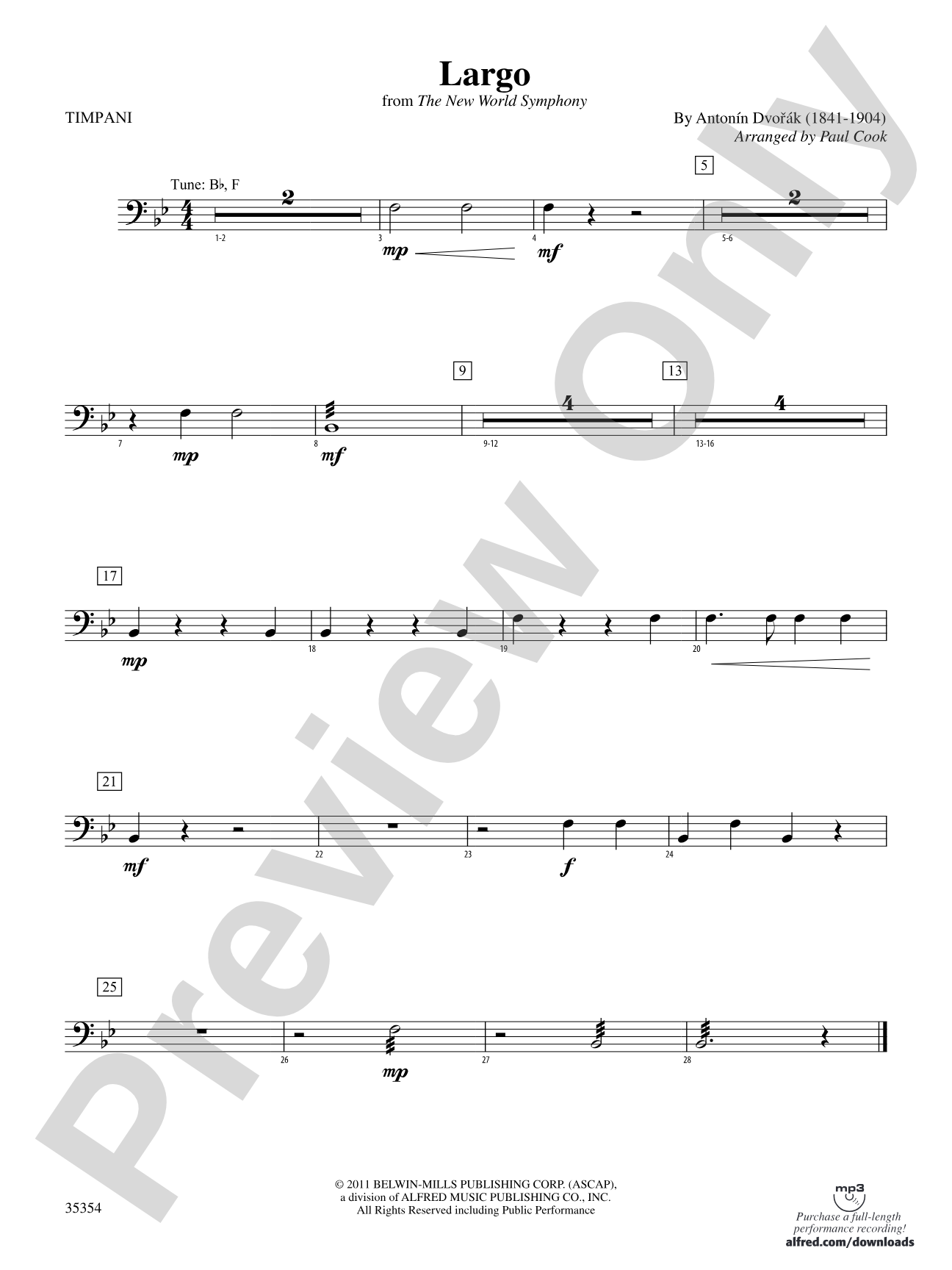

Largo (from the New World Symphony): Timpani
By Antonín Dvorák / arr. Paul Cook
Grade: 1 (Very Easy)
Item: 00-PC-0014909_TMP
$3.00
Pickup currently not available
Description
Antonín Dvorák's "Largo" from his 9th Symphony From the New World is a favorite for audiences here and abroad for its simplistic, yet moving melody. Paul Cook's stirring arrangement brings Dvorák's cherished theme to your beginners. The percussion parts can be performed as written or eliminated for a more traditional setting. Aside from adding some musical history, this arrangement supports instruction of balanced dynamics, proper breath support, and tone quality.


Don't just read it, hear it, play along with it, and watch your students grow with it. In MakeMusic Cloud, Largo (from the New World Symphony): Timpani comes alive with professional accompaniment, adjustable tempo, and built-in practice tools that turn solo practice into real progress.
Open in the Player
Jump straight in and assign it today.
Start Your Free Trial
Open this title and explore the full library in minutes.
Sample Audio
1
Audio File
--:--
0:00
0:00
Sample Video
No sample videos found.
Additional Details
Series:
Belwin Beginning Band
Publisher:
Alfred Music
Page Count:
126
SKU:
00-PC-0014909_TMP
More about this title
About the Composer: Antonín Dvorák
Antonín Dvorák (1841-1904) was a Czech composer who drew deeply from his nation's folk traditions while mastering the symphonic forms of Western Europe. His 9th Symphony, subtitled "From the New World," became one of the most recognizable works in classical music after its 1893 premiere in New York, where Dvorák served as director of the National Conservatory of Music.
Dvorak's gift for melody and orchestration made him a bridge between Romantic grandeur and accessible beauty. His works have long served music educators because they combine emotional depth with structural clarity, allowing students to engage with genuine masterworks rather than mere exercises.
Why we love this
Paul Cook's Grade 1 arrangement preserves the iconic, soaring melody that has captivated audiences for over 130 years while remaining genuinely playable for developing musicians. The flexible percussion parts let you scale the arrangement to your ensemble's needs and performance setting. Most importantly, students hear themselves playing a recognized masterpiece, which builds investment and pride in their musicianship from day one.
What to expect
Noble and contemplative without being austere. The melody unfolds with a gentle inevitability, full of yearning and warmth. Even in a Grade 1 context, the piece conveys emotional maturity and invites performers to listen to themselves with new ears.
Who it's for
Beginning concert bands with mixed instrumentation who are ready to encounter real repertoire. This arrangement works for ensembles in their first or second year of study, and it serves equally well in elementary, middle school, and youth band settings. Conductors seeking to teach musicality and tone production alongside cultural literacy will find this piece invaluable.
How to get the most out of it
- Shape the melody with careful attention to phrase direction rather than mechanical dynamics. Even at Grade 1, the Largo should breathe; mark where the line naturally crests and settles.
- Balance the harmonic voices in the band so the supporting parts never eclipse the primary melody. This is essential training for ensemble listening and interdependence.
- If you include the optional percussion parts, use them as a unifying element that clarifies pulse without overwhelming the lyrical character of the piece.
- Secure uniform breath support and tone quality across your section first chairs. These fundamentals directly serve the sustained, singing quality Dvorák's theme demands.
How to use it
Open a concert with this piece to immediately signal that your band makes music of substance. Its recognition factor brings instant audience connection and sets a thoughtful, engaging tone for the rest of your program. It also works beautifully as a festival or contest selection because the emotional honesty transcends difficulty level.
Skills your students will build
- Sustaining unified tone quality across phrases and dynamic levels
- Shaping long melodic lines with intentional phrasing rather than mechanical breath marks
- Balancing harmonic voices so featured melodies are heard distinctly
- Responding to conductor direction for expressive rubato and breath control
- Understanding how orchestration serves a single, central musical idea