
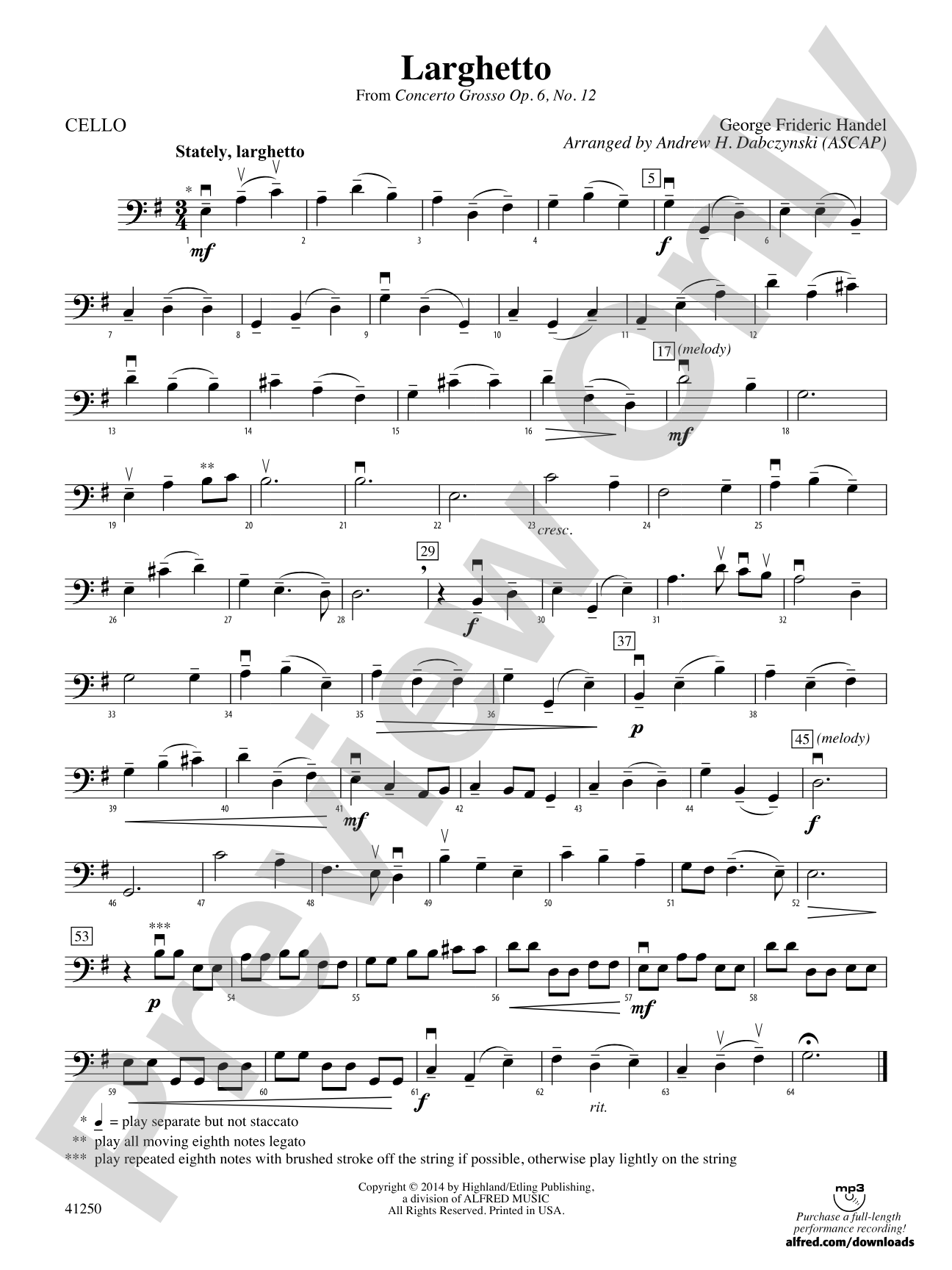

Larghetto (from Concerto Grosso Op. 6, No. 12): Cello
By George Frideric Handel / arr. Andrew H. Dabczynski
Grade: 1.5
Item: 00-PC-0016369_VC1
$5.99
Pickup currently not available
Description
Here is an opportunity to perform a familiar piece of music that is superb for practicing foundational string skills. And as importantly, beginning and advanced students alike can learn to play with authentic and challenging Baroque style in this carefully edited arrangement. A satisfying centerpiece for any concert! (2:30)
Correlates to String Explorer Book 1, Unit 12. This title is available in MakeMusic Cloud.


Correlates to String Explorer Book 1, Unit 12. This title is available in MakeMusic Cloud.
Don't just read it, hear it, play along with it, and watch your students grow with it. In MakeMusic Cloud, Larghetto (from Concerto Grosso Op. 6, No. 12): Cello comes alive with professional accompaniment, adjustable tempo, and built-in practice tools that turn solo practice into real progress.
Open in the Player
Jump straight in and assign it today.
Start Your Free Trial
Open this title and explore the full library in minutes.
Sample Audio
1
Audio File
--:--
0:00
0:00
Sample Video
No sample videos found.
Additional Details
Series:
Highland/Etling String Explorer
Publisher:
Alfred Music
Page Count:
72
SKU:
00-PC-0016369_VC1
More about this title
About the Composer: George Frideric Handel
George Frideric Handel (1685-1759) stands as one of the Baroque era's most prolific and inventive composers. Born in Germany and trained in Italy, he spent most of his career in England, where he became a naturalized citizen and a dominant figure in London's musical life. His gift for memorable melody and structural clarity made his works accessible to both court audiences and the general public.
Handel composed across nearly every genre of his time: operas, oratorios, concertos, chamber works, and keyboard music. His Concerti Grossi, Op. 6, represent the pinnacle of Baroque orchestral writing, balancing the contrast between a small group of soloists and the full ensemble with elegant proportions and expressive depth. These works remain essential to string orchestra repertoire because they embody Baroque principles that teach young musicians how to shape phrases, maintain period style, and collaborate within an ensemble.
Why we love this
Handel's melodic gift shines through in this Larghetto, and Dabczynski's arrangement preserves the composer's authentic voice while making it genuinely playable for developing ensembles. A movement of this caliber and brevity (2:30) works perfectly as a concert centerpiece without overwhelming younger students, yet it demands real musicianship in terms of phrasing, intonation, and stylistic control. String directors get a piece that sounds polished and purposeful, not simplified.
What to expect
The Larghetto unfolds with graceful restraint, allowing each phrase to breathe and resonate. It invites an unhurried elegance where every note and silence carries weight, reflecting the contemplative beauty that Baroque composers prized in slow movements.
Who it's for
This arrangement serves Grade 1.5 string orchestras and intermediate ensembles preparing for concert or festival performance. Teachers working with String Explorer Book 1 will find it correlates directly to Unit 12, making it an ideal culminating piece for students at that proficiency level.
How to get the most out of it
- Shape the main melodic line with gentle dynamic gradations rather than abrupt changes; Baroque phrasing lives in the conversation between voices, not in dramatic gestures.
- Balance the first violins with the lower voices so the harmonic movement supports rather than hides the melody. Handel's part-writing rewards clear ensemble listening.
- Approach the tempo as a singing pace; find the breath in the Larghetto that mirrors vocal phrasing, even though strings have no natural breath points.
- Use the recorded accompaniment in MakeMusic Cloud to lock ensemble timing, but also rehearse without it so students internalize the harmonic pulse independently.
How to use it
Program this as the emotional anchor in a concert mixing Baroque and contemporary works; its genuine musicality will deepen your audience's engagement before moving to livelier fare. It also works as a contest festival selection where judges recognize that authentic Baroque style and transparent orchestration demand real musical maturity from young players.
Skills your students will build
- Baroque phrasing and stylistic interpretation
- Balanced ensemble voicing in four-part writing
- Sustaining tone quality through slow tempos
- Intonation sensitivity in harmonic progressions
- Independence from recorded accompaniment while using it as a learning tool