Larghetto and Allegro (from Sonata No. 4): Violoncello Sheet Music Preview

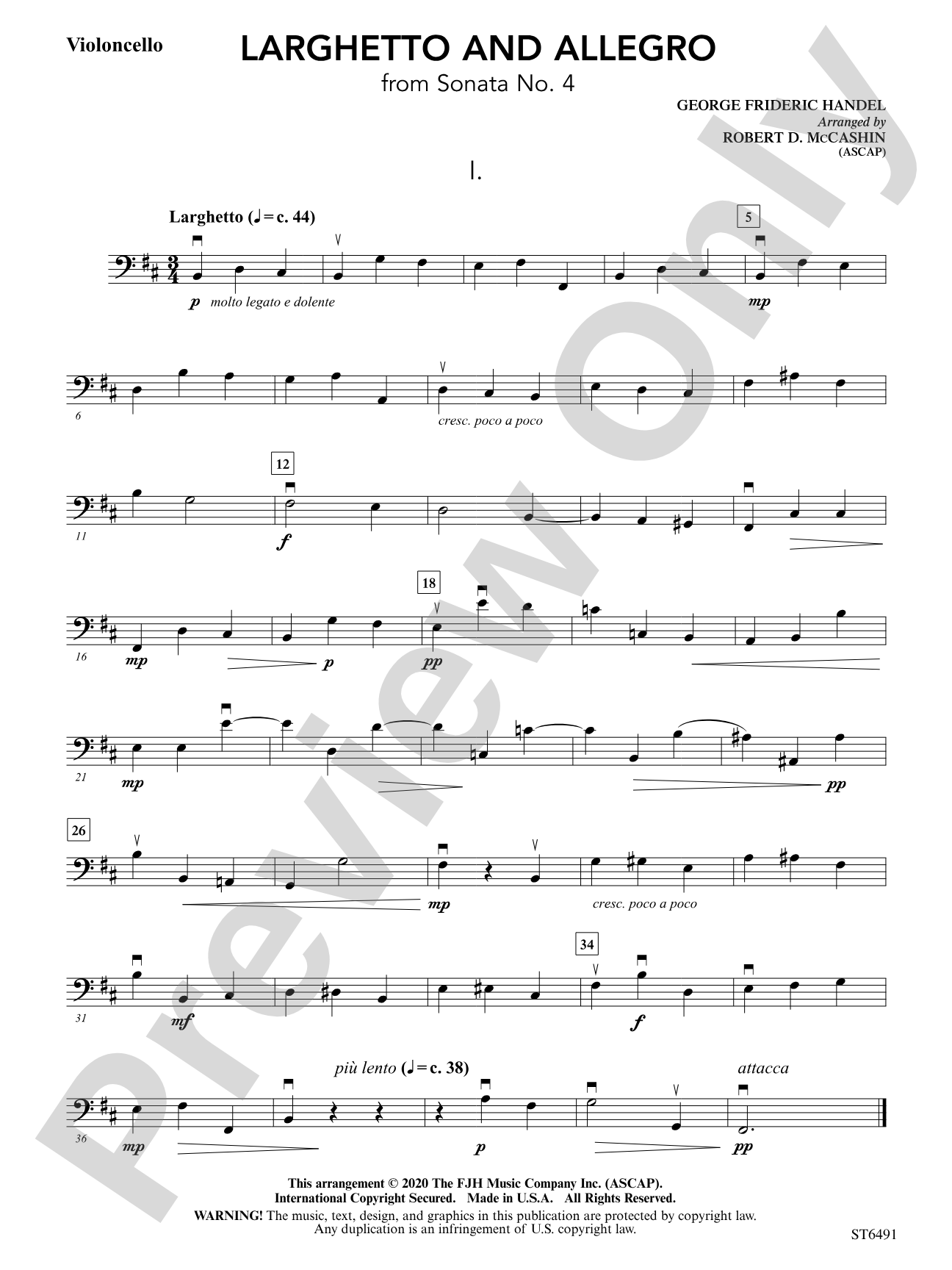
Larghetto and Allegro (from Sonata No. 4): Violoncello

from Sonata No. 4

By George Frideric Handel / arr. Robert D. McCashin

Grade: 3.5

Item: 98-PC-DST6491_VC1

Digital Download
$7.00
Description
This outstanding pair of contrasting movements moves from a plaintive and pleading Larghetto to an Allegro with all the cheer and sparkle one can imagine. An exceptional opportunity to work on the music of Handel while providing a wealth of opportunities for musical development!

Larghetto and Allegro (from Sonata No. 4): Violoncello isn't in MakeMusic Cloud just yet...but it could be. Let us know you'd like to see it, and you'll help shape what comes next. In the meantime, start a free trial and dive into thousands of interactive titles your students can play along with today.

Sample Audio
0:00
0:00
Sample Video
Additional Details
Series: FJH String Orchestra
Publisher: The FJH Music Company, Inc.
SKU: 98-PC-DST6491_VC1

More about this title

About the Composer: George Frideric Handel

Handel spent much of his career in London, where he became a master of vocal music, instrumental works, and opera. His compositional output was enormous and remarkably varied, yet his string writing consistently demonstrates the clarity, balance, and harmonic sophistication that defined the Baroque era.

For string musicians, Handel offers something essential: music that requires elegant phrasing, clean articulation, and genuine ensemble listening. His sonatas and chamber works remain among the finest teaching tools available, introducing students to the conventions and expressive possibilities of 18th-century instrumental music.

Why we love this

McCashin's arrangement captures the emotional arc of Handel's original sonata movement without losing the intimacy of the source material. The contrast between the mournful opening and the buoyant finale creates a complete musical statement that speaks to learners at this level, and the technical demands are balanced perfectly for Grade 3.5 ensembles aiming for festival performances.

What to expect

The Larghetto unfolds like a gentle lament, with tender harmonies and a contemplative melody that invites singers in the ensemble to consider phrasing and breath as expressive tools. The Allegro bursts with Baroque lightness and forward motion, full of the sparkle and brightness characteristic of Handel's instrumental writing at its most accessible.

Who it's for

This is ideal for Grade 3.5 string orchestras preparing for contest or festival play, especially programs seeking a sophisticated Baroque work that doesn't require advanced soloists. Directors will appreciate how quickly students can achieve a polished, expressive performance without extensive rehearsal time.

How to get the most out of it

  • Shape the Larghetto with long, connected phrases; resist the urge to breathe in every measure. The "pleading" character depends on sustained line work across the entire section.
  • In the Allegro, maintain clarity in running passages by practicing articulation patterns consistently across all sections. Baroque style thrives on precision, not heaviness.
  • Let the dynamic contrasts between movements tell the story. The Larghetto should feel genuinely somber, so the Allegro lands with real joy and energy by comparison.
  • Balance the continuo figurations with the melodic content; McCashin's arrangement distributes the harmonic foundation across the ensemble, so every voice matters.

How to use it

Pair this as a centerpiece for a Baroque concert, or program it as a classic palate cleanser between heavier Romantic works. The emotional journey from darkness to light makes it especially effective early in a recital, setting a thoughtful tone before moving into other styles.

Skills your students will build

  • Baroque phrasing and long-line thinking in slow movements
  • Articulation contrast between lyrical and rhythmic passages
  • Ensemble balance in works with distributed harmonic responsibility
  • Expressive use of dynamics to shape emotional narrative
  • Clean intonation in four-part harmonic writing

You May Also Like