
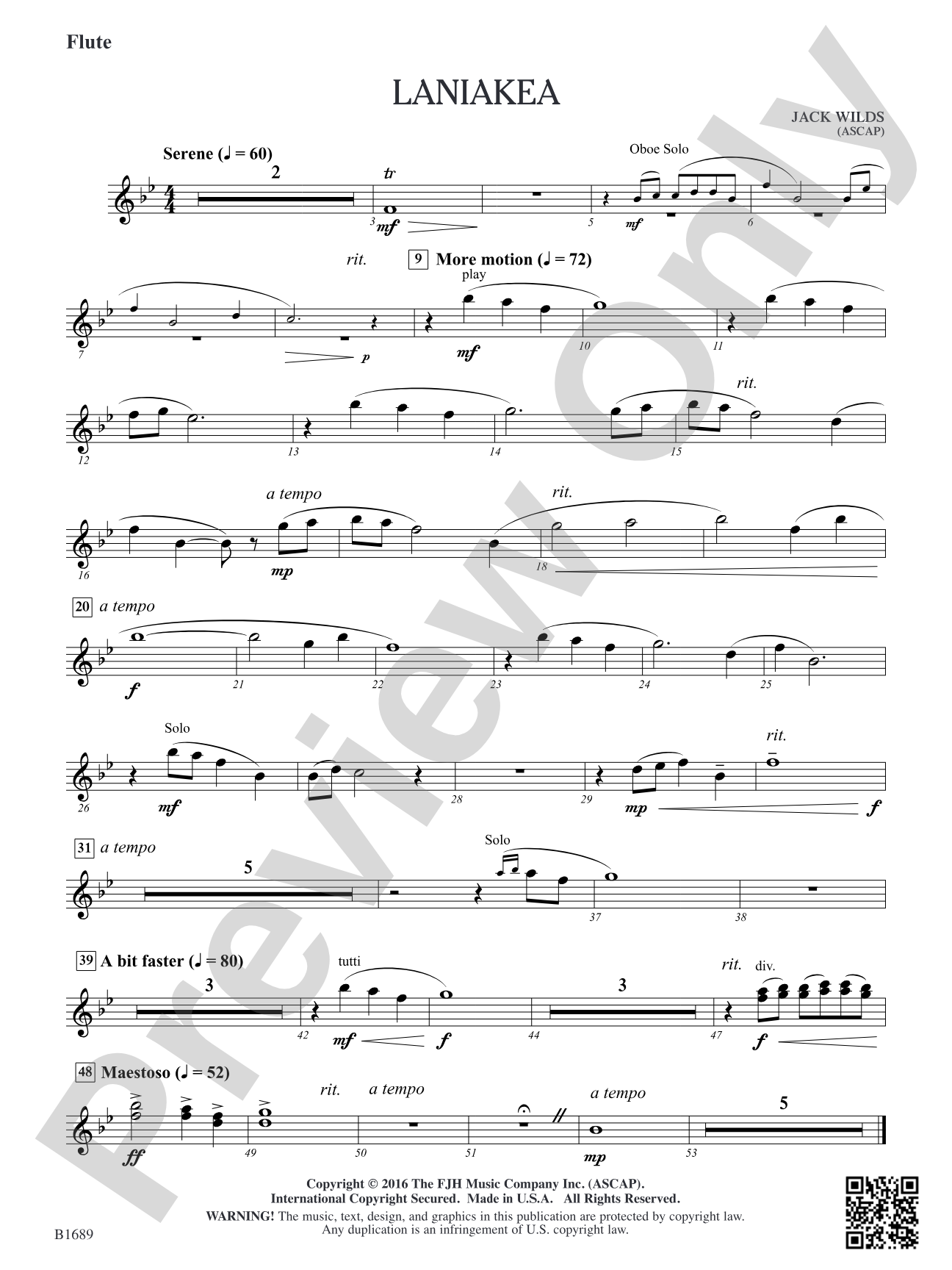

Laniakea: Flute
By Jack Wilds
Grade: 2.5
Item: 98-PC-DB1689_F1
$7.00
Pickup currently not available
Description
Laniakea, Hawaiian for “immeasurable heaven,” is the name of our local supercluster, the massive structure of 100,000 galaxies in which the Milky Way is located. This lyrical work portrays a lone astronaut floating in a space suit at the edge of Laniakea and the emotions that might accompany such an experience. While the writing is very accessible, a sense of awe runs through the entire work that will leave your audience breathless.


Laniakea: Flute isn't in MakeMusic Cloud just yet...but it could be. Let us know you'd like to see it, and you'll help shape what comes next. In the meantime, start a free trial and dive into thousands of interactive titles your students can play along with today.
Request This Title
Tell us you want it.
Start Your Free Trial
Explore everything that's ready to play right now.
Sample Audio
1
Audio File
--:--
0:00
0:00
Sample Video
Additional Details
Series:
FJH Young Band
Publisher:
The FJH Music Company, Inc.
SKU:
98-PC-DB1689_F1
More about this title
About the Composer: Jack Wilds

Jack Wilds composes for ensembles spanning ages 5 to 95, drawing inspiration from visual art, philosophy, poetry, and pure musical architecture. His chamber works have been championed by the Attacca Quartet, members of the New York Philharmonic and Atlanta Symphony, and ensembles across international festivals including the International Trombone Festival and Wyoming Festival.
A former public school band director, Wilds has published over 40 works for developing musicians, with wind band compositions appearing on festival required lists across multiple continents and at the Midwest Clinic. He lectures at Texas State University in composition, theory, ear training, and music technology, and serves as Co-Director of Music at First Presbyterian Church in San Marcos. He has studied composition with Michael Ippolito, Chris Trapani, and Donald Grantham.
Why we love this
Wilds captures genuine emotional weight at an accessible level. Rather than relying on technical complexity, the piece uses orchestration, harmonic color, and pacing to evoke wonder, making it a strong choice for bands developing interpretive maturity without overwhelming developing musicians. The contest/festival designation signals proven success with adjudicators and audiences alike.
What to expect
Laniakea unfolds with quiet grandeur. A lone voice emerges against a vast backdrop, evoking both isolation and transcendence. The orchestration breathes space around the melody, creating moments of awe that feel earned rather than forced, inviting listeners into contemplation of the cosmos.
Who it's for
Grade 2.5 concert bands seeking repertoire that builds musicianship without requiring virtuosity. The piece works for groups ready to explore expressive conducting and ensemble balance, and for directors programming contest or festival events.
How to get the most out of it
- Shape the melodic lines with intent. Even at Grade 2.5, the writing rewards careful phrase shaping and dynamic control. Listen for where the harmony shifts and let that guide your ensemble's voicing.
- Balance the texture to keep the lyrical elements singing forward. With a concept this specific, transparency helps the musical narrative come through.
- Take time in rehearsal to discuss the visual imagery. Knowing that players are imagining an astronaut experiencing the vastness of space will deepen their musical choices and commitment.
- Manage the ensemble's tempo consistency across longer lines. Accessible writing can tempt groups to rush; steady pulse supports the awe the piece aims to create.
How to use it
This works beautifully as a concert opener or centerpiece that sets a reflective tone and transitions your audience into deeper listening. Pair it with contrasting repertoire (a march, a folk song arrangement) to showcase your band's interpretive range, or feature it in a thematic concert exploring music inspired by nature or space.
Skills your students will build
- Expressive phrasing and shape within diatonic, singable melodic lines
- Balancing melody and accompaniment across an ensemble
- Sustaining steady pulse in moderate tempos
- Responding to the conductor's interpretive gestures
- Understanding how program music conveys emotion without text