
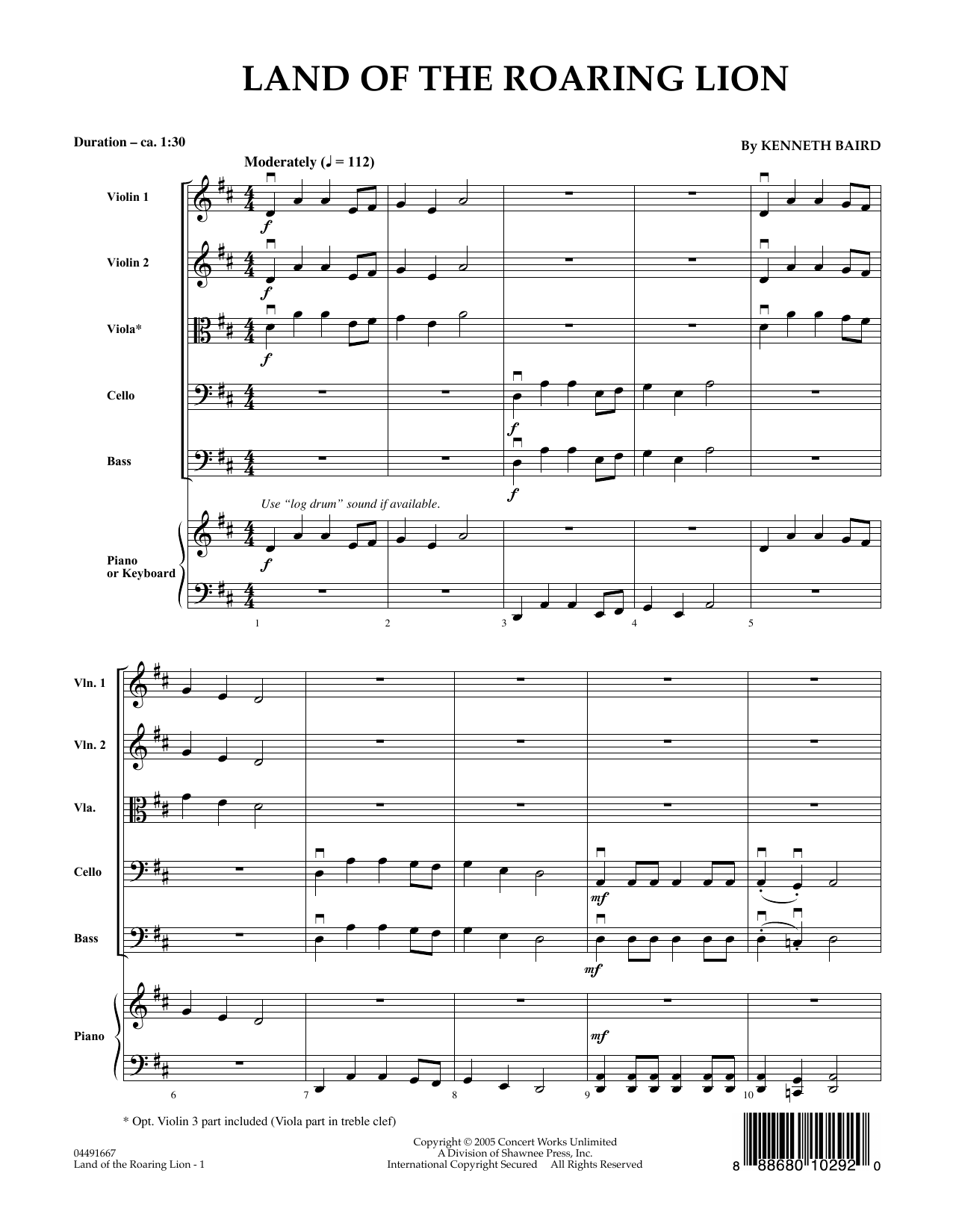

Land of the Roaring Lion: String Orchestra Conductor Score & Parts
By Kenneth Baird
Grade: 1
Item: 35-PK00338947
$45.00
Pickup currently not available
Buy Extra Parts (Digital PDF Download)
| Product | Price | Quantity |
|---|---|---|
| Land of the Roaring Lion - Conductor Score (Full Score) | $7.50 | |
| Land of the Roaring Lion - Violin 1 | $7.00 | |
| Land of the Roaring Lion - Violin 2 | $7.00 | |
| Land of the Roaring Lion - Violin 3 (Viola Treble Clef) | $7.00 | |
| Land of the Roaring Lion - Viola | $7.00 | |
| Land of the Roaring Lion - Cello | $7.00 | |
| Land of the Roaring Lion - Bass | $7.00 | |
| Land of the Roaring Lion - Piano | $7.00 |
Parts Added to Cart!
Description
A fun, well-crafted ensemble piece for beginning level players that features imitation between sections, simple harmony in parallel lines, and bold, modal sonorities. As always, Kenneth Baird creates interesting parts for all players. Dur: 1:30


Land of the Roaring Lion: String Orchestra Conductor Score & Parts isn't in MakeMusic Cloud just yet...but it could be. Let us know you'd like to see it, and you'll help shape what comes next. In the meantime, start a free trial and dive into thousands of interactive titles your students can play along with today.
Request This Title
Tell us you want it.
Start Your Free Trial
Explore everything that's ready to play right now.
Sample Audio
No sample audio found.
Sample Video
No sample videos found.
Additional Details
Publisher:
Hal Leonard
SKU:
35-PK00338947
More about this title
About the Composer: Kenneth Baird
Kenneth Baird has built a reputation for writing string orchestra music that serves young ensembles without talking down to them. His approach centers on distributing musical interest across all parts, ensuring that every student feels invested in the texture rather than relegated to accompanying figures.
Balancing accessibility with musical substance, Baird crafts pieces where beginners encounter genuine compositional ideas. Modal harmony, section dialogue, and clear voice leading become tools for learning, not obstacles to overcome.
Why we love this
Baird's gift for crafting engaging parts across a beginning ensemble shines here. You'll find yourself appreciating how the imitation between sections gives every stand a moment to lead, keeping attention focused and energy sustained throughout the piece.
What to expect
Bold and alive, with a hint of exoticism in its modal colors. The piece rolls forward with straightforward momentum, letting simple harmonic motion and imitative texture create interest rather than relying on complexity or technical fireworks.
Who it's for
Beginning string orchestras that have moved past unison playing and are ready to tackle elementary harmonic writing. This works for groups where you want to build confidence in part independence while maintaining strong ensemble cohesion.
How to get the most out of it
- Bring out the initiative when each section enters with the imitation. These aren't echoes; they're conversations. Mark where the original idea passes from one group to another and shape accordingly.
- The parallel harmony tends to sound hollow if the intonation drifts. Spend rehearsal time locking intervals within each section before blending them together.
- Modal sonorities can sound exotic or murky depending on balance. Keep the melody clear and let the harmonic foundation support it rather than overwhelm it.
- At 1:30, this piece moves quickly. Establish tempo and style early so the ensemble can breathe together without losing momentum.
How to use it
Slot this into a concert where you want to showcase your ensemble's growing musicality without veering into showpiece territory. It pairs well as an opener or as a bridge between a unison piece and something more harmonically adventurous.
Skills your students will build
- Maintaining rhythmic precision within a homophonic texture
- Following imitative entries and responding with musical shape
- Singing through parallel harmonies with stable intonation
- Responding to modal sonorities and non-diatonic harmonic language