
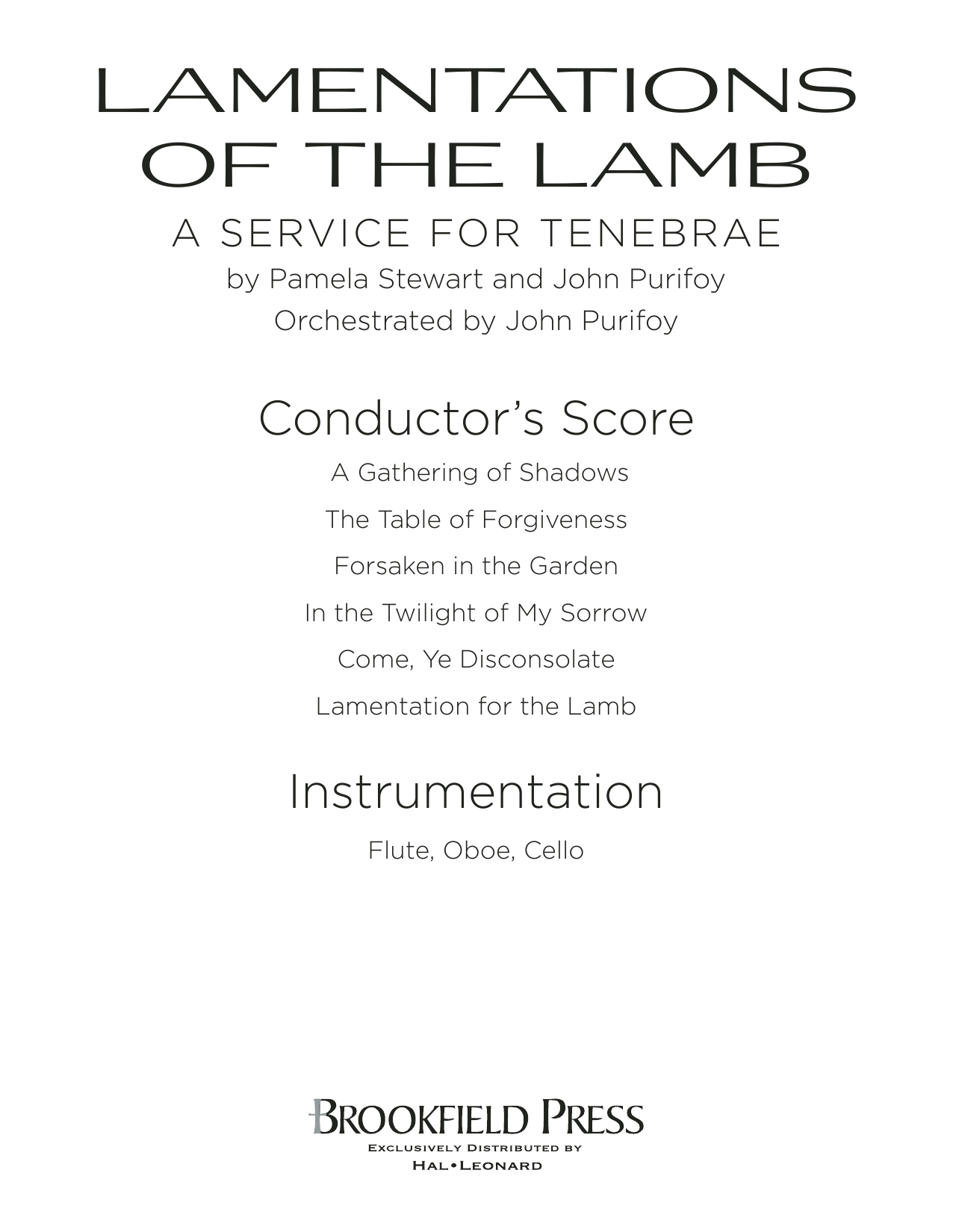
Lamentations of the Lamb: Choral Instrumental Pak
By John Purifoy
Item: 35-PK01822152
$85.00
Pickup currently not available
Buy Extra Parts (Digital PDF Download)
Parts Added to Cart!
Description
The writing team of John Purifoy and Pamela Stewart have crafted a brief work for Maundy Thursday or Good Friday, suitable for use as a Tenebrae service. Told from the historical perspective of the Gospels, as well as from the Old Testament laments that foreshadow them, °Lamentations of the Lamb° takes us on a journey through the final days in the life of Christ. Each anthem itself is a plaintive lament taken from these combined narratives. With a final stirring lamentation offered by creation, here is a powerful ending to Holy Week in preparation for Easter.¶Songs include: °A Gathering of Shadows; The Table of Forgiveness; Forsaken in the Garden; In the Twilight of My Sorrow; Come, Ye Disconsolate; Lamentation for the Lamb.° Score and parts (fl, ob, vc) available on CD-ROM.


Lamentations of the Lamb: Choral Instrumental Pak isn't in MakeMusic Cloud just yet...but it could be. Let us know you'd like to see it, and you'll help shape what comes next. In the meantime, start a free trial and dive into thousands of interactive titles your students can play along with today.
Request This Title
Tell us you want it.
Start Your Free Trial
Explore everything that's ready to play right now.
Sample Audio
No sample audio found.
Sample Video
No sample videos found.
Additional Details
Publisher:
Hal Leonard
SKU:
35-PK01822152
More about this title
About the Composer: John Purifoy
John Purifoy is a composer and arranger with deep roots in sacred music and choral writing. His work demonstrates a gift for setting theological narratives to music that speaks to both the intellect and the heart, making complex spiritual themes accessible to ensembles and congregations.
Why we love this
Purifoy and Stewart have created something rare: a cohesive multi-movement work that functions beautifully as both a liturgical service and a concert experience. The pairing of Gospel narrative with Old Testament foreshadowing gives singers substantive theological content to inhabit, and the inclusion of instrumental parts elevates the production without requiring a full orchestra.
What to expect
The music unfolds as a meditation on suffering and loss, moving through moments of intimate vulnerability and building toward moments of collective grief. Harmonic language supports the plaintive character, and the instrumental additions create an atmosphere of contemplative depth rather than bombast.
Who it's for
This work serves choirs and music directors planning a Tenebrae service, Good Friday observance, or comprehensive Holy Week presentation. It works equally well for choral programs seeking a substantial, multi-movement work that blends liturgical purpose with strong musicality.
How to get the most out of it
- Pay careful attention to the arc across all six anthems rather than treating each movement as isolated; the cumulative emotional weight builds toward the final lamentation and shapes how you approach dynamics and pacing in earlier pieces.
- Balance the instrumental parts thoughtfully so they enhance rather than compete with the choral lines; the flute, oboe, and cello should feel like they're deepening the emotional landscape the singers are creating.
- Explore the contrast between movements that tell the historical narrative (the Gospels) and those rooted in Old Testament lament; this distinction can inform your interpretive choices about text clarity and emotional coloring.
- Coordinate closely with your instrumentalists about articulation and breath points to ensure the instrumental writing supports rather than fights against the choral phrasing.
How to use it
Consider programming this as the centerpiece of a Maundy Thursday or Good Friday service, where its six movements can unfold as part of a larger liturgical experience. Alternatively, it serves as a powerful closing concert piece in a spring choral festival or Holy Week concert, offering singers and audiences a moment of musical and spiritual substance during a season when many programs lean toward Easter celebration.
Skills your students will build
- Singing with sustained legit tone through extended phrases without sacrificing text clarity
- Interpreting theological and narrative content to shape musical expression
- Balancing ensemble sound while maintaining individual vocal line independence across multiple movements
- Responding to instrumental accompaniment and adjusting blend and phrasing accordingly
- Building emotional intensity across a large-scale multi-movement work