Lamentation Sheet Music Preview

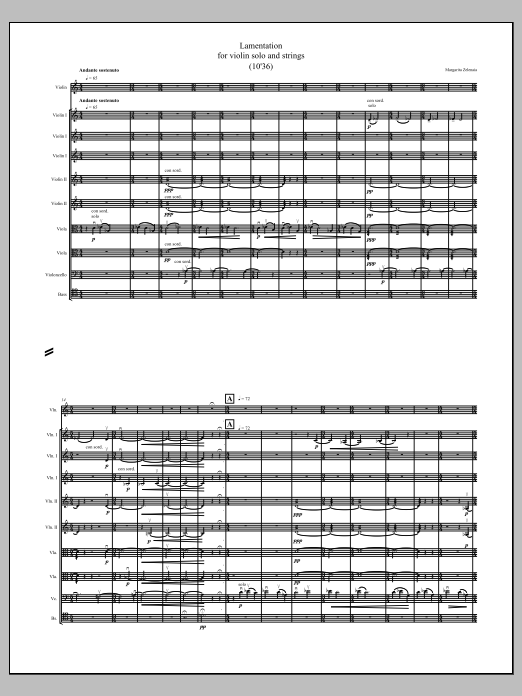
Lamentation: String Orchestra Conductor Score & Parts

Arranged by Margarita Zelenaia

Item: 35-PK00279141

Digital Download
$1.80

Buy Extra Parts (Digital PDF Download)

Product Price Quantity
Lamentation - Full Score $1.80

Parts Added to Cart!

Description
Lamentation

Lamentation: String Orchestra Conductor Score & Parts isn't in MakeMusic Cloud just yet...but it could be. Let us know you'd like to see it, and you'll help shape what comes next. In the meantime, start a free trial and dive into thousands of interactive titles your students can play along with today.

Sample Audio
No sample audio found.
Sample Video
Additional Details
Publisher: Hal Leonard
SKU: 35-PK00279141

More about this title

About the Arranger: Margarita Zelenaia

Margarita Zelenaia is an accomplished arranger known for her work adapting classical and contemporary works for string ensembles. Her arrangements prioritize clarity of line and textural balance, making substantial works accessible to student and semi-professional orchestras without sacrificing musical integrity.

Zelenaia's approach to orchestration emphasizes the natural strengths of string writing while maintaining the harmonic and melodic essence of the original material. Her scores are practical for rehearsal while remaining musically satisfying in performance.

Why we love this

Zelenaia's arrangement opens up this substantial work to orchestras that might otherwise lack the instrumentation to attempt it. The string writing sits naturally under the fingers and in the voice, which means your rehearsal time focuses on musicality rather than technical frustration.

What to expect

The work carries a contemplative, solemn character that unfolds gradually. Rich harmonic language and sustained string writing create an atmosphere of introspection and quiet intensity.

Who it's for

String orchestras at the intermediate to advanced level seeking a mature work with emotional depth. This suits ensembles ready to move beyond pedagogical arrangements into repertoire that demands interpretive commitment.

How to get the most out of it

  • Balance the opening statement carefully; inner voices should never disappear even when they support the primary melody.
  • Maintain structural clarity by observing all phrase breaks with slight breath, especially in longer lines without rests.
  • Trust the harmonic movement to create shape rather than imposing artificial rubato; let the arrangement's voice leading do the work.

How to use it

Program this as a centerpiece work on a concert featuring classical and Romantic-era string literature. Its emotional gravity pairs well with lighter works, allowing it to anchor a program's middle section and shift the audience's attention toward deeper listening.

Skills your students will build

  • Sustaining tone quality across extended passages
  • Voice leading independence within harmonic frameworks
  • Shaping longer phrases without relying on vibrato or tempo changes
  • Responding to and balancing multiple melodic lines simultaneously

You May Also Like