
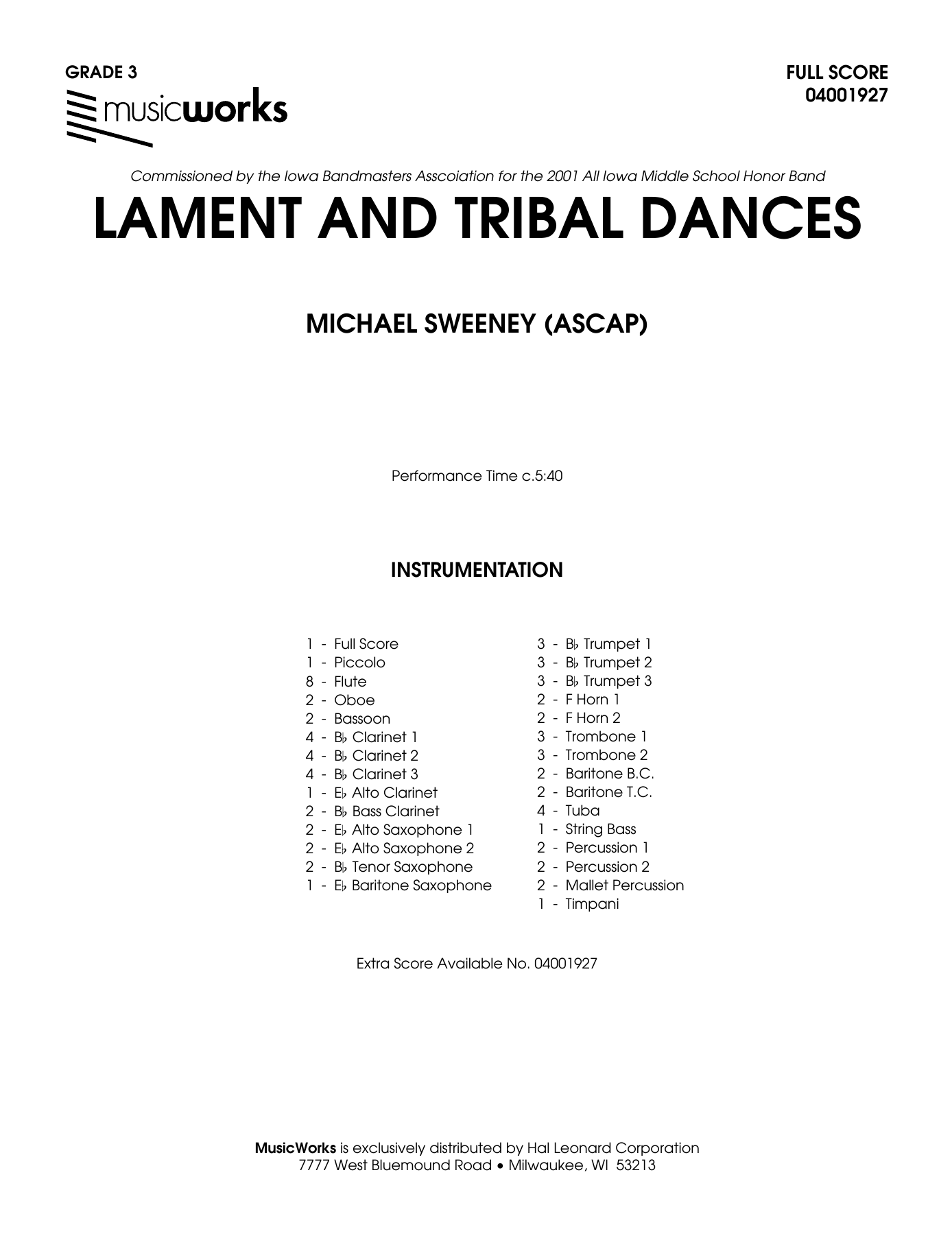

Lament and Tribal Dances: Concert Band Conductor Score & Parts
By Michael Sweeney
Grade: 3
Item: 35-PK01603323
$75.00
Pickup currently not available
Buy Extra Parts (Digital PDF Download)
Parts Added to Cart!
Description
Commissioned by the Iowa Bandmasters Association, this dynamic work from Michael Sweeney is written in three contrasting sections. The opening "Lament" features a plaintive horn melody and expansive harmonies. The mood then shifts to an intensely rhythmic dance using an unusual modal scale. In the final section, the flutes switch to recorders and a driving percussion ostinato figure helps propel this magnificent piece to a dramatic ending. A rewarding and satisfying work from one of today's best composers for young bands.


Discover MakeMusic Cloud: thousands of interactive titles your students can play along with today.
Sample Audio
No sample audio found.
Sample Video
Additional Details
Publisher:
Hal Leonard
SKU:
35-PK01603323
More about this title
About the Composer: Michael Sweeney
Michael Sweeney stands among the most prolific composers writing for young and developing bands today. His works span from educational concert pieces to full-length musicals, all marked by clear orchestration, memorable themes, and genuine understanding of what student musicians can achieve at various levels.
Sweeney's gift lies in writing music that challenges students without overwhelming them. His melodies are singable, his rhythms are logical, and his use of the concert band palette consistently finds fresh combinations that keep both players and audiences engaged.
Why we love this
Sweeney builds a complete musical narrative across three movements without padding or repetition. The structural clarity here serves both rehearsal and performance; students understand where they are in the piece because the harmonic and textural shifts are unmistakable. The modal dance section gives you a rhythmic anchor that almost teaches itself through its relentless drive.
What to expect
The opening draws you inward with its gentle, horn-centered songfulness. Then the rhythm section suddenly locks into a hypnotic groove, and the band transforms into something more primal and driving. By the final section, with recorders gleaming above the relentless percussion pulse, the piece builds toward genuine triumph rather than mere volume.
Who it's for
Grade 3 bands ready for music that moves beyond simple statements. This work rewards both straightforward and developing sections equally, so your strongest players stay engaged while less experienced ones find clear entry points and supportable parts.
How to get the most out of it
- Balance the opening horn melody against the accompanying voices. This isn't a solo feature but a unified sound; the horns should sing without dominating the harmonic foundation beneath them.
- Lock into the modal scale that defines the second section. Its unfamiliar intervallic world can sound sloppy if players approach it casually; isolate those passages and sing the collection to internalize the pitch set.
- Treat the percussion ostinato in the final section as your metronome. Once it's locked, the winds can layer their figures on top without losing shape.
- Exploit the timbral shift when flutes move to recorders. The change isn't decorative; it signals the final push and should be heard as a distinct moment by the audience.
How to use it
Open a concert with this piece to establish mood and energy in one gesture. It also pairs well in a thematic set exploring contrasts, whether you're programming works about storytelling, dance, or emotional transformation. The relatively compact length makes it useful as a concert anchor without consuming your full rehearsal year.
Skills your students will build
- Playing sustained, songful lines without sacrificing harmonic support
- Reading and performing modal scales (non-major, non-minor tonality)
- Locking rhythmic ostinato patterns across the ensemble
- Executing smooth transitions between contrasting sections
- Balanced voicing across harmonic textures