
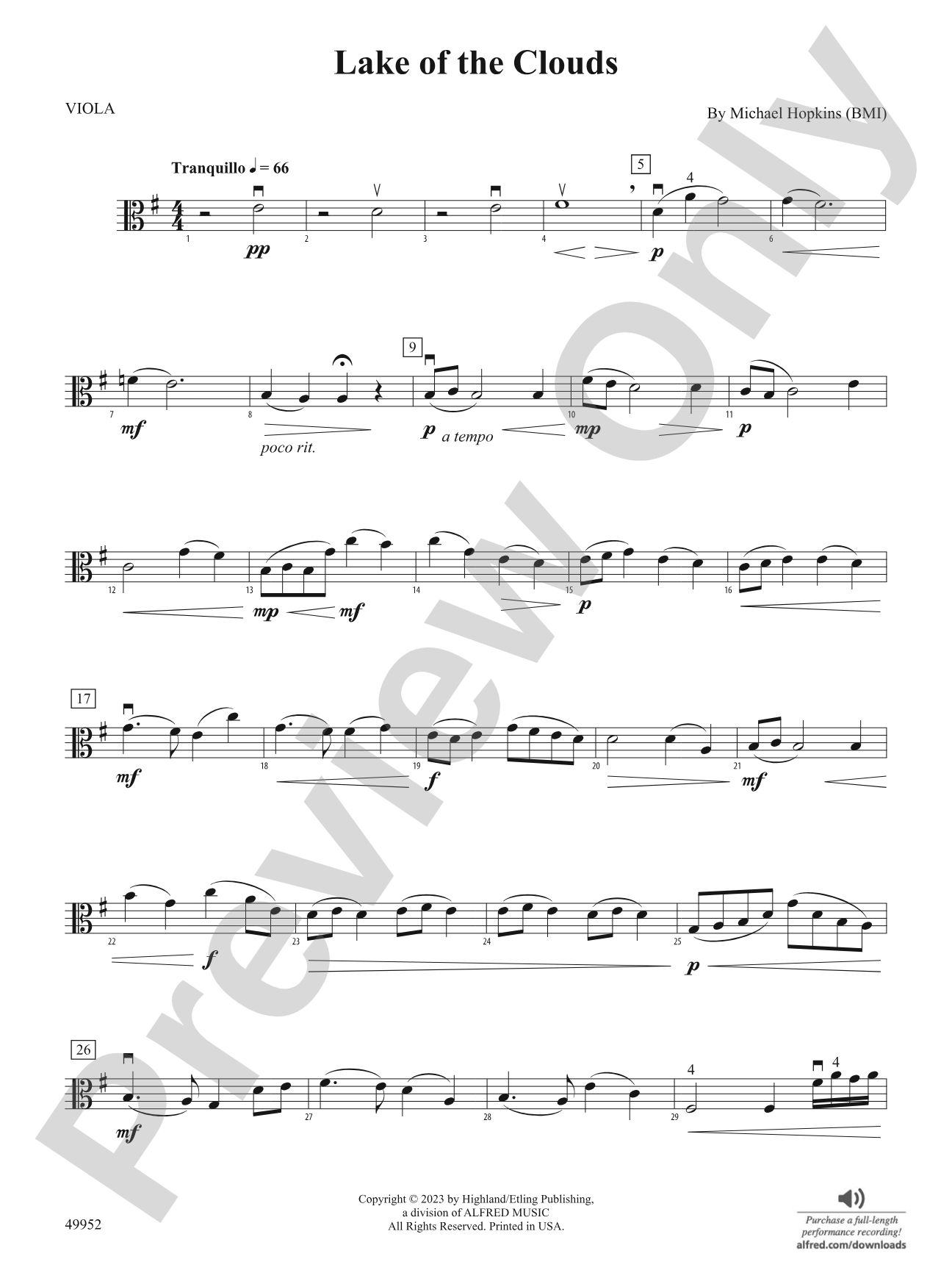

Lake of the Clouds: Viola
By Michael Hopkins
Grade: 3
Item: 00-PC-0019136_VA1
$3.00
Pickup currently not available
Description
Lake of the Clouds, by Michael Hopkins, is a beautiful lyrical original concert work for string orchestra. A visit to the Lake of the Clouds, situated in a valley between two ridges in the Porcupine Mountains in the Upper Peninsula of Michigan, inspired the composition. The lake is deep blue and lies within thick old-growth forests. The music depicts the majestic beauty and enchanting scenery of this natural treasure. This is an outstanding piece for working on sustaining tone, legato bows, dynamics, and phrasing. (4:00)
The PerformancePlus+ series is an innovative addition to the ever-expanding MakeMusic Cloud interactive library. These engaging selections are presented with educational resources designed to enrich the rehearsal process and create outstanding performances. Including:


The PerformancePlus+ series is an innovative addition to the ever-expanding MakeMusic Cloud interactive library. These engaging selections are presented with educational resources designed to enrich the rehearsal process and create outstanding performances. Including:
- Assignment, recording, and assessment tools within MakeMusic Cloud
- Piece-specific exercises focused on skills and techniques
- Educational tips and suggestions to support learning
Available in print and digital formats.
Don't just read it, hear it, play along with it, and watch your students grow with it. In MakeMusic Cloud, Lake of the Clouds: Viola comes alive with professional accompaniment, adjustable tempo, and built-in practice tools that turn solo practice into real progress.
Open in the Player
Jump straight in and assign it today.
Start Your Free Trial
Open this title and explore the full library in minutes.
Sample Audio
1
Audio File
--:--
0:00
0:00
Sample Video
No sample videos found.
Additional Details
Series:
Highland/Etling String Orchestra - PerformancePlus+
Publisher:
Alfred Music
SKU:
00-PC-0019136_VA1
More about this title
About the Composer: Michael Hopkins

Michael Hopkins leads the music education program at the University of Michigan, where he teaches string techniques, orchestra methods, and music psychology. His background includes conducting university orchestras at Vermont and directing middle and high school orchestras across Colorado, Michigan, and Vermont. He founded the Burlington Chamber Orchestra and has guest conducted at over 100 festivals and clinics nationwide.
Hopkins has composed and arranged more than 70 published works for orchestra and is a frequent presenter at national music education conferences on string pedagogy and music technology. His scholarship appears in the Journal of Research in Music Education, American String Teacher, and Music Educators' Journal. He authored The Art of String Teaching, a foundational resource for string teachers at all levels.
Why we love this
Hopkins writes with the practical knowledge of someone who has spent decades teaching and conducting student orchestras. Lake of the Clouds balances genuine musical substance with achievable technical demands at Grade 3, making it rewarding rather than frustrating for young players. The programmatic inspiration gives students something concrete to visualize, transforming rehearsal from technique drill into collaborative storytelling.
What to expect
The music unfolds like a journey through quiet forests and deep water, with long singing lines that float above gentle harmonic support. Majestic moments emerge gradually, never rushed, inviting the listener into the serene beauty of a remote landscape.
Who it's for
String orchestras in grades 3-5 looking for a concert piece that develops tone production and bow control without relying on technical pyrotechnics. Directors preparing students for festival performances or working toward more refined, lyrical playing will find this piece both musically satisfying and pedagogically purposeful.
How to get the most out of it
- Shape the long melodic lines by thinking of each phrase as a single continuous breath; avoid rhythmic breaks within the slurs.
- Layer your dynamic approach: establish the foundation with bass voices, then have upper strings shape their dynamics around the harmonic support below.
- Record a rehearsal and listen back specifically for uniformity of bow speed during the sustained passages; this reveals imbalance that's difficult to hear in real time.
- Invite students to research and discuss the Lake of the Clouds location before rehearsing; connecting the visual landscape to the musical imagery deepens their interpretive choices.
How to use it
Program this as a centerpiece for a spring concert alongside a more energetic opener and a lighter closing piece; its sustained lyricism benefits from being heard fresh, not buried between faster works. It also works well as a contest or festival selection where judges value refinement and musicianship over velocity.
Skills your students will build
- Sustaining full-bow tone across long phrase lengths
- Legato bow changes with no audible separation
- Dynamic shaping and control within soft to moderate dynamic ranges
- Phrasing and breath placement in string writing
- Ensemble balance and sectional blend in sustained harmonies