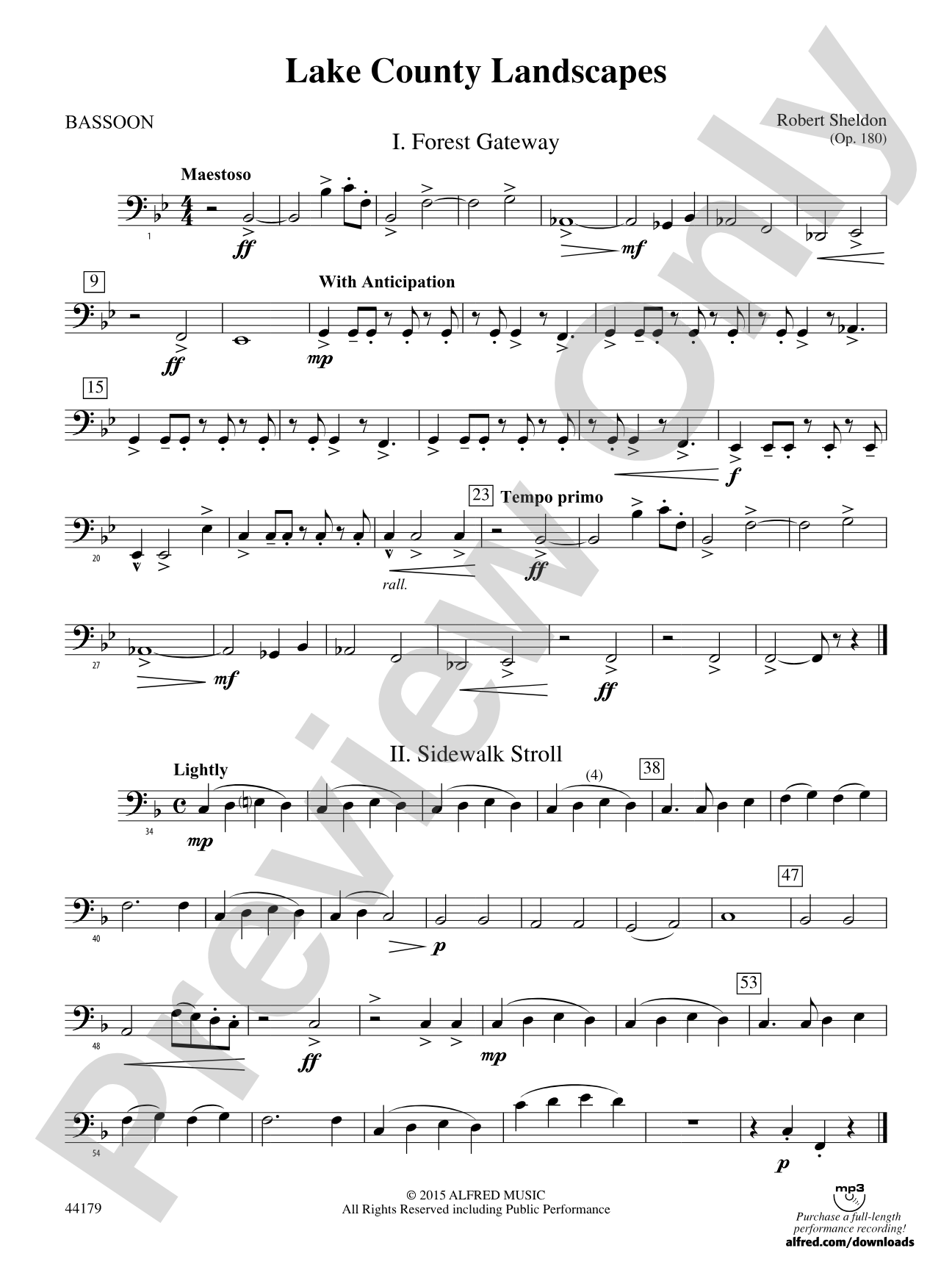
Lake County Landscapes: Bassoon Sheet Music Preview

Lake County Landscapes: Bassoon

By Robert Sheldon

Grade: 3 (Medium)

Item: 00-PC-0017029_B1

Digital Download
$3.00
Description
Lake County Landscapes is a mini-suite that pays tribute to four charming places. An excellent teaching piece, developing bands are presented with brief musical tableaus, each having a distinctive style while exploring common time, 3/4, and 6/8 meters. (4:30)

Don't just read it, hear it, play along with it, and watch your students grow with it. In MakeMusic Cloud, Lake County Landscapes: Bassoon comes alive with professional accompaniment, adjustable tempo, and built-in practice tools that turn solo practice into real progress.

Sample Audio
0:00
0:00
Sample Video
Additional Details
Series: Young Symphonic
Publisher: Alfred Music
Page Count: 264
SKU: 00-PC-0017029_B1

More about this title

About the Composer: Robert Sheldon

Robert Sheldon

Robert Sheldon's wind band compositions appear on contest and concert programs worldwide, performed by ensembles ranging from middle school bands to professional groups. His awards from the American School Band Director's Association, Phi Beta Mu, and ASCAP recognize a catalog that balances accessibility with genuine musical substance. He co-authored Sound Innovations for Concert Band and continues to produce new works annually while maintaining an active schedule as a guest conductor and clinician across the United States and internationally.

Sheldon's conducting appearances span five continents, including residencies at honor bands and educational conferences. His works have been performed at Carnegie Hall, Orchestra Hall in Chicago, Boston Symphony Hall, the Sydney Opera House, and the Kennedy Center. In 2020, VanderCook College of Music honored him with a doctorate recognizing his contributions to wind band literature and music education.

Why we love this

Sheldon constructs each movement with a clear pedagogical purpose without sacrificing musical personality. The meter rotation serves real classroom needs, building student confidence through manageable sections that establish patterns before adding complexity. Programming a complete suite by a well-established composer sends a professional signal while allowing your band to work on distinct musical problems within a single rehearsal unit.

What to expect

Four distinct snapshots unfold as your band moves through common time, waltz meter, and compound meter. Each movement maintains its own tonal center and rhythmic personality while remaining direct and approachable, creating a satisfying arc from start to finish.

Who it's for

Grade 3 concert bands ready to engage multiple meters within a single rehearsal cycle. This works well for ensembles that have solidified 4/4 fundamentals and are developing comfort with simple meters in different contexts.

How to get the most out of it

  • Establish steady pulse early in rehearsals before introducing the meter changes. Each landscape functions as an independent vignette, so mark clear sectional breaks in your score to help students navigate transitions without losing momentum.
  • Balance the band's tutti textures so that inner voices remain audible. Sheldon's scoring typically gives meaningful material to every section, and clarity in the middle voices prevents the piece from sounding muddy during fuller passages.
  • Shape phrasing according to the character suggested by each movement's title. Avoid letting the shorter overall length fool you into rushing; each landscape benefits from breathing space and architectural clarity.

How to use it

Perform the complete suite as a concert centerpiece or festival selection where the 4:30 duration fits comfortably between larger works. The suite also works effectively as a pacing tool in a concert program, offering contrast if programmed alongside heavier or more contemporary pieces.

Skills your students will build

  • Reading and executing common time, 3/4, and 6/8 meters in single concert piece
  • Maintaining steady tempo during meter modulations
  • Balancing tutti textures across the full ensemble
  • Responding to distinct stylistic cues within a multi-movement work
  • Ensemble intonation across sustained passages and moving lines

You May Also Like