
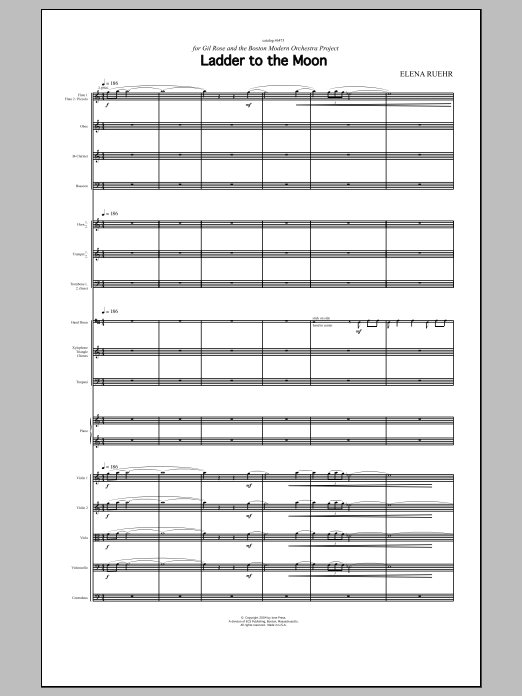

Ladder to the Moon: Full Orchestra Conductor Score & Parts
Arranged by Elena Ruehr
Item: 35-PK00277732
$29.90
Pickup currently not available
Buy Extra Parts (Digital PDF Download)
| Product | Price | Quantity |
|---|---|---|
| Ladder to the Moon - Full Score | $6.30 | |
| Ladder to the Moon - Flute/Piccolo | $0.90 | |
| Ladder to the Moon - Flute | $1.05 | |
| Ladder to the Moon - Oboe | $0.75 | |
| Ladder to the Moon - Clarinet | $1.05 | |
| Ladder to the Moon - Bassoon | $1.05 | |
| Ladder to the Moon - F Horn | $1.05 | |
| Ladder to the Moon - F Horn | $1.05 | |
| Ladder to the Moon - Trumpet | $0.75 | |
| Ladder to the Moon - Trumpet | $0.75 | |
| Ladder to the Moon - Trombone | $0.90 | |
| Ladder to the Moon - Trombone | $0.75 | |
| Ladder to the Moon - Percussion | $1.65 | |
| Ladder to the Moon - Piano | $1.05 | |
| Ladder to the Moon - Timpani | $1.05 | |
| Ladder to the Moon - Violin | $1.65 | |
| Ladder to the Moon - Violin | $1.65 | |
| Ladder to the Moon - Viola | $1.65 | |
| Ladder to the Moon - Violoncello | $1.50 | |
| Ladder to the Moon - Contrabass | $1.35 |
Parts Added to Cart!
Description
This is one of three orchestral works based on the paintings of Georgia O'Keefe, commissioned by the Boston Modern Orchestra Project. Sample can be heard at my website: elenaruehr.org. Can be played on its own or with the other works in the set: Sky Above Clouds and Summer Days. Duration: 12:00


Ladder to the Moon: Full Orchestra Conductor Score & Parts isn't in MakeMusic Cloud just yet...but it could be. Let us know you'd like to see it, and you'll help shape what comes next. In the meantime, start a free trial and dive into thousands of interactive titles your students can play along with today.
Request This Title
Tell us you want it.
Start Your Free Trial
Explore everything that's ready to play right now.
Sample Audio
No sample audio found.
Sample Video
No sample videos found.
Additional Details
Publisher:
Hal Leonard
SKU:
35-PK00277732
More about this title
About the Arranger: Elena Ruehr
Elena Ruehr is a composer whose work draws inspiration from visual art, particularly the modernist paintings of Georgia O'Keeffe. Her commissions from major ensembles like the Boston Modern Orchestra Project demonstrate her standing in contemporary classical music. Ruehr writes with orchestral sophistication while maintaining accessibility for performers, making her work valuable for programs seeking substantive 20th and 21st century repertoire.
Why we love this
Ruehr's response to O'Keeffe's visual language produces orchestral writing that feels genuinely inspired rather than derivative. The O'Keeffe trilogy opens a rich programming opportunity: you can present all three works as a thematic concert event, or program individual pieces when you need substantial contemporary work with genuine artistic vision backing it.
What to expect
The music evokes the vast, meditative quality of O'Keeffe's New Mexico landscapes; it unfolds with architectural clarity while maintaining a sense of luminous mystery. Listeners experience an orchestral soundworld that feels both modern and organically connected to nature itself.
Who it's for
This work suits orchestras comfortable with contemporary idioms and visual art as compositional stimulus. It works equally well in university orchestras, community orchestras with strong musicianship, and secondary school ensembles with solid intonation and musical maturity.
How to get the most out of it
- Listen to the composer's recording on her website before your first read-through; understanding her conception of tempo and color shapes how you'll shape the work across twelve minutes.
- Balance the relationship between solo and tutti passages carefully, as the orchestration often features individual instruments or small groups emerging from the full ensemble.
- Pay attention to dynamic shaping within sustained passages; what appears static on the page often contains subtle harmonic movement that benefits from gradual tonal adjustment.
How to use it
Consider programming Ladder to the Moon alongside other visual art-inspired works to create a thematic concert around interdisciplinary creativity. Alternatively, pair it with classical or romantic orchestral works to demonstrate contemporary composers' engagement with timeless artistic questions. The twelve-minute duration makes it a natural centerpiece without overwhelming a traditional concert format.
Skills your students will build
- Balancing articulation in sustained chord progressions
- Blending diverse instrumental timbres in contemporary harmonic contexts
- Shaping long-form orchestral structure without traditional tonal closure
- Responding to non-narrative musical conception