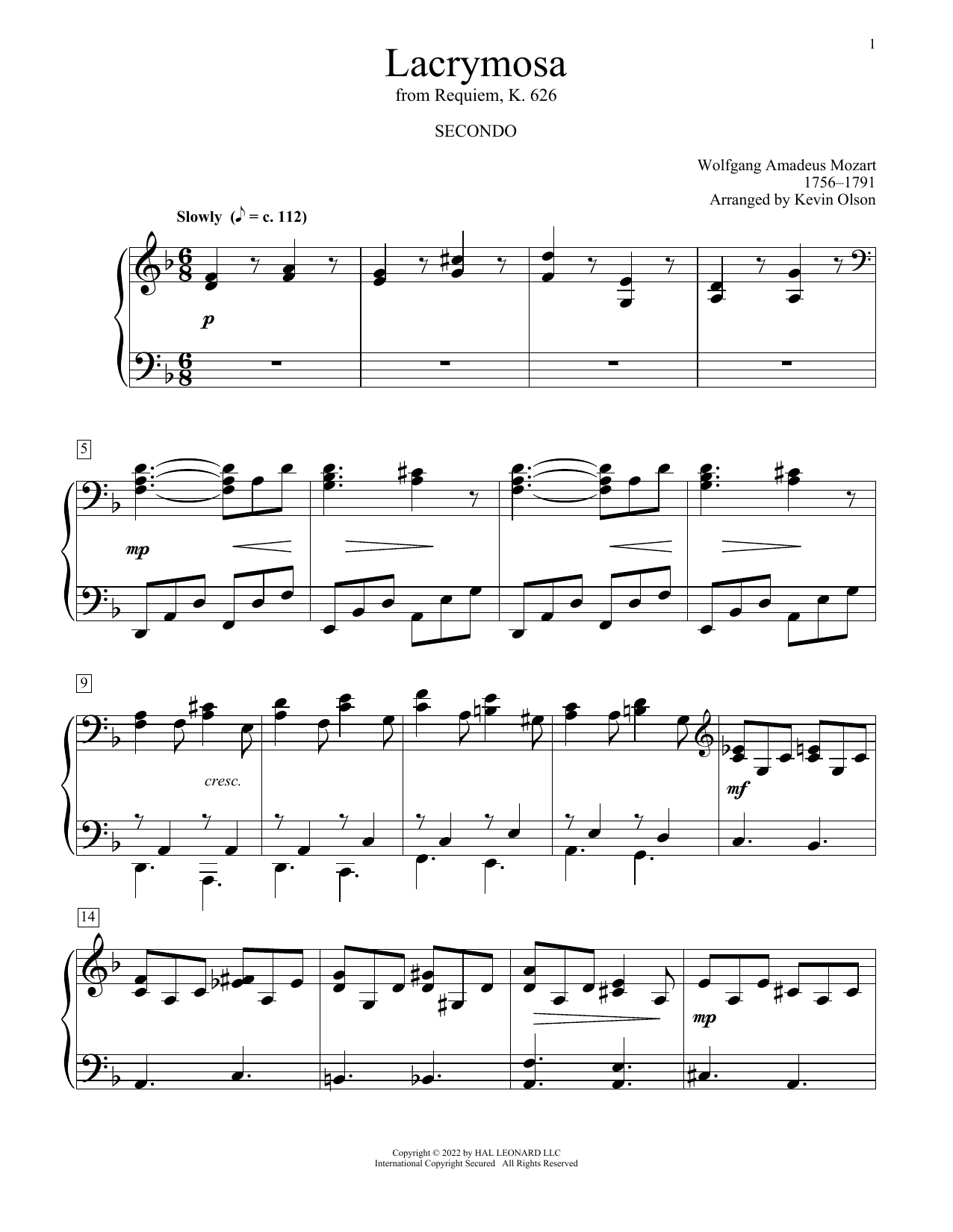
Kevin Olson has built a reputation as an arranger who understands how to translate large orchestral works into idiomatic settings for smaller ensembles. His arrangements prioritize musical integrity while remaining playable by musicians at realistic levels.
Why we love this
Olson's treatment of this iconic Mozart passage respects the original's emotional weight while giving piano trio players a chance to grapple with genuine dramatic material. The six-page arrangement neither oversimplifies nor demands the virtuosity of a solo recital piece, making it genuinely useful for advanced student ensembles and semi-professional groups.
What to expect
The piece inhabits that liminal space between funeral liturgy and intimate sorrow. You feel the Latin text's gravity even in translation; the sparse arrangement forces every phrase to resonate with purpose and prevents the kind of orchestral wash that can distance performers from the actual emotional content.
Who it's for
This arrangement serves advanced high school ensembles, college chamber groups, and motivated community musicians comfortable with classical repertoire and Mozart's harmonic language. It works for programs that want serious concert material without the logistics of a full orchestra.
How to get the most out of it
Shape the opening melody with a clear narrative arc; this isn't about speed but about drawing listeners into the text's spiritual weight even without Mozart's full orchestration.
Balance the piano part carefully during passages where it carries harmonic foundation. The sonority should support rather than overwhelm the string lines.
Work the cadential moments with intention. These are architecture points where ensemble precision matters as much as expression.
How to use it
This fits naturally into a concert exploring spirituality in music, paired alongside other sacred or meditative work. It's equally powerful as an encore that shifts a program's emotional temperature entirely, leaving the audience quiet and reflective.
Skills your students will build
Sustaining legit singing tone across long phrases in a chamber setting
Balancing three instruments without conductor doubling parts
Interpreting Mozart's harmonic language and voice leading
Executing clean cutoffs and releases as ensemble communication
Managing dynamic restraint and drama without orchestral color
You May Also Like
Scan to Complete Your Purchase
Use your phone's camera to scan the code below
You'll log in on your phone and the order will be added to your account