Lacrimosa (from Requiem): 2nd Violin Sheet Music Preview

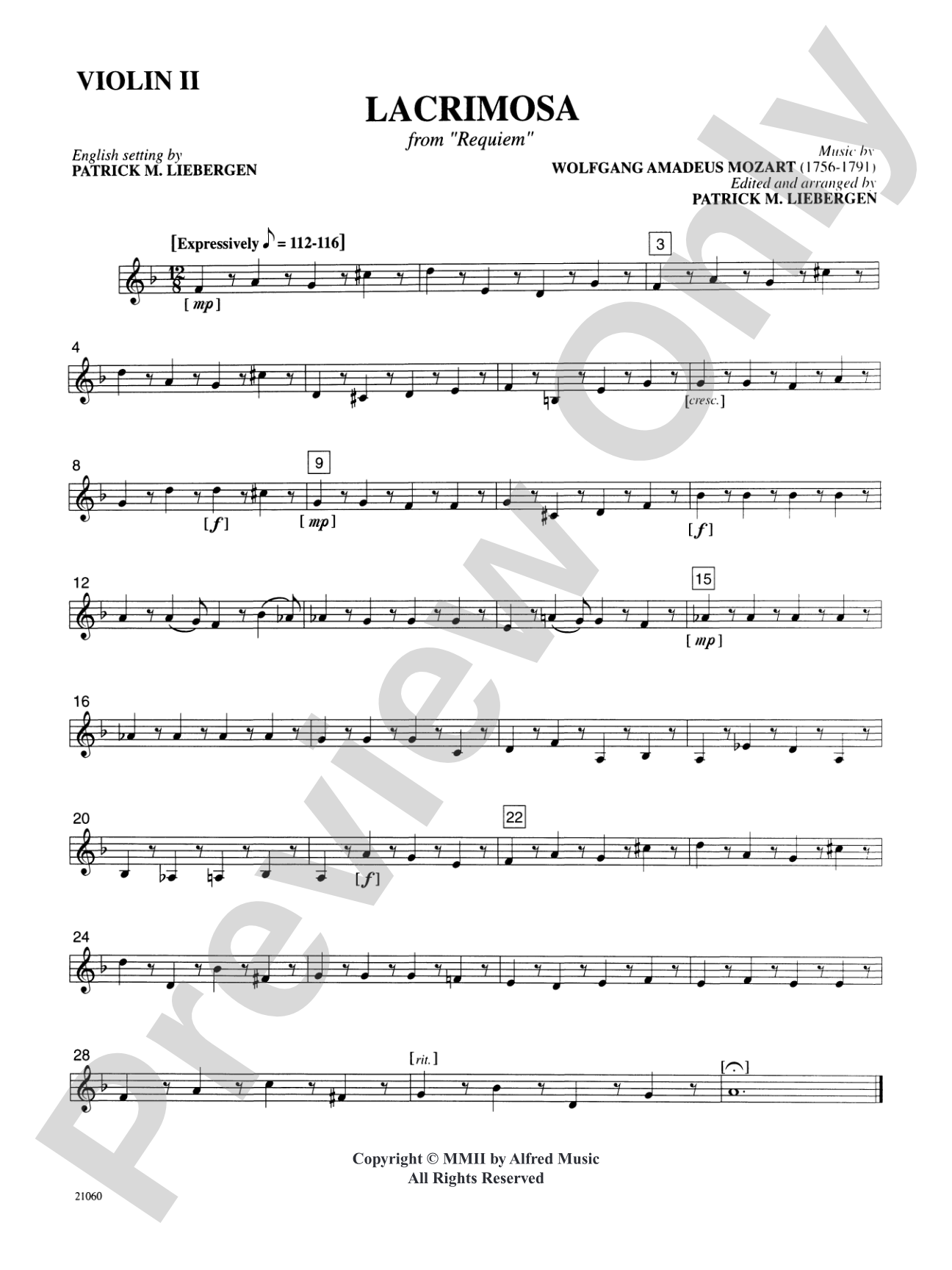
Lacrimosa (from Requiem): 2nd Violin

Music by Wolfgang Amadeus Mozart / arr. Patrick M. Liebergen

Item: 00-PC-0016169_VN2

Digital Download
$3.00
Description
Includes parts for a woodwind trio/string quartet.

Don't just read it, hear it, play along with it, and watch your students grow with it. In MakeMusic Cloud, Lacrimosa (from Requiem): 2nd Violin comes alive with professional accompaniment, adjustable tempo, and built-in practice tools that turn solo practice into real progress.

Sample Audio
0:00
0:00
Sample Video
Additional Details
Series: Alfred Choral Designs
Publisher: Alfred Music
Page Count: 14
SKU: 00-PC-0016169_VN2
Instrumentation: SoundPax

More about this title

About the Composer: Wolfgang Amadeus Mozart

Mozart composed the Requiem in K. 626 during the final months of his life in Vienna, leaving the work incomplete at his death in December 1791. His student Franz Xaver Süssmayr completed the instrumentation and remaining movements based on Mozart's sketches and compositional intentions. The Requiem stands as one of the most performed sacred works in the Western canon, combining the dramatic intensity of the Dies Irae with moments of profound tenderness and spiritual depth.

The Lacrimosa, which concludes the Dies Irae section, exemplifies Mozart's gift for expressing human emotion through music. Written in a minor key with descending melodic lines, the movement captures both grief and resignation. Its enduring power in concert halls and liturgical settings reflects Mozart's ability to transform Latin liturgical text into music that speaks across centuries and cultures.

Why we love this

Patrick Liebergen's arrangement preserves the emotional gravity of Mozart's original while creating an accessible version for choirs working with chamber ensemble accompaniment. The SoundPax format lets directors shape their own balance between choir and instruments, rather than being locked into a predetermined orchestral texture. Singers encounter one of music history's most significant sacred works without requiring a full orchestra or extensive rehearsal time.

What to expect

Lacrimosa opens with a hushed, lamenting quality as the choir enters the text about weeping and sorrow. The movement unfolds with restrained intensity, balancing minor-key darkness against Mozart's characteristic harmonic sophistication. The overall effect is contemplative and elegiac, inviting listeners into a moment of collective grieving and spiritual reflection.

Who it's for

This arrangement serves intermediate to advanced choirs that want to perform a cornerstone of the sacred repertoire with chamber ensemble support. Directors seeking a Requiem movement for liturgical services, concert programming, or festival performances will find this version both musically substantial and logistically manageable.

How to get the most out of it

  • Shape the descending melodic contour in the soprano line with gentle dynamic tapering, allowing gravity to pull the phrase downward rather than pushing through it artificially.
  • Coordinate with the woodwind/string parts during phrase endings to ensure the choir and instruments breathe together; the Lacrimosa gains its power from unified ensemble breathing.
  • Balance choir texture against the instrumental accompaniment by asking singers to listen actively rather than singing at full volume; Mozart's voice-leading is delicate and deserves clarity.

How to use it

This work fits naturally into a concert exploring Mozart's sacred music or a broader program centered on Requiem settings across different eras. A single movement allows programming flexibility without committing to the entire mass; pair it with contrasting sacred repertoire or use it as an emotional centerpiece in a mixed concert.

Skills your students will build

  • Singing exposed minor-key melodic lines with expressive control and accurate intonation
  • Balancing choral texture against chamber ensemble accompaniment while maintaining independent voice security
  • Interpreting Latin text with appropriate phrasing and emotional weight in a sacred context
  • Responding to instrumental cues and ensemble coordination across vocal and instrumental parts

You May Also Like