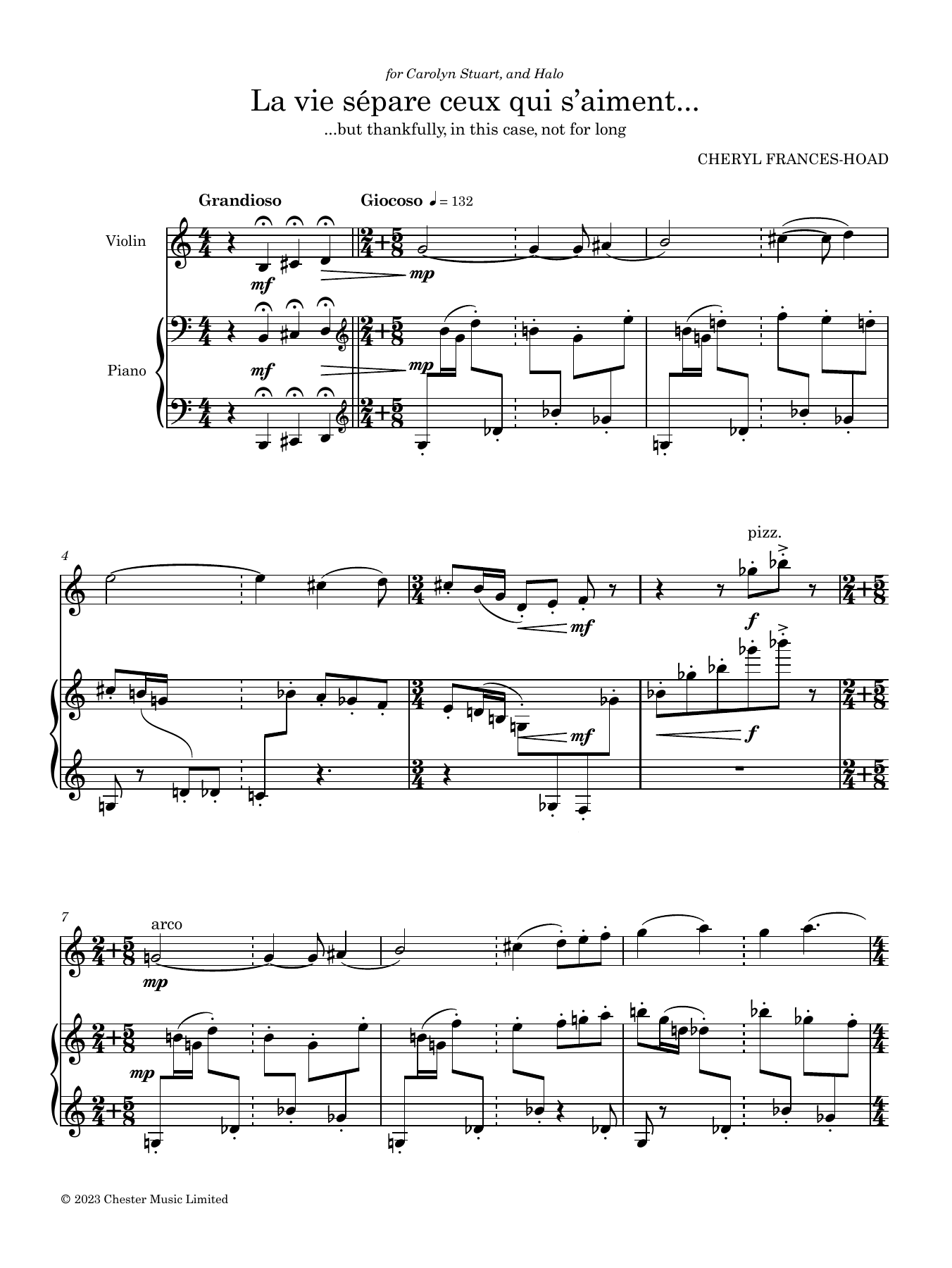
Cheryl Frances-Hoad is a British composer whose output spans instrumental, vocal, and chamber music across contemporary classical idioms. Her work frequently draws on literary and emotional narratives, translating poetic language into musical gesture with particular sensitivity to texture and instrumental color.
Why we love this
The title alone signals Frances-Hoad's gift for distilling complex emotional states into intimate musical moments. This violin and piano pairing captures something both fragile and resilient, making it a compelling choice for recital programs that need emotional depth without dramatic excess.
What to expect
The piece inhabits the quiet space where separation and memory meet. It moves through its material with restraint and consideration, never rushing toward resolution but instead lingering in the emotional texture of parting and absence.
Who it's for
Intermediate to advanced violinists with strong chamber music experience will find this piece both performable and artistically satisfying. It suits students developing their ability to sustain lyrical lines and pianists seeking repertoire that centers the accompanist as a true musical partner.
How to get the most out of it
Treat the opening as a conversation rather than a solo statement; the piano voice is as expressive as the violin line and deserves equal attention from the listener's perspective.
Explore the dynamic landscape carefully. Even small shifts in color and volume carry meaning in a piece this concentrated.
Balance technical evenness with emotional specificity. The nine pages reward both precision and interpretive commitment.
How to use it
Program this as a pairing with other chamber works exploring loss or transition, or place it as a centerpiece in a recital where intimacy is the goal. Its French title and emotional reserve make it particularly effective in thematic concerts built around art song or poetry.
Skills your students will build
Sustaining long melodic lines with shape and continuity
Collaborative listening and ensemble balance in chamber music
Interpreting emotional text through instrumental color
Navigating modal or contemporary harmonic language
Control of vibrato and dynamic nuance in legato passages
You May Also Like
Scan to Complete Your Purchase
Use your phone's camera to scan the code below
You'll log in on your phone and the order will be added to your account