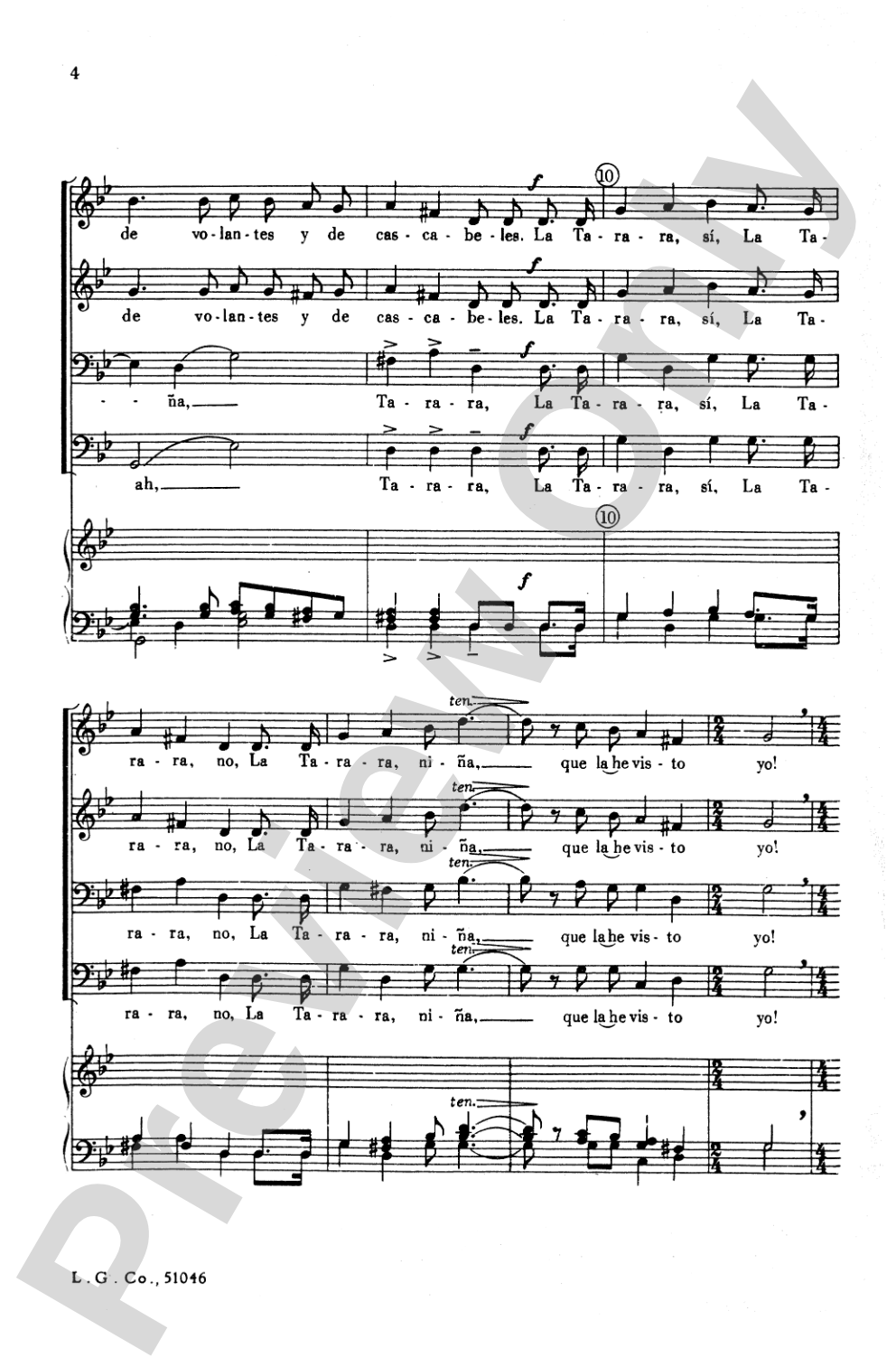
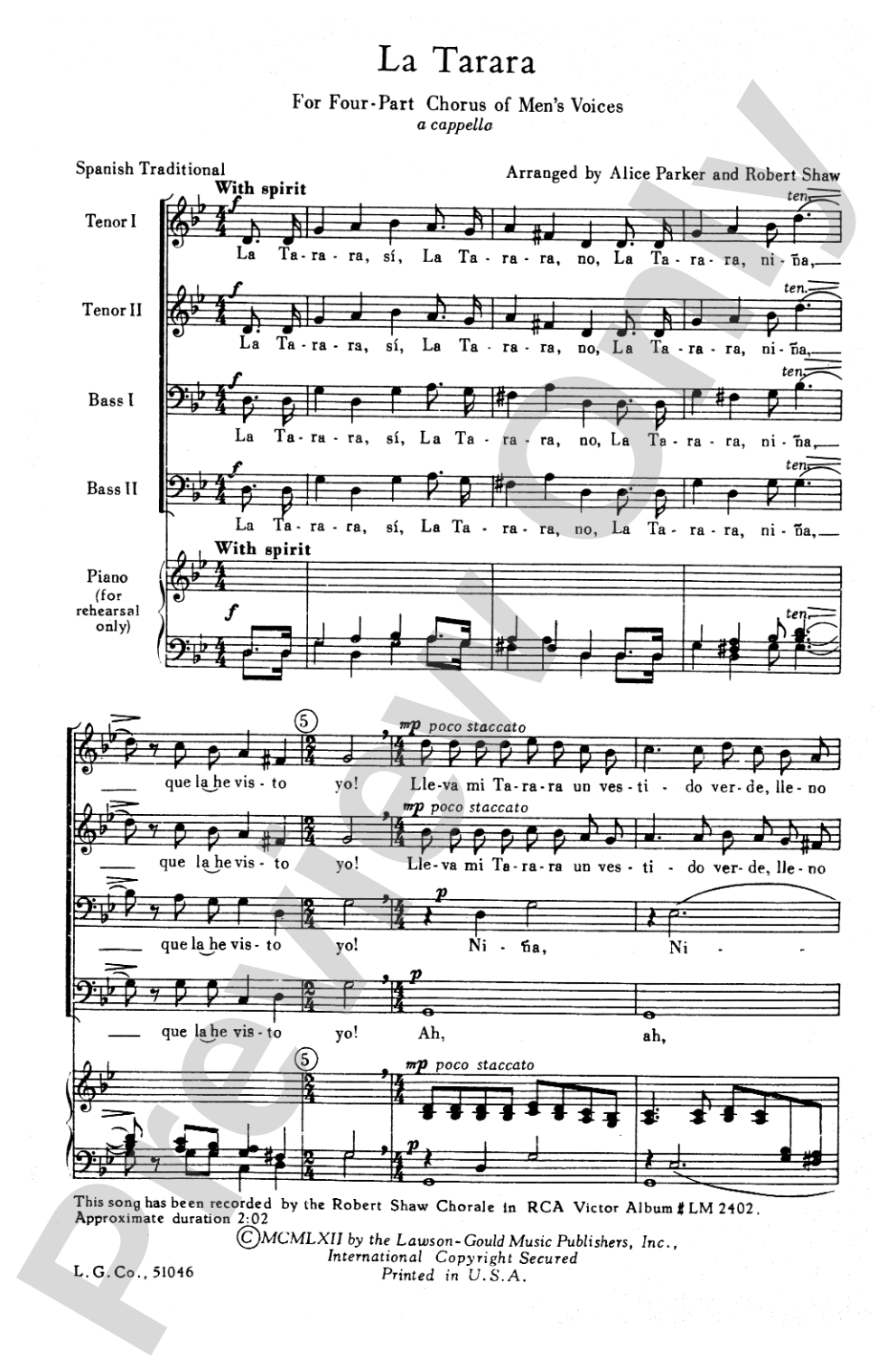
La Tarara Sheet Music Preview

La Tarara: 4-Part Men's Chorus Choral Octavo

Arr. Robert Shaw and Alice Parker

Item: 00-PO-0004963

Digital Download
$2.25

Minimum order quantity: 20 copies

Description

La Tarara: 4-Part Men's Chorus Choral Octavo isn't in MakeMusic Cloud just yet...but it could be. Let us know you'd like to see it, and you'll help shape what comes next. In the meantime, start a free trial and dive into thousands of interactive titles your students can play along with today.

Sample Audio
No sample audio found.
Sample Video
Additional Details
Series: Alfred Archive Edition: Robert Shaw Choral Series
Publisher: Alfred Music
Page Count: 12
SKU: 00-PO-0004963

More about this title

About the Arranger: Robert Shaw

Robert Shaw was a legendary choral conductor and arranger whose work fundamentally shaped American choral music in the 20th century. He founded the Robert Shaw Chorale in 1948 and served as director of the Atlanta Symphony Orchestra's chorus for decades, bringing meticulous musicianship and innovative arranging techniques to both professional and educational ensembles. Shaw's arrangements are prized for their clarity of voice leading, respect for text, and accessibility across skill levels.

Why we love this

Shaw and Parker's treatment of this Spanish folk material delivers authentic character without sacrificing singability for men's voices. The flexible voicing (TB/TTB/TBB/TTBB) means you can cast it to your actual roster rather than forcing singers into unsuitable ranges. The arrangement captures the vitality and rhythmic drive of the original while sitting comfortably in a rehearsal-friendly tessitura.

What to expect

Energetic and grounded, with the infectious rhythmic vitality of Spanish folk tradition. The piece has an unpretentious directness that appeals equally to singers and audiences, combining rhythmic drive with accessible melody.

Who it's for

This octavo works for men's choirs across levels, from high school through university and community ensembles. The flexible voicing system accommodates varying choir sizes and voice distributions without requiring rearrangement.

How to get the most out of it

  • Anchor the rhythmic pulse in the lower voices. The driving character depends on secure bass and baritone lines that don't rush the ensemble.
  • Shape the melodic line with attention to phrase length rather than note length. This folk melody needs breath and momentum, not mechanical evenness.
  • Balance accessibility with authenticity. The Spanish vernacular text deserves clear articulation and forward vowels; avoid oversinging or prettifying the folk idiom.
  • Use the flexible voicing strategically during rehearsal. Try different combinations when you're learning the piece to hear how voice distribution affects blend and balance.

How to use it

Program this alongside other folk material for a thematic concert exploring song traditions across cultures, or place it as a lighter moment in a set of sacred or art song repertoire. The 12-page length and moderate difficulty make it a natural choice for mid-year programming when rehearsal time is limited.

Skills your students will build

  • Rhythmic precision in ensemble singing, particularly with syncopated or driving patterns
  • Diction and articulation in Spanish text
  • Balancing unison and harmonic sections within flexible voicing arrangements
  • Phrasing and shaping in folk-based material

You May Also Like