La Suerte de los Tontos (Fortune of Fools): Piano Accompaniment Sheet Music Preview

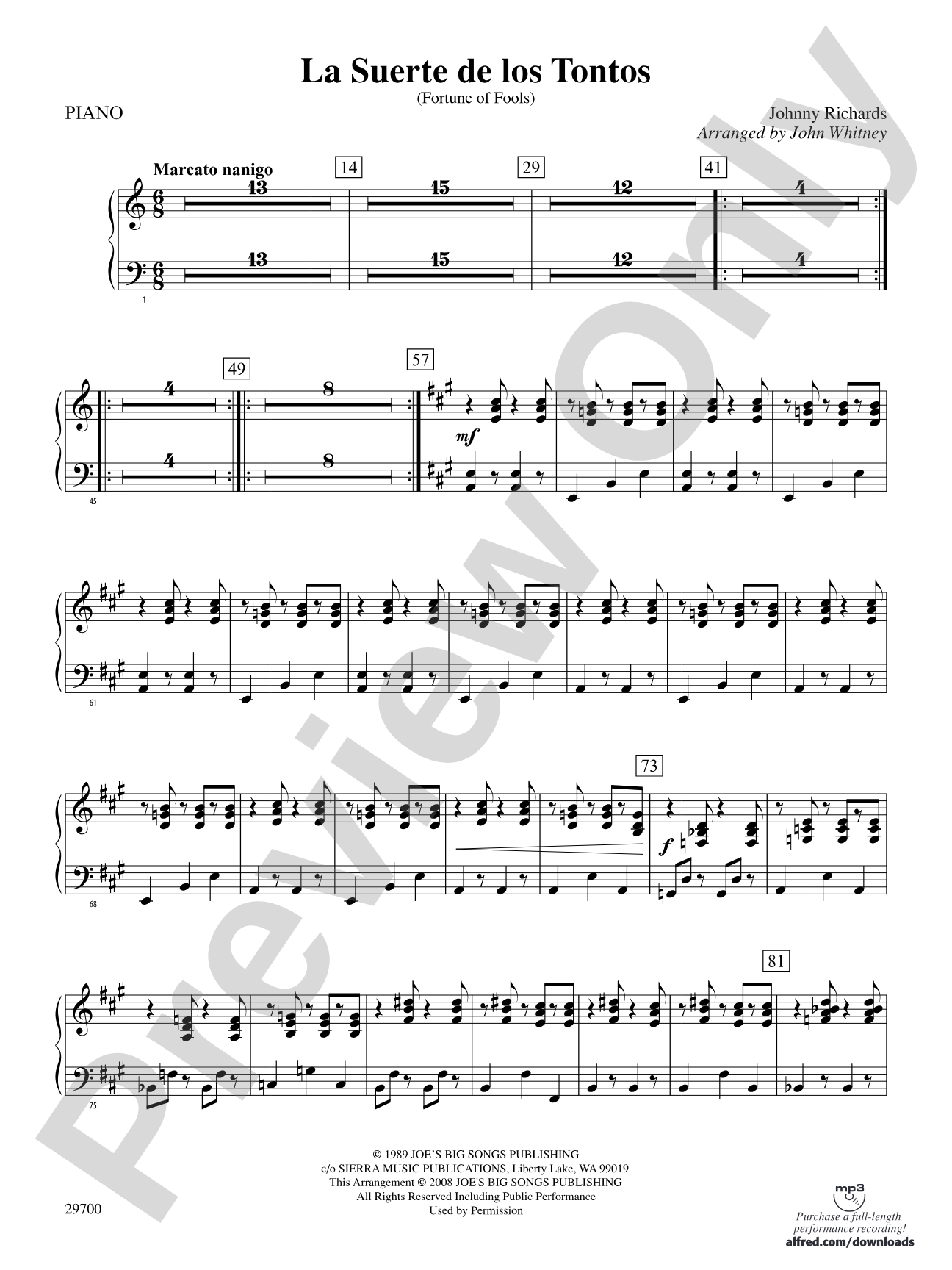
La Suerte de los Tontos (Fortune of Fools): Piano Accompaniment

By Johnny Richards / arr. John Whitney

Grade: 5

Item: 00-PC-0016179_K

Digital Download
$3.00
Description
Remember the word "fire" when preparing this music. It is powerful, dynamic and exciting music with infectious rhythmic feel, emphasized by the rhythm section and the counterpoint. Written for the Stan Kenton Band as one of the seven movements of Cuban Fire Suite, this piece makes Latin jazz perfect for the orchestra! (4:30)

Don't just read it, hear it, play along with it, and watch your students grow with it. In MakeMusic Cloud, La Suerte de los Tontos (Fortune of Fools): Piano Accompaniment comes alive with professional accompaniment, adjustable tempo, and built-in practice tools that turn solo practice into real progress.

Sample Audio
0:00
0:00
Sample Video
Additional Details
Series: Pop Concert Full Orchestra
Publisher: Alfred Music
Page Count: 240
SKU: 00-PC-0016179_K

More about this title

About the Composer: Johnny Richards

Johnny Richards (1911-1968) was a composer and arranger who shaped the sound of modern big band and orchestral jazz. Known for his sophisticated harmonic language and ability to blend Latin rhythms with jazz idioms, Richards created music that challenged both players and listeners. His work with Stan Kenton's orchestra produced some of the most adventurous large ensemble writing in American jazz, establishing him as a major voice in the evolution of concert jazz.

Why we love this

This piece delivers the exact energy you need when your program calls for something that grabs an audience immediately. The Latin jazz idiom sits perfectly in a full orchestra setting, and the counterpoint Richards wrote gives every section meaningful material rather than relegating anyone to purely rhythmic support. Contest judges consistently reward orchestras that can execute this kind of music with precision and swing.

What to expect

Propulsive and glamorous, with a driving clave heartbeat that never lets up. The orchestration sparkles with brass hits and reed counterpoint, while the rhythm section pushes the whole ensemble forward with unmistakable Latin energy. It feels like the best moment of a big band set captured in orchestral form.

Who it's for

Full orchestra directors seeking a dynamic contest or festival selection that showcases Latin jazz arranging at the highest level. This works for advanced high school orchestras and college ensembles with strong rhythm sections and Section leaders comfortable with swing style playing.

How to get the most out of it

  • Lock the rhythm section (piano, bass, drums) to a steady clave pattern before full rehearsals begin; the entire ensemble depends on their pocket to feel the Latin pulse correctly.
  • Balance the counterpoint by identifying which sections carry the melodic line in each phrase; in Latin jazz, the melody often moves between trumpet, trombone, and saxophone sections rather than staying in one voice.
  • Emphasize the infectious rhythmic feel by having the entire orchestra tap or count the clave pattern during early rehearsals, even sections playing sustained notes or harmonic filler.
  • Give the rhythm section freedom to breathe and shape the groove slightly; their slight pushes and pulls behind the beat create the fire the piece demands rather than a metronomic tick.

How to use it

Program this as a centerpiece for a Latin jazz or American music concert, where it can anchor the second half and send the audience out energized. It pairs naturally with other Kenton-era material or with contemporary Latin jazz compositions, creating a cohesive thematic program.

Skills your students will build

  • Playing with swing feel and Latin clave rhythms in an ensemble context
  • Reading complex counterpoint across all sections simultaneously
  • Balancing solo passages and harmonic background parts in a big band arrangement
  • Responding to and supporting a driving rhythm section
  • Executing rhythmic precision in fast, syncopated passages across the full orchestra

You May Also Like