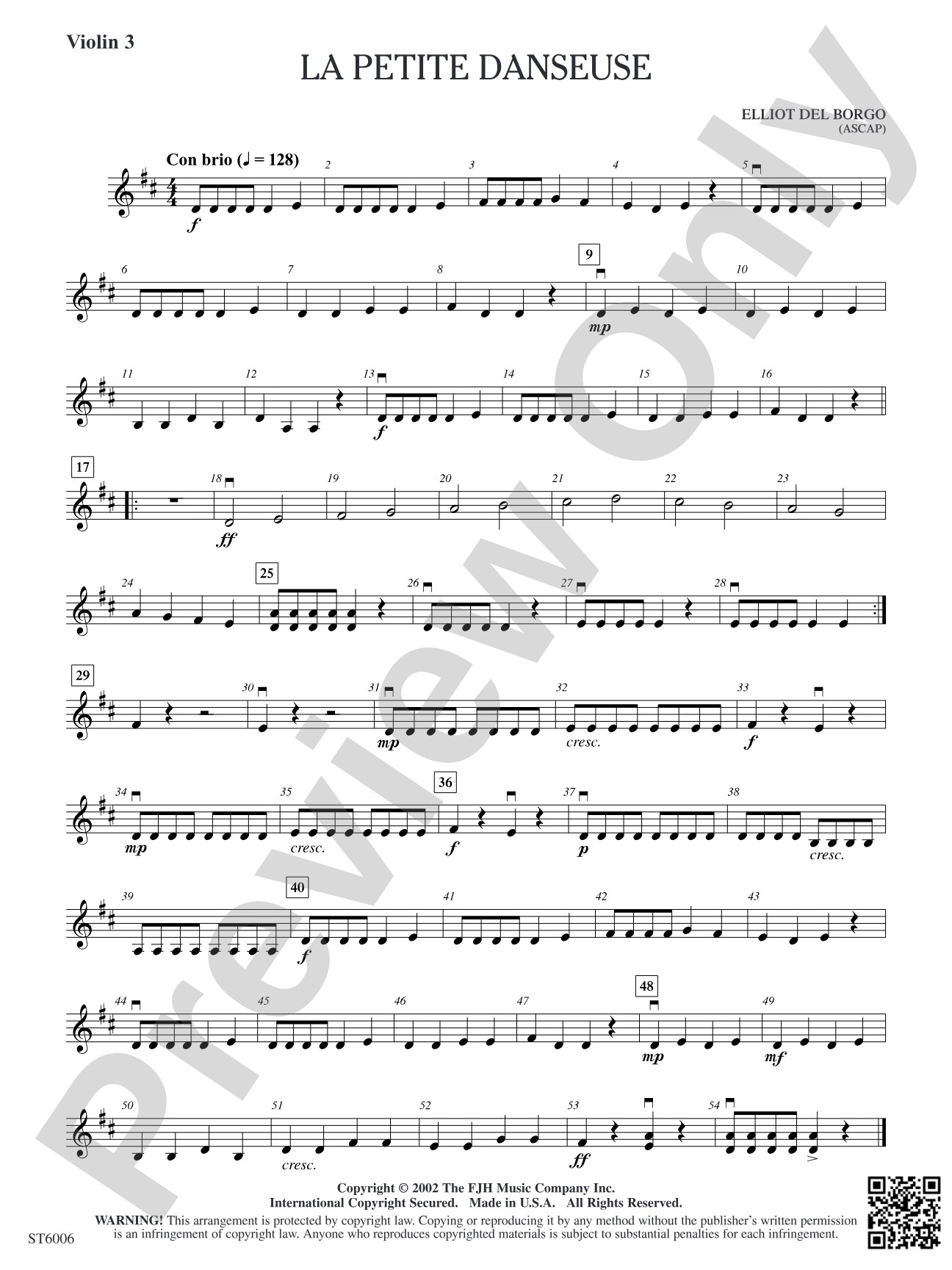
La petite danseuse: Optional Violin 3 (Viola) Sheet Music Preview

La petite danseuse: Optional Violin 3 (Viola)

By Elliot Del Borgo

Grade: 1.5

Item: 98-PC-DST6006_VN3

Digital Download
$7.00
Description
First-year players will enjoy this very easy and energetic piece in D major using only the first three strings. Repetitive rhythms and solid scoring help guarantee success with your beginning string orchestra. Highly recommended.

La petite danseuse: Optional Violin 3 (Viola) isn't in MakeMusic Cloud just yet...but it could be. Let us know you'd like to see it, and you'll help shape what comes next. In the meantime, start a free trial and dive into thousands of interactive titles your students can play along with today.

Sample Audio
0:00
0:00
Sample Video
Additional Details
Series: FJH Beginning Strings
Publisher: The FJH Music Company, Inc.
SKU: 98-PC-DST6006_VN3

More about this title

About the Composer: Elliot Del Borgo

Elliot Del Borgo is a prolific composer and arranger whose works span concert band, wind ensemble, orchestra, and string settings. His compositions for young musicians are known for their musical integrity, clear pedagogical design, and accessibility without sacrificing artistic merit. Del Borgo has contributed significantly to the repertoire available to beginning and intermediate ensembles, with particular strength in creating pieces that build confidence while maintaining genuine musicality.

Why we love this

Del Borgo understands what beginning string orchestras need: a piece that sounds energetic and accomplished without requiring technical wizardry. The D major tonality and first-position-only approach remove technical barriers, yet the rhythmic momentum and orchestral color make this feel like real music, not a stepping stone. Your students will walk off stage feeling they've performed something worth performing.

What to expect

The piece breathes vitality and charm, moving with the lightness of a young dancer finding her way across the stage. The D major key feels bright and open, and the rhythmic patterns create momentum that carries the ensemble forward naturally. It's the kind of music that makes beginning players feel genuinely musical rather than merely technical.

Who it's for

Beginning string orchestra directors with players in their first year of study will find this piece immediately rewarding. It works well for ensembles where students are still gaining confidence with basic technique, and it serves as an excellent choice for young musicians preparing for their first contest or festival appearance.

How to get the most out of it

  • Establish a steady tempo from the start; the repetitive rhythms thrive on rock-solid pulse work, so lock in the foundation before adding nuance.
  • Balance the melodic line with the supporting voices so the primary material cuts through without drowning out the harmonic foundation.
  • Keep the energy consistent throughout; resist the urge to slow down on repeated sections, which can flatten what should feel buoyant.
  • Use rehearsal time on intonation in D major, checking that open strings and first-position notes ring cleanly together.

How to use it

This works beautifully on a youth orchestra or beginning strings festival concert, where it can anchor a program of early pieces and showcase how far first-year players have come. Consider pairing it with other short, character-driven works at the Grade 1-2 level to build a cohesive opening section of your concert.

Skills your students will build

  • Playing in first position across all four strings
  • Maintaining steady rhythm and pulse with repetitive melodic patterns
  • Balancing melody and accompaniment in an orchestral texture
  • Reading and executing articulation and dynamics in a group setting
  • Building ensemble unison and intonation in D major

You May Also Like