
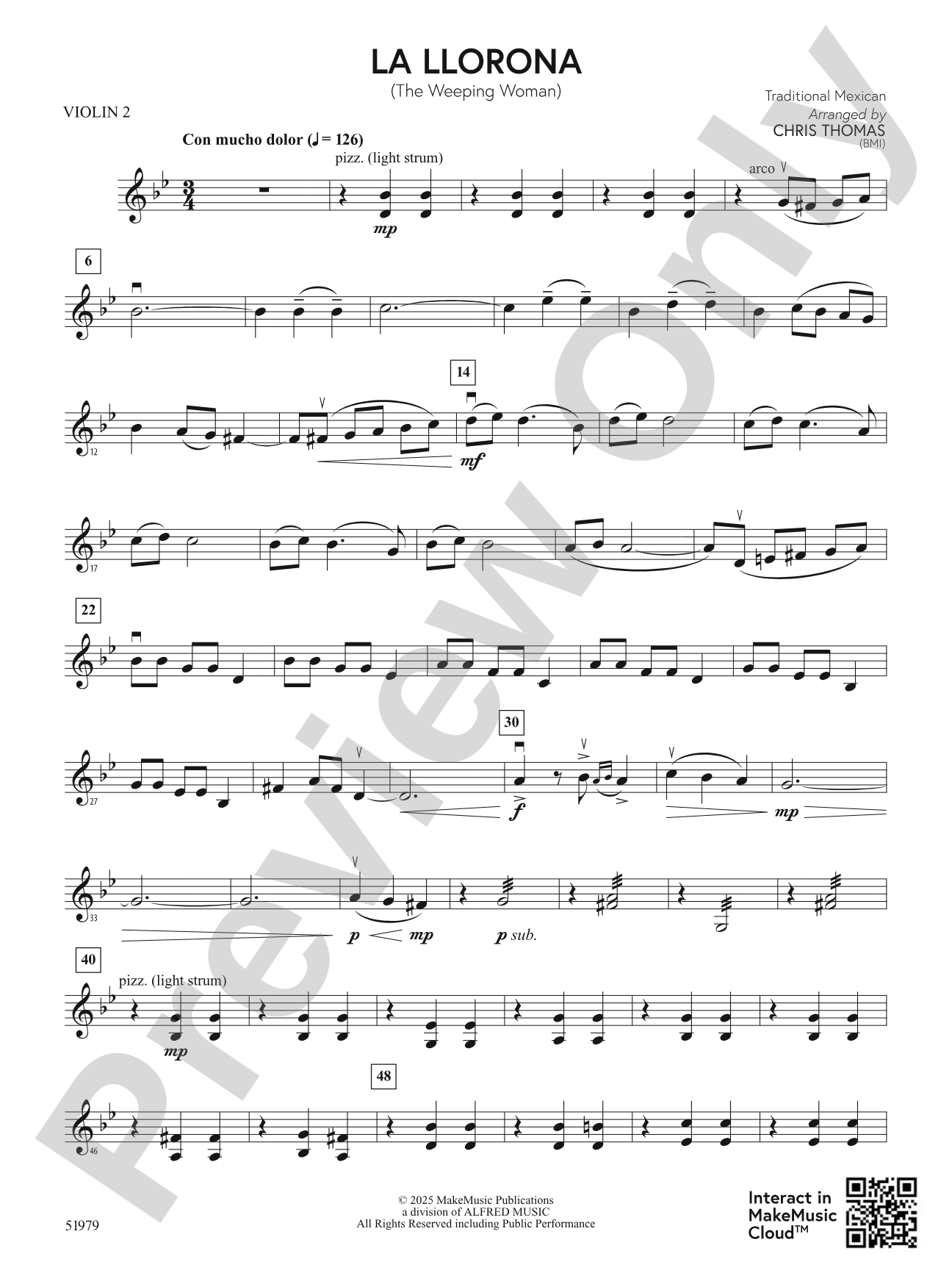

La Llorona: 2nd Violin
(The Weeping Woman)
Traditional Mexican / arr. Chris Thomas
Grade: 3.5-4
Item: 00-PC-0019458_VN2
$3.00
Pickup currently not available
Description
La Llorona (The Weeping Woman) is an iconic Mexican song rooted in one of the country's most famous and haunting legends. This arrangement by Chris Thomas features powerful melodies, strumming strings reminiscent of guitars, and dense, contemporary harmonies. Feature a quartet of soloists while also showcasing your ensemble in this fantastic work! (3:30)


Don't just read it, hear it, play along with it, and watch your students grow with it. In MakeMusic Cloud, La Llorona: 2nd Violin comes alive with professional accompaniment, adjustable tempo, and built-in practice tools that turn solo practice into real progress.
Open in the Player
Jump straight in and assign it today.
Start Your Free Trial
Open this title and explore the full library in minutes.
Sample Audio
1
Audio File
--:--
0:00
0:00
Sample Video
Additional Details
Series:
MakeMusic Symphony Strings
Publisher:
MakeMusic Publications
SKU:
00-PC-0019458_VN2
More about this title
About the Arranger: Chris Thomas

Chris Thomas composes for film, television, theme parks, and concert stages worldwide. His work has earned him a Hollywood Music in Media Award, two second-place finishes in the American Prize in Composition, a Global Music Award, and the Gold Medal at the Park City Film Music Festival. He has orchestrated and conducted for major studios including Sony, ABC, FOX, CBS, and HBO, and his concert works have been performed at Carnegie Hall, the Sydney Opera House, and the Hollywood Bowl.
Thomas's thematic compositions appear throughout major theme parks across the globe, from Evermore Adventure Park to Knott's Berry Farm and attractions in the United Kingdom. His Symphony No. 1 (the Malheur Symphony) became the subject of his 2019 TED Talk. His music for Emmy-nominated films and for The Woman Rebel (Academy Award shortlist) demonstrates his range across media and concert repertoire.
Why we love this
This arrangement captures the raw emotional power of a legendary Mexican narrative while building in pedagogical flexibility through the featured quartet passage. The contemporary harmonic language and guitar-like string textures create an immediately distinctive sound that engages student musicians without requiring extensive technical heroics, making it equally compelling at a festival or concert program.
What to expect
Haunting and deeply lyrical, this piece channels the pathos of the Llorona legend through sweeping string melodies and rich harmonic colors. The guitar-inspired rhythmic textures anchor the work in folk tradition while the dense contemporary harmonies create an emotional intensity that builds from introspective passages to moments of genuine power.
Who it's for
String orchestras at the intermediate-advanced level (grades 3.5-4) seeking repertoire that combines cultural authenticity with contemporary arranging. Directors programming for festivals, competitions, or concert showcases will appreciate the built-in dramatic arc and the opportunity to feature strong student soloists.
How to get the most out of it
- Balance the quartet soloists carefully against the ensemble; these passages work best when the soloists project with confidence and the full orchestra pulls back slightly to frame their lines.
- Pay attention to the rhythmic strumming patterns that emulate guitar accompaniment. Consistent articulation and unified bow direction across the sections will bring out the authenticity of the folk-music inspiration.
- Shape the powerful melodies through dynamic contrast and phrase direction. This material deserves lyrical playing rather than mechanical execution, even at the faster passages.
- Use the recorded accompaniment to lock ensemble rhythms and establish the desired tempo before diving into the solo quartet sections.
How to use it
This work thrives as a centerpiece in a multicultural concert program or as a standout festival entry that showcases both ensemble cohesion and individual musician artistry. The 3:30 length makes it ideal for programming between larger works, and its programmatic storytelling connects well with thematic concert concepts exploring world music or legend-based repertoire.
Skills your students will build
- Maintaining ensemble balance between featured soloists and full orchestra
- Executing rhythmic string textures that imitate guitar strumming patterns
- Shaping sustained melodic lines through dynamic phrasing and bow control
- Performing in contemporary harmonic language and unconventional chord progressions
- Ensemble precision in mixed ensemble passages (quartet plus full string orchestra)