
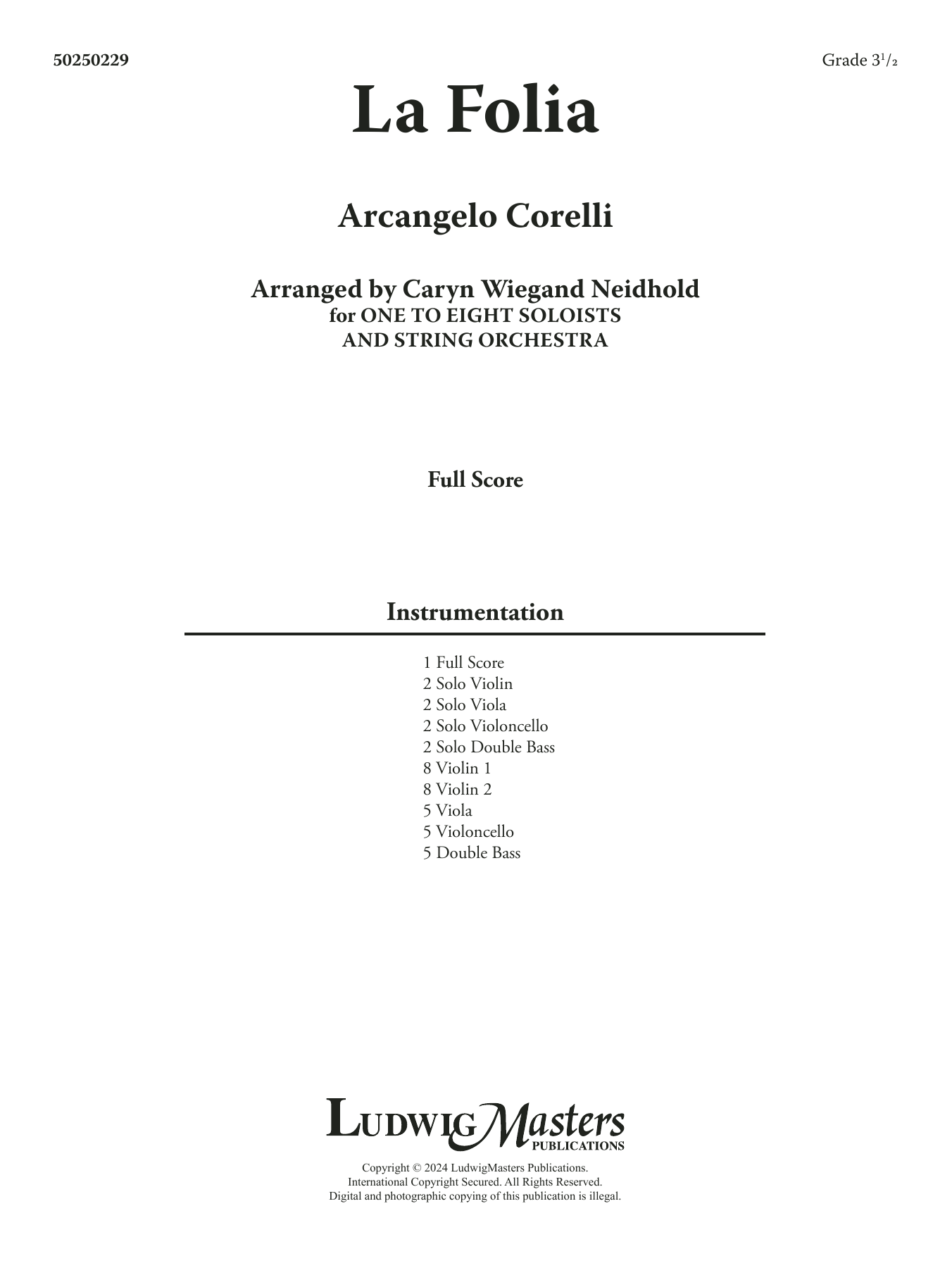

La Folia (arr. Caryn Wiegand Neidhold): String Orchestra Conductor Score & Parts
By Arcangelo Corelli / Arranged by Caryn Wiegand Neidhold
Grade: 3.5
Item: 35-PK01513605
$55.00
Pickup currently not available
Buy Extra Parts (Digital PDF Download)
Parts Added to Cart!
Description
Ever popular, now viola, cello, and bass students can join the violins performing this time-honored piece by Corelli. Each variation may be performed by a different student, allowing up to eight students to be featured on your next concert.


La Folia (arr. Caryn Wiegand Neidhold): String Orchestra Conductor Score & Parts isn't in MakeMusic Cloud just yet...but it could be. Let us know you'd like to see it, and you'll help shape what comes next. In the meantime, start a free trial and dive into thousands of interactive titles your students can play along with today.
Request This Title
Tell us you want it.
Start Your Free Trial
Explore everything that's ready to play right now.
Sample Audio
No sample audio found.
Sample Video
No sample videos found.
Additional Details
Publisher:
Hal Leonard
SKU:
35-PK01513605
More about this title
About the Composer: Arcangelo Corelli
Arcangelo Corelli (1653-1713) was an Italian violinist and composer whose concertos and sonatas defined the string writing of the late Baroque. His systematic approach to composition and performance established foundational techniques still taught in violin pedagogy today. La Folia, based on a centuries-old harmonic progression, became one of his most enduring works precisely because its elegant variations showcase both technical brilliance and lyrical depth.
Corelli's influence on string orchestra repertoire cannot be overstated. He moved beyond the continuo-based ensemble music of his predecessors to write for strings as a unified, independent voice. His works remain central to music education because they balance accessibility with genuine musical substance, making them ideal for students building both technical facility and interpretive sensibility.
Why we love this
Caryn Wiegand Neidhold's arrangement opens La Folia to the entire string section without sacrificing its architectural integrity. By distributing eight variations across different combinations of instruments, this version transforms what might be a concerto feature into an ensemble piece where every player has a moment to shine. The Grade 3.5 level keeps it accessible while the variations themselves demand real musicality.
What to expect
Nobility wrapped in an accessible package. The repeating harmonic foundation anchors each variation while the individual lines dance above it with increasing complexity and character. There's something inherently satisfying about watching a familiar progression transform across eight different instrumental voices.
Who it's for
String orchestras seeking to feature multiple soloists within a single elegant piece. Directors who want to program something that sounds mature and audience-friendly while building viola and cello confidence at the intermediate level.
How to get the most out of it
- Assign students to variations early enough that they can claim ownership of their lines. This psychological investment translates into stronger focus and better tone during rehearsals.
- Balance the harmonic foundation across violas and cellos during accompaniment variations. The integrity of the ground bass (the repeating harmonic progression) depends on consistency from these middle voices.
- Explore contrasts between variations in tempo and character. Even though La Folia shares a single harmonic structure, each variation invites its own personality.
- Use the recorded accompaniment first to help students internalize the progression, then work toward independence from it.
How to use it
Perfect for a concert centered on Baroque or early classical repertoire, or paired alongside other variation sets to create thematic programming. The variations also work well when spaced across a concert rather than performed consecutively, giving you flexible options for balancing your concert flow.
Skills your students will build
- Secure intonation while playing an accompanying figure that repeats throughout the piece
- Stylistic understanding of Baroque ornamentation and phrasing
- Listening to harmonic progression as an anchor point rather than melodic line
- Coordination within smaller instrumental combinations (viola duets, cello sections, mixed pairs)
- Independence and confidence in featured roles with full orchestra support