La Fille Aux Cheveux De Lin (The Girl With The Flaxen Hair) Sheet Music Preview

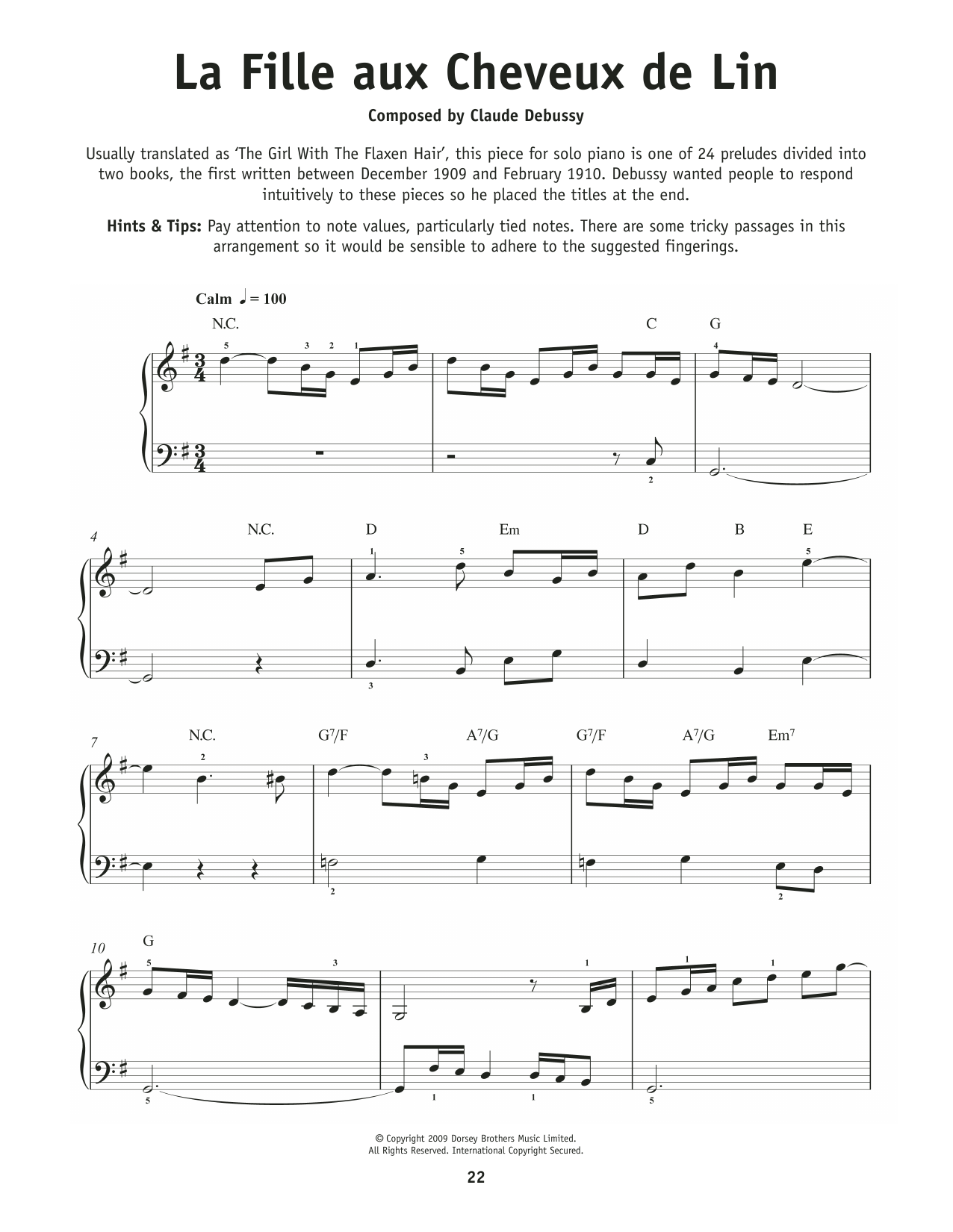
La Fille Aux Cheveux De Lin (The Girl With The Flaxen Hair): Really Easy Piano

As performed by Claude Debussy

Item: 35-DS01588365

Digital Download
$4.99
Description

Discover MakeMusic Cloud: thousands of interactive titles your students can play along with today.

Sample Audio
No sample audio found.
Sample Video
Additional Details
Publisher: Hal Leonard
Page Count: 2
SKU: 35-DS01588365

More about this title

About the Artist: Claude Debussy

Claude Debussy (1862-1918) was a French composer who fundamentally reshaped how music could sound and function. Rather than following the rigid harmonic rules of his predecessors, Debussy treated harmony as color and gesture, letting timbre and sonority drive musical meaning. His approach influenced nearly every composer who followed, making him essential listening for anyone serious about understanding twentieth-century music.

Debussy's piano works remain central to teaching repertoire because they demonstrate how technical facility serves interpretive imagination. His scores reveal a composer equally interested in what the instrument can whisper as in what it can declare.

Why we love this

This piece has become a cornerstone of intermediate piano repertoire precisely because it rewards close listening and patient work. Debussy's impressionistic palette demands that students move beyond note-reading into genuine shaping of line, dynamics, and color; the music simply will not come alive otherwise. It's a work that opens ears while building real musicianship.

What to expect

Hazy and luminous, like watching light scatter through water or hair catching sunlight. The melody unfolds gently over shimmering harmonies that seem to float rather than progress, creating a sense of stillness within delicate movement.

Who it's for

Pianists with solid command of scale work and basic rubato who are ready to engage with impressionistic harmony and texture. Teachers seeking a foundational Debussy piece that builds interpretive maturity without requiring advanced technical facility.

How to get the most out of it

  • Treat the melody as speech rather than song. Let the phrasing breathe naturally, with slight rubato emerging from the shape of the line rather than imposed from outside.
  • The accompanying figures should shimmer and dissolve, not pulse metrically. Think of them as harmonic color that supports the top line without anchoring it.
  • Listen closely to the pedal; Debussy's pedal markings are compositional choices, not ornament. Change it thoughtfully to blur and blend harmonies exactly as notated.
  • Explore the dynamic range between ppp and p. Much of the piece lives in these intimate dynamics, and the subtle shifts between them carry all the expression.

How to use it

This works beautifully as a solo recital piece or as part of a program exploring French impressionism alongside works by Ravel or Satie. It pairs well with Romantic-era repertoire to show how harmony and form evolved in the early twentieth century.

Skills your students will build

  • Voicing chords for color and sonority rather than clarity
  • Shaping melodic lines without overstatement
  • Using the sustain pedal as a compositional element
  • Reading impressionistic notation and translating it into sound
  • Balancing foreground melody with background texture

You May Also Like