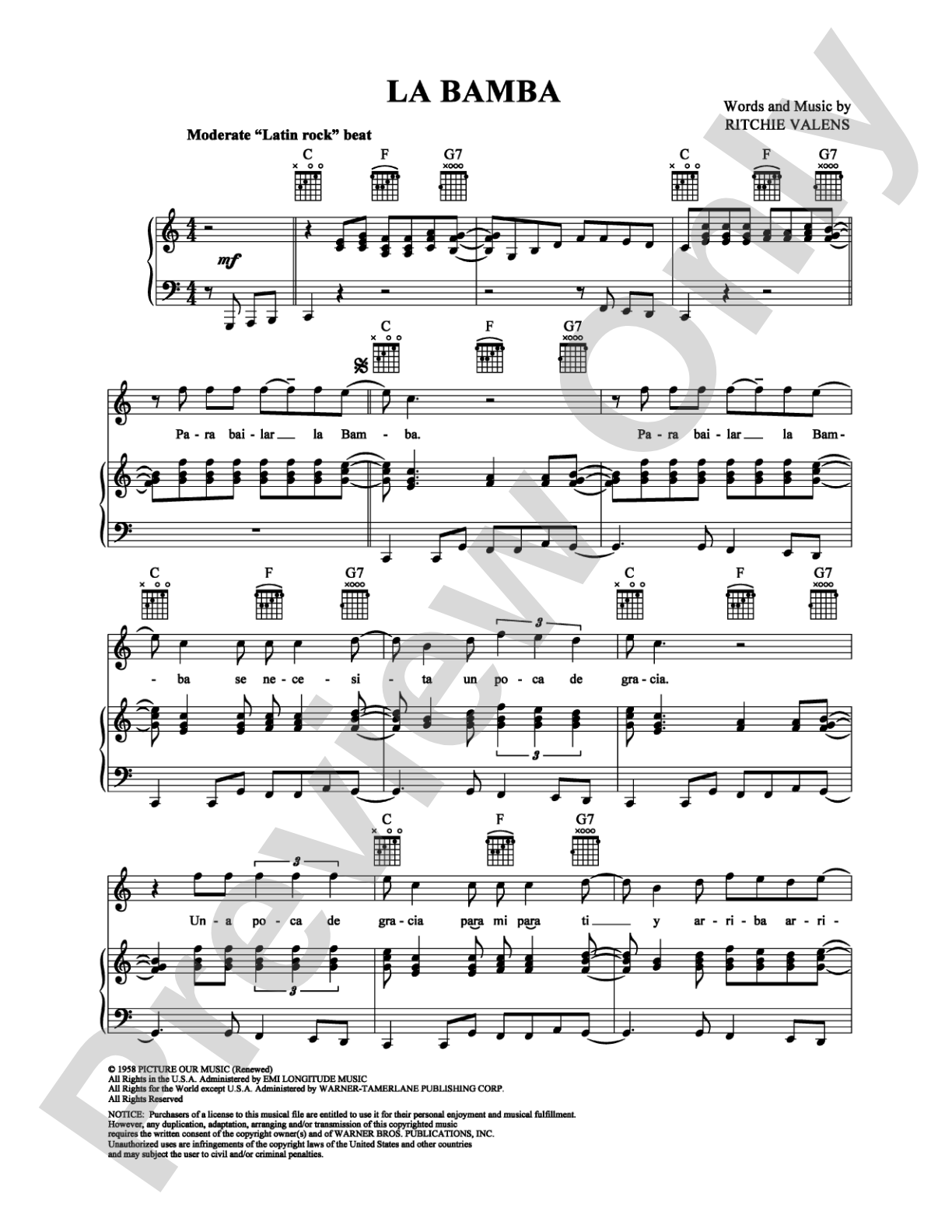
La Bamba: Piano/Vocal/Chords Digital Sheet Music

La Bamba: Piano/Vocal/Chords Digital Sheet Music

Ritchie Valens

Item: 00-PS-0009282

Digital Download
$3.99
Description

La Bamba: Piano/Vocal/Chords Digital Sheet Music isn't in MakeMusic Cloud just yet...but it could be. Let us know you'd like to see it, and you'll help shape what comes next. In the meantime, start a free trial and dive into thousands of interactive titles your students can play along with today.

Sample Audio
No sample audio found.
Sample Video
Additional Details
SKU: 00-PS-0009282

More about this title

About the Artist: Ritchie Valens

Ritchie Valens (1941-1959) was a pioneering rock and roll musician who became one of the first Latino artists to achieve mainstream success in American pop music. Born Richard Steven Valenzuela in California, he brought Mexican folk traditions into the language of 1950s rock, creating a sound that felt both authentically rooted and wildly contemporary. His recording career lasted only about two years before his tragic death in a plane crash, yet his influence on popular music and cultural representation in the industry has proven enduring.

Valens' approach to songwriting demonstrated how traditional musical material could be transformed through modern production and arrangement without losing its essential character. For music educators, his work illustrates the power of cultural bridge-building in repertoire and serves as a gateway for students to explore how folk traditions intersect with popular music styles.

Why we love this

This arrangement captures the infectious energy and Latin percussion backbone that made the original recording iconic, while remaining accessible for pianists and singers at a range of levels. The chord chart support makes it practical for ensemble settings, giving students room to interpret the groove while staying anchored to clear harmonic structures. Programming it opens conversations about cultural influence in rock and roll history while delivering genuine fun in performance.

What to expect

Energetic and celebratory, with a lilting Latin-influenced rhythm that pulls you forward even in quieter moments. The melody sits comfortably in a conversational range, and the harmonic movement is straightforward enough to feel grounded yet engaging enough to hold interest across the full arrangement.

Who it's for

Singers and pianists looking for repertoire that bridges popular music and cultural history, from high school students building rock and pop literacy to adult learners seeking material with genuine historical weight and immediate appeal. This arrangement works equally well for voice students exploring pop idioms and pianists developing accompaniment skills in non-classical styles.

How to get the most out of it

  • Keep the rhythm section locked and driving; the clave-influenced percussion pattern is the heartbeat of this piece, so anchor your accompaniment to a steady pulse even when interpreting melodic phrasing.
  • Pay attention to the call-and-response sections between vocal and piano; they should feel conversational rather than rigid, with the accompaniment responding dynamically to the singer's phrasing.
  • Lean into the bilingual lyrics and let them shape your vocal tone and articulation; the code-switching between Spanish and English carries cultural and musical meaning worth honoring in performance.
  • Use light touch and rhythmic clarity in the piano accompaniment rather than heavy chording; this piece breathes better when the harmonic support feels buoyant and contributes to forward momentum.

How to use it

Include it in a concert exploring rock and roll history, cultural representation in popular music, or 1950s repertoire. It pairs naturally with other Latin-influenced pop standards or as a lighter moment alongside more substantial vocal or piano works, and its relatively short length makes it ideal for variety programs or student recitals.

Skills your students will build

  • Reading lead sheet notation with chord symbols
  • Coordinating vocal phrasing with piano accompaniment in pop idioms
  • Understanding and playing rhythmic patterns rooted in Latin percussion
  • Interpreting stylistic articulation and dynamics in rock and roll performance
  • Code-switching between Spanish and English lyrics with appropriate musical phrasing

You May Also Like