
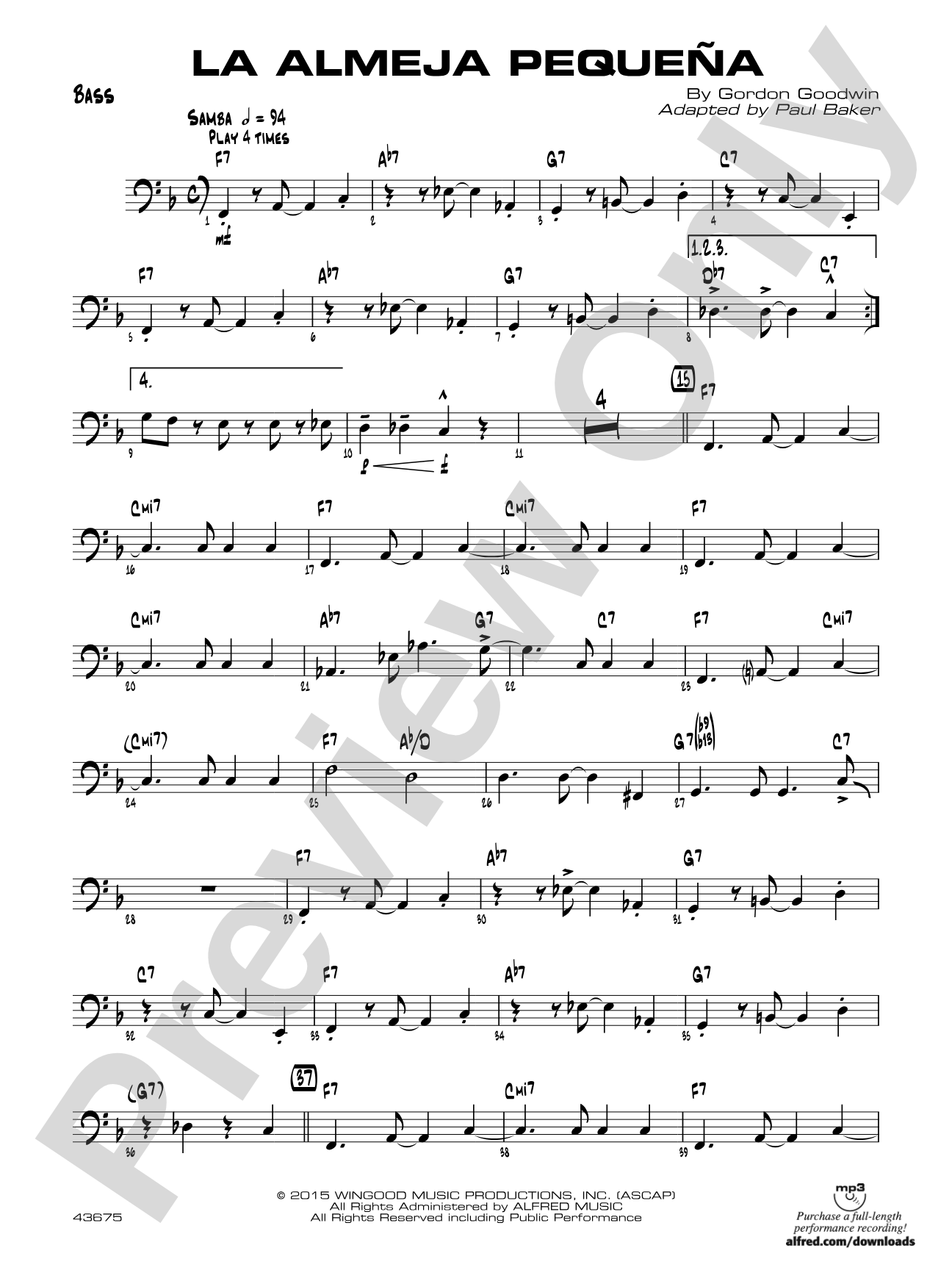

La Almeja Pequena: String Bass
By Gordon Goodwin / arr. Paul Baker
Grade: 2.5 (Medium Easy)
Item: 00-PC-0016815_SB
$3.00
Pickup currently not available
Description
Originally done by the Big Phat Band, La Almeja Pequena arranged by Paul Baker is a samba played around 90 BPM in cut time. It's a very exciting Latin chart with solos for alto 1 and trumpet 2, and the trumpet 1 range is to written G on top of the staff. There are two auxiliary percussion parts, plus the usual optional parts to include flute, clarinet, and vibes. (4:27)


Don't just read it, hear it, play along with it, and watch your students grow with it. In MakeMusic Cloud, La Almeja Pequena: String Bass comes alive with professional accompaniment, adjustable tempo, and built-in practice tools that turn solo practice into real progress.
Open in the Player
Jump straight in and assign it today.
Start Your Free Trial
Open this title and explore the full library in minutes.
Sample Audio
1
Audio File
--:--
0:00
0:00
Sample Video
Additional Details
Series:
Young Jazz Ensemble
Publisher:
Alfred Music
Page Count:
110
SKU:
00-PC-0016815_SB
More about this title
About the Composer: Gordon Goodwin

Gordon Goodwin began composing at five years old, transcribing complete pieces from his imagination onto paper rather than fragments or single melodic ideas. By age thirteen, he had already written his first big band chart, Hang Loose, signaling the compositional sophistication that would define his career. His film and television work has earned him three Emmy Awards and multiple Grammy nominations, with orchestrations featured in Bad Boys II, Remember the Titans, Star Trek: Nemesis, and numerous other major productions.
Beyond Hollywood, Goodwin has written for and performed alongside artists including Christina Aguilera, Quincy Jones, Ray Charles, and Toni Braxton. Since founding Gordon Goodwin's Big Phat Band in 2000, he has established himself as both bandleader and arranger, with the ensemble's albums earning Grammy recognition and the distinction of being the first commercially available DVD audio releases. Goodwin has conducted orchestras across North America and Europe, building a reputation that spans composition, arrangement, orchestration, and performance.
Why we love this
Paul Baker's arrangement maintains the infectious energy of the Big Phat Band original while keeping the chart accessible for younger ensembles. The solos for alto 1 and trumpet 2 give emerging improvisers real improvisation opportunities within a structured, supportive arrangement, and the auxiliary percussion writing adds textural sophistication without overwhelming a developing section.
What to expect
La Almeja Pequena pulses with warmth and rhythmic buoyancy. The samba groove creates an immediate sense of forward motion and celebration, supported by layered textures that build from the foundation of the rhythm section outward, culminating in a chart that feels both contemporary and playful.
Who it's for
This chart fits jazz ensembles working at the 2.5 grade level who are ready to tackle authentic Latin jazz writing without excessive technical demands. Conductors seeking contest or festival material that combines modern big band language with accessible ranges and voicing will find this performance-ready from early in the preparation process.
How to get the most out of it
- Keep the cut-time pulse driving forward at 90 BPM; the samba feel thrives on consistent forward momentum rather than dragging or rushing the subdivision.
- Balance the trumpet 1 range carefully, especially on written G at the staff's top; watch for fatigue in the high register and consider strategic breathing points during longer phrases.
- Let the auxiliary percussion dialogue shine as a textural feature; these parts anchor the Latin groove and deserve clarity in the mix.
- Work the alto 1 and trumpet 2 solos individually before full ensemble rehearsal so each soloist understands harmonic landmarks and can build confidence in their lines.
How to use it
This works exceptionally well as a closer or showcase piece on a concert featuring jazz standards, where its modern big band energy provides fresh contrast to earlier material. It also excels in festival settings where a sub-three-minute, Grade 2.5 chart with genuine stylistic integrity demonstrates a program's range and technical maturity.
Skills your students will build
- Reading and executing cut-time signatures with consistent subdivisions
- Playing within Latin jazz ensemble contexts, particularly samba grooves and syncopated phrasing
- Managing trumpet range from the staff into the G above the staff with control and endurance
- Improvising over a 12-bar blues or standard harmonic progression (alto and trumpet soloists)
- Balancing sonority across section textures while maintaining rhythmic independence